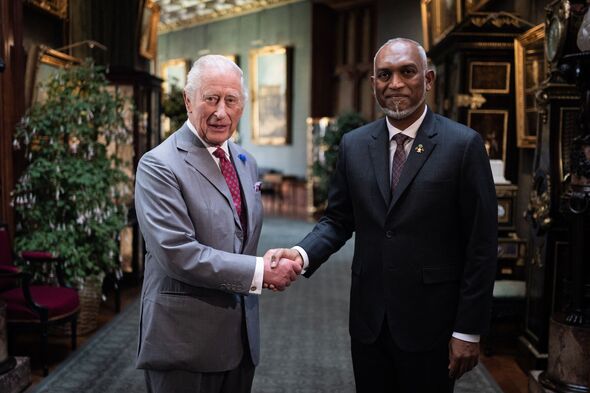
Head of the Commonwealth King Charles with Maldives President Mohamed Muizzu (Image: Getty)
Britain MUST do more to cash in on opportunities presented by Brexit, the president of the tiny Brit-loving island nation of the Maldives today said. And, not just the UK, but everyone in the Commonwealth needed to work harder to utilise the huge economic potential of the historic global network.
Since the Brexit referendum in 2016, trade with the EU is down.
But more worryingly, trade with the Commonwealth, which Governments were supposed to seize upon as an economic corollary to the falling EU trade, hasn’t grown either.
In an exclusive interview with Express.co.uk Maldives President Mohamed Muizzu said anglophile Commonwealth nations like Maldives were very keen to boost trade with the UK – but all parties needed to work harder to achieve this.
He said: “The Commonwealth is the largest international club of nations the Maldives is part of, aside from the United Nations itself. As a family of primarily English-speaking countries, and one that is not limited by regional geography, there is no other organisation like it.
“Much more can and should be done. Because Commonwealth nations tend to have heritage, legal, language, electoral, and governance systems in common we already have what is dubbed the ‘Commonwealth Advantage’ – whereby members of the organisation find on average trade costs are 21 percent lower than between non-Commonwealth countries.
“However, we could strive to do much more through a Commonwealth free trade agreement that has been long debated but never seriously discussed or negotiated.”
In 2014 Britain’s trade with the EU accounted for 44.5% of all UK exports. Last year this dropped to 41.1%.
Lack of political skill or determination to push for and open new markets means Britain.
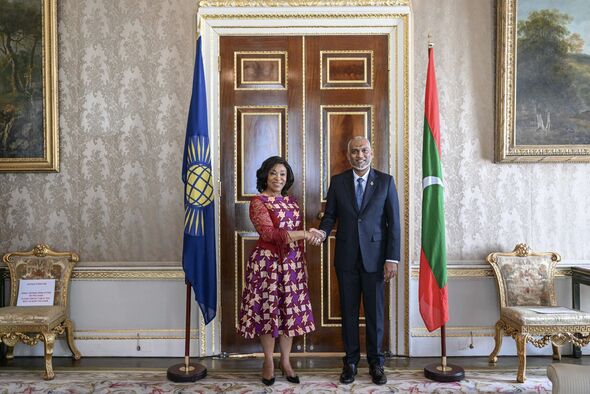
President Muizzu with Commonwealth Secretary-General Rt. Hon. Shirley Botchwey (Image: Maldives Govt)
President Muizzu said: “We should all try harder. The Commonwealth is a unique but frankly underused network that benefits all of us, and we can do more with it.
“There are big opportunities for British businesses in the Maldives, and vice versa. First, in the creative economy, a sector for which Britain is the world’s second largest exporter of services. We see the creative sector – encompassing digital content, design, media, gaming, cultural enterprise and arts – as a major engine for future growth. We have a national target to make creative industries contribute at least 15% of GDP by 2030.
“Second, in digital governance – and the UK is one of the leaders globally in e-government services – there are clear opportunities for UK tech firms, software providers, e-governance experts and cybersecurity firms.
“Third, in renewable energy, where our ambitions are deliberately bold. Today, just four per cent of our electricity comes from renewables. By 2028, we intend to raise that to one-third. Our first large-scale floating solar project, already granted Special Economic Zone status, will deliver 100 megawatts of clean electricity — a first for the region. It will save millions in fuel imports. Offshore wind and marine energy – where Britain is an undisputed world leader in engineering, financing, and installed capacity – can accelerate this transition dramatically.
“And finally, there are fisheries and ocean innovation. We launched our new Maldives Fishery brand ‘From Maldives’ – our trademark for premium, sustainable, and traceable seafood – in London earlier this year. As globally recognised innovators in traceability, marine science, and sustainable packaging in the aquaculture industry, there is clear space for British companies to plug into these developments.”
The Commonwealth consists of 56 nations, many, but not all, with links to Britain’s colonial past.
Latest figures show the Commonwealth’s worldwide exports of goods and services reached $4.8 trillion in 2022, accounting for 15% of all global trade.
Trade between members hit $854 billion in the same year and is expected to surpass $1 trillion by 2026.