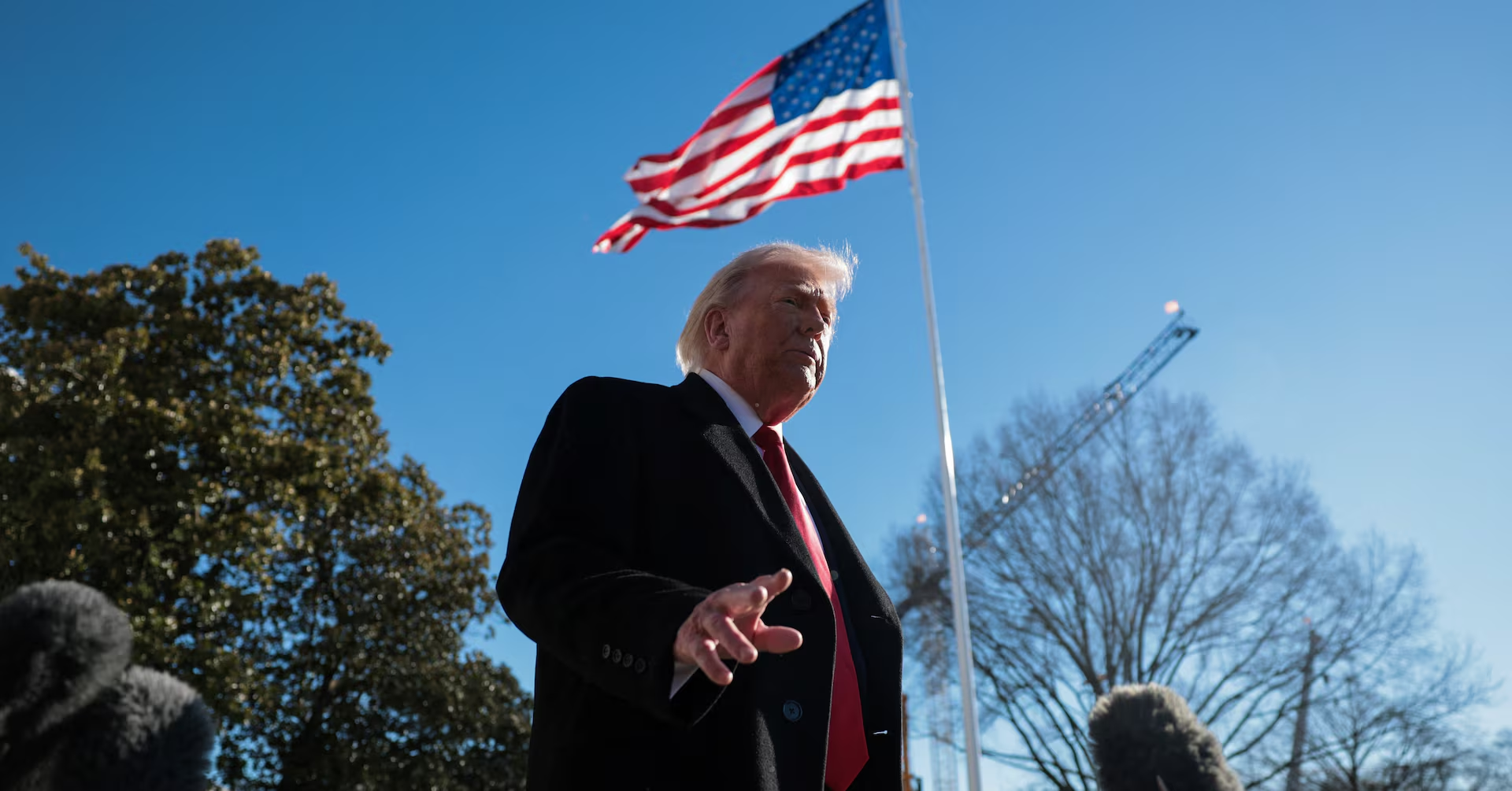
ORLANDO, Florida, Jan 20 (Reuters) – U.S. President Donald Trump’s latest foreign policy and trade war salvos are upsetting global markets, but the question is whether these ructions will escalate or fade away, as was the case during the last 12 months.
The latter is probably more likely, but either way, it is apparent that investors are struggling to adequately price the fundamental shifts in the world’s geopolitical tectonic plates.
Sign up here.
And the shifts that have already taken place in 2026 are truly breathtaking. The Trump administration has removed the leader of Venezuela, and now appears to be the Latin American country’s de facto ruler.A violent crackdown on protests in Iran has killed thousands, with the threat of a U.S. response still lingering.And then there is Trump’s latest push to acquire Greenland from fellow NATO ally Denmark by any means necessary. The U.S.-Europe alliance, and indeed the very rules-based global order built since World War Two appears to be in jeopardy.The economic and financial terrain is a minefield too. Trump has issued a host of interventionist decrees on issues from credit card rates to mortgage-backed securities, while also pressuring U.S. oil executives to invest billions in Venezuela. And lest we forget, his Justice Department is still threatening to indict Federal Reserve Chair Jerome Powell.
Until now, though, this “Trumpian assault” on the U.S. and global rules-based order – to borrow a phrase from Matt King, founder of Satori Insights – seemed at odds with the relative calm across markets.
That calm is fracturing. The escalating spat between Trump and many of America’s closest European allies has triggered a widespread selloff in stocks, bonds and the dollar. Safe-haven gold has continued to climb, busting through $4,700 per ounce.
This looks like a return of the so-called ‘Sell America’ trade. Yet if last year is any guide, these market jitters may turn out to be speed bumps on the way to new highs rather than roadblocks.
An arrow chart with the title ‘G10 currency moves against the US dollar’chartFUNDAMENTALS MATTER, RIGHT?
Putting the geopolitical drama aside, consensus expectations for U.S. economic growth and corporate profits suggest that Wall Street is unlikely to stay down for long.
The International Monetary Fund on Monday raised its 2026 U.S. growth estimate to 2.4% from 2.1% in October, due in part to the huge sums being plowed into artificial-intelligence data centers, chips and power generation.
Moreover, early indications from the fourth quarter earnings season are encouraging. Of the 33 companies in the S&P 500 that have reported so far, 84.8% have notched an earnings beat. If the LSEG consensus estimate for year-on-year earnings growth of 9.0% materializes, that should put upward pressure on equities.
Finally, it’s good to remember that high uncertainty isn’t necessarily bad for growth or profits. In some cases, it could even be positive. Think of the investment needed to fund a global rearmament wave, or to fuel the scramble for energy security and AI independence.
chartchartNO ROOM FOR LIMBO
Markets’ relative calm over the past year may partly be the result of a virtuous cycle – or, looked at another way, an illusion. Passive investment funds continue to send a steady flow of capital into credit and equity markets, helping to keep volatility low and prices high. As long as the music is playing, investors will keep dancing.
But the confusing trends of the last year – including simultaneous rallies in both risk-on and risk-off assets – also reflect the fact that it is simply very difficult to accurately price risk of this scale. What value does an investor assign to the end of NATO and the U.S.-Europe alliance, or the emergence of a new multi-polar world carved into three broad “spheres of influence” headed by the U.S., China and Russia?
“For investors, regime change is hard to navigate. It’s like you are either at war or you aren’t at war. There’s no limbo,” says Satori Insights’ Matt King.
“The risk rally is consistent with fundamentals, but not necessarily driven by fundamentals. There’s something very odd about it. You can explain it, but there is a degree of vulnerability about it.”
This applies to corporate earnings too. There’s an assumption that tech and broader earnings will remain at current levels. Threats to the cycle – such as excess AI capacity due to competition from China or regulatory pressure from the EU – don’t appear to be captured in analysts’ forecasts. But those risks still exist.
Perhaps Trump’s push for Greenland will be the straw that breaks investors’ backs, and the current market jitters will turn into a true correction. You might not want to bet on it though.
(The opinions expressed here are those of the author, a columnist for Reuters)Enjoying this column? Check out Reuters Open Interest (ROI),, opens new tab your essential new source for global financial commentary. Follow ROI on LinkedIn,, opens new tab and X., opens new tabAnd listen to the Morning Bid daily podcast on Apple, opens new tab, Spotify, opens new tab, or the Reuters app, opens new tab. Subscribe to hear Reuters journalists discuss the biggest news in markets and finance seven days a week.
By Jamie McGeever; Editing by xxxxxxxxx
Our Standards: The Thomson Reuters Trust Principles., opens new tab
Opinions expressed are those of the author. They do not reflect the views of Reuters News, which, under the Trust Principles, is committed to integrity, independence, and freedom from bias.