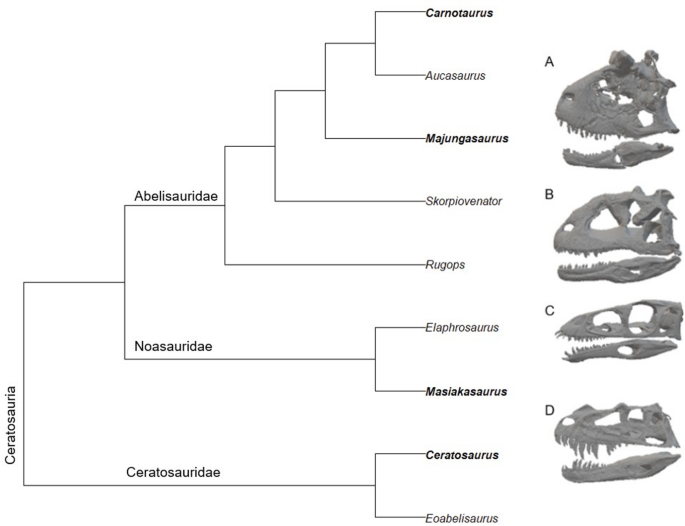
Carrano, M. T. & Sampson, S. D. The phylogeny of ceratosauria (Dinosauria: Theropoda). J. Syst. Paleontol. 6, 183–236 (2008).
Hone, D. W. E. & Benton, M. J. The evolution of large size: how does cope’s rule work? Trends Ecol. Evol. 20, 4–6 (2005).
Hone, D. W. E., Keesey, T. M., Pisani, D. & Purvis, A. Macroevolutionary trends in the dinosauria: cope’s rule. J. Evol. Biol. 18, 587–595 (2005).
Benson, R. B. J. et al. Rates of dinosaur body mass evolution indicate 170 million years of sustained ecological innovation on the avian stem lineage. PLoS Biol. 12, e1001853 (2014).
Benson, R. B. J., Hunt, G., Carrano, M. T. & Campione, N. Cope’s rule and the adaptive landscape of dinosaur body size evolution. Palaeontology 61, 13–48 (2018).
Rauhut, O. W. M. & Carrano, M. T. The theropod dinosaur Elaphrosaurus bambergi Janensch, 1920, from the late jurassic of Tendaguru, Tanzania. Zool. J. Linn. Soc. 178, 546–610 (2016).
Bonaparte, J. F., Novas, F. E. & Coria., R. A. Carnotaurus Sastrei Bonaparte, the horned, lightly built carnosaur from the middle cretaceous of patagonia. Contrib. Sci. 416, 1–41 (1990).
Therrien, F. & Henderson, D. M. My theropod is bigger than yours … or not: estimating body size from skull length in theropods. J. Vertebr. Paleontol. 27, 108–115 (2007).
Cerroni, M. A. & Paulina-Carabajal, A. Novel information on the endocranial morphology of the abelisaurid theropod Carnotaurus Sastrei. C.R. Palevol. 18, 985–995 (2019).
Bonaparte, J. F. The Gondwanian theropod families abelisauridae and noasauridae. Hist. Biol. 5, 1–25 (1991).
Grillo, O. N. & Delcourt, R. Allometry and body length of abelisauroid theropods: Pycnonemosaurus Nevesi is the new King. Cretac. Res. 69, 71–89 (2017).
Delcourt, R. Ceratosaur palaeobiology: new insights on evolution and ecology of the Southern rulers. Sci. Rep. 8, 9730 (2018).
Sampson, S. D. & Loewen, M. A. Tyrannosaurus Rex from the upper cretaceous (Maastrichtian) North Horn formation of utah: biogeographic and paleoecologic implications. J. Vertebr. Paleontol. 25 (2), 469–472 (2005).
Brusatte, S. L., Averianov, A., Sues, H. D., Muir, A. & Butler, I. B. New tyrannosaur from the mid-Cretaceous of Uzbekistan clarifies evolution of giant body sizes and advanced senses in tyrant dinosaurs. Proc. Natl. Acad. Sci. 113, 3447–3452 (2016).
Mazzetta, G. V., Fariña, R. A. & Vizcaíno, S. F. On the palaeobiology of the South American horned theropod Carnotaurus Sastrei Bonaparte. Gaia 18, 185–192 (1998).
Madsen, J. H. Jr & Welles, S. P. Ceratosaurus (Dinosauria, Theropoda): a revised osteology. Utah Geological Survey, Miscellaneous Publication, Salt Lake City, 2, 1–80 (2000).
Sampson, S. D. & Witmer, L. M. Craniofacial anatomy of Majungasaurus crenatissimus (Theropoda: Abelisauridae) from the late cretaceous of Madagascar. J. Vertebr. Paleontol. 27, 32–104 (2007).
Novas, F. E. The Age of Dinosaurs in South America. 450 (Indiana University Press, Bloomington & Indianapolis, 2009).
Pereyra, E. E. S., Pérez, D. E. & Méndez, A. H. Macroevolutionary trends in ceratosauria body size: insights of phylogenetic comparative methods. BMC Ecol. Evo. 25, 32 (2025).
Sampson, S. D., Carrano, M. T. & Forster, C. A. A bizarre predatory dinosaur from the late cretaceous of Madagascar. Nature 409, 504–506 (2001).
Carrano, M. T., Sampson, S. D. & Forster, C. A. The osteology of Masiakasaurus knopfleri, a small abelisauroid (Dinosauria: Theropoda) from the late cretaceous of Madagascar. J. Vertebr. Paleontol. 22, 510–534 (2002).
Erickson, G. M., Lappin, A. K. & Vliet, K. A. The ontogeny of bite-force performance in American alligator (Alligator mississippiensis). J. Zool. 260, 317–327 (2003).
Deeming, D. C. Inter-relationships among body mass, body dimensions, jaw musculature and bite force in reptiles. J. Zool. 318, 23–33 (2022).
Rowe, A. J. & Rayfield, E. J. Carnivorous dinosaur lineages adopt different skull performances at gigantic size. Curr. Biol. 35, 3664–3673e3 (2025).
Molnar, R. E. The cranial morphology of tyrannosaurus Rex. Palaeontographica Abteilung Band. A217 Lieferung, 4–6, 137–176 (1991).
Cuff, A. R. & Rayfield, E. J. Feeding mechanics in spinosaurid theropods and extant crocodilians. PLoS One. 8 (5), e65295 (2013).
Smart, S. & Sakamoto, M. Using linear measurements to diagnose the ecological habitat of Spinosaurus. PeerJ 12, e17544 (2024).
Rauhut, O. W. M. & Pol, D. Probable basal allosauroid from the early middle jurassic Cañadón Asfalto formation of Argentina highlights phylogenetic uncertainty in Tetanuran theropod dinosaurs. Sci. Rep. 9 (1), 18826 (2019).
Bonaparte, J. F. Dinosaurs: a jurassic assemblage from patagonia. Science 205 (4413), 1377–1379 (1979).
Ibiricu, L. M. et al. Latest cretaceous megaraptorid theropod dinosaur sheds light on megaraptoran evolution and palaeobiology. Nat. Commun. 16, 8298 (2025).
Ross, F. C. Finite element analysis in vertebrate biomechanics. Anat. Record Part. A: Discoveries Mol. Cell. Evolutionary Biology. 283A, 253–258 (2005).
Rayfield, E. J. Finite element analysis and Understanding the biomechanics and evolution of living and fossil organisms. Annu. Rev. Earth Planet. Sci. 35, 541–576 (2007).
Cunningham, J. A., Rahman, I. A., Lautenschlager, S., Rayfield, E. J. & Donoghue, P. C. J. A virtual world of paleontology. Trends Ecol. Evol. 29, 347–357 (2014).
Rowe, A. J. & Rayfield, E. J. The efficacy of computed tomography scanning versus surface scanning in 3D finite element analysis. PeerJ 10, e13760 (2022).
Rowe, A. J. & Snively, E. Biomechanics of juvenile tyrannosaurid mandibles and their implications for bite force: evolutionary biology. Anat. Rec. 305, 373–392 (2021).
Ma, W., Pittman, M., Butler, R. J. & Lautenschlager, S. Macroevolutionary trends in theropod dinosaur feeding mechanics. Curr. Biol. 32, 677–686e3 (2022).
Johnson-Ransom, E. et al. Comparative cranial biomechanics reveal that late cretaceous tyrannosaurids exerted relatively greater bite force than in early-diverging tyrannosauroids. Anat. Rec. 307, 1897–1917 (2024).
Rowe, A. J. & Rayfield, E. J. Morphological evolution and functional consequences of giantism in tyrannosauroid dinosaurs. iScience 27, 110679 (2024).
Mazzetta, G. V., Cisilino, A. P., Blanco, R. E. & Calvo, N. Cranial mechanics and functional interpretation of the horned carnivorous dinosaur Carnotaurus Sastrei. J. Vertebr. Paleontol. 29, 822–830 (2009).
Sakamoto, M. Estimating bite force in extinct dinosaurs using phylogenetically predicted physiological cross-sectional areas of jaw adductor muscles. PeerJ 10, e13731 (2022).
Therrien, F., Henderson, D. M. & Ruff, C. Bite me – Biomechanical models of theropod mandibles and implications for feeding behavior. In Carpenter, Kenneth (ed.). The carnivorous dinosaurs. 179–198, 228. ISBN 978-0-253-34539-4. (Indiana University Press, 2005).
Brusatte, S. L., Carr, T. D., Erickson, G. M., Bever, G. S. & Norell, M. A. A long-snouted, multihorned tyrannosaurid from the late cretaceous of Mongolia. Proc. Natl. Acad. Sci. 106, 17261–17266 (2009).
Cerroni, M. A., Canale, J. I. & Novas, F. E. The skull of Carnotaurus Sastrei Bonaparte 1985 revisited: insights from craniofacial bones, palate and lower jaw. Hist. Biol. 33 (10), 2444–2485 (2020).
Holliday, C. M. & Witmer, L. M. Cranial kinesis in dinosaurs: intracranial joints, Protractor muscles, and their significance for cranial evolution and function in diapsids. J. Vertebr. Paleontol. 28, 1073–1088 (2008).
Pol, D. et al. A new abelisaurid dinosaur from the end cretaceous of patagonia and evolutionary rates among the ceratosauria. Cladistics 40, 307–356 (2024).
Barbosa, G. G., Langer, M. C., de Oliveira Martins, N. & Montefeltro, F. C. Assessing the palaeobiology of Vespersaurus paranaensis (Theropoda, Noasauridae), Cretaceous, Bauru Basin – Brazil, using finite element analysis. Cretac. Res. 150, 105594 (2023).
Meso, J. G. et al. Shed teeth from Portezuelo formation at Sierra Del Portezuelo reveal a higher diversity of predator theropods during Turonian-Coniacian times in Northern patagonia. BMC Ecol. Evo. 24, 59 (2024).
Dal Sasso, C., Maganuco, S. & Cau, A. The oldest ceratosaurian (Dinosauria: Theropoda), from the lower jurassic of Italy, sheds light on the evolution of the three-fingered hand of birds. PeerJ 6, e5976 (2018).
Smith, J. B. Dental morphology and variation in Majungasaurus crenatissimus (Theropoda: Abelisauridae) from the late cretaceous of Madagascar. J. Vertebr. Paleontol. 27, 103–126 (2007).
Tortosa, T. et al. A new abelisaurid dinosaur from the late cretaceous of Southern france: palaeobiogeographical implications. Ann. De Palaeontologie. 100, 63–86 (2014).
Norman, D. B. Carnosaurs. The Illustrated Encyclopedia of Dinosaurs. 62–67. ISBN 978-0-517-46890-6. (Salamander Books Ltd.,1985).
Paul, G. S. Ceratosaurs. Predatory Dinosaurs of the World. 274–279. ISBN 978-0-671-61946-6. (Simon & Schuster, 1988).
Rowe, T. & Gauthier, J. Ceratosauria. In The Dinosauria. (eds Weishampel, D.B. et al.). 151–168. ISBN 978-0-520-06726-4. (University of California Press, 1990).
Sombathy, R., O’Connor, P. M. & D’Emic, M. D. Osteohistology of the unusually fast-growing theropod dinosaur ceratosaurus. J. Anat. 247, 765–789 (2025).
GilmoreC.W. Osteology of the carnivorous dinosauria in the united States National Museum, with special reference to the genera Antrodemus (Allosaurus) and ceratosaurus. Bull. United States Natl. Museum. 110, 1–154 (1920).
Porro, L. B. et al. Free body analysis, beam mechanics, and finite element modeling of the mandible of Alligator mississippiensis. J. Morphol. 272, 910–937 (2011).
Zapata, U. et al. Material properties of mandibular cortical bone in the American alligator, Alligator mississippiensis. Bone 46, 860–867 (2010).
Herbst, E. C., Lautenschlager, S., Bastiaans, D., Miedema, F. & Scheyer, T. M. Modeling tooth enamel in FEA comparisons of skulls: comparing common simplifications with biologically realistic models. iScience 24, 103182 (2021).
Holliday, C. M. New insights into dinosaur jaw muscle anatomy. Anat. Rec. 292, 1246–1265 (2009).
Sakamoto, M. Scaling bite force in predatory animals: how does T. rex compare with living predators? J. Vertebr. Paleontol. 26, 118A (2006).
Sakamoto, M. Assessing bite force estimates in extinct mammals and archosaurs using phylogenetic predictions. Palaeontology 64, 743–753 (2021).
Marcé-Nogué, J., de Esteban-Trivigno, S., Escrig, C. & Gil, L. Accounting for differences in element size and homogeneity when comparing finite element models: armadillos as a case study. Palaeontologia Electronica. 19 (2), 1–22 (2016).
Morales-García, N. M., Burgess, T. D., Hill, J. J., Gill, P. G. & Rayfield, E. J. The use of extruded finite-element models as a novel alternative to tomography-based models: a case study using early mammal jaws. J. R Soc. Interface. 16, 20190674 (2019).
Ballell, A. & Ferrón, H. G. Biomechanical insights into the dentition of Megatooth sharks (Lamniformes: Otodontidae). Sci. Rep. 11, 1232 (2021).