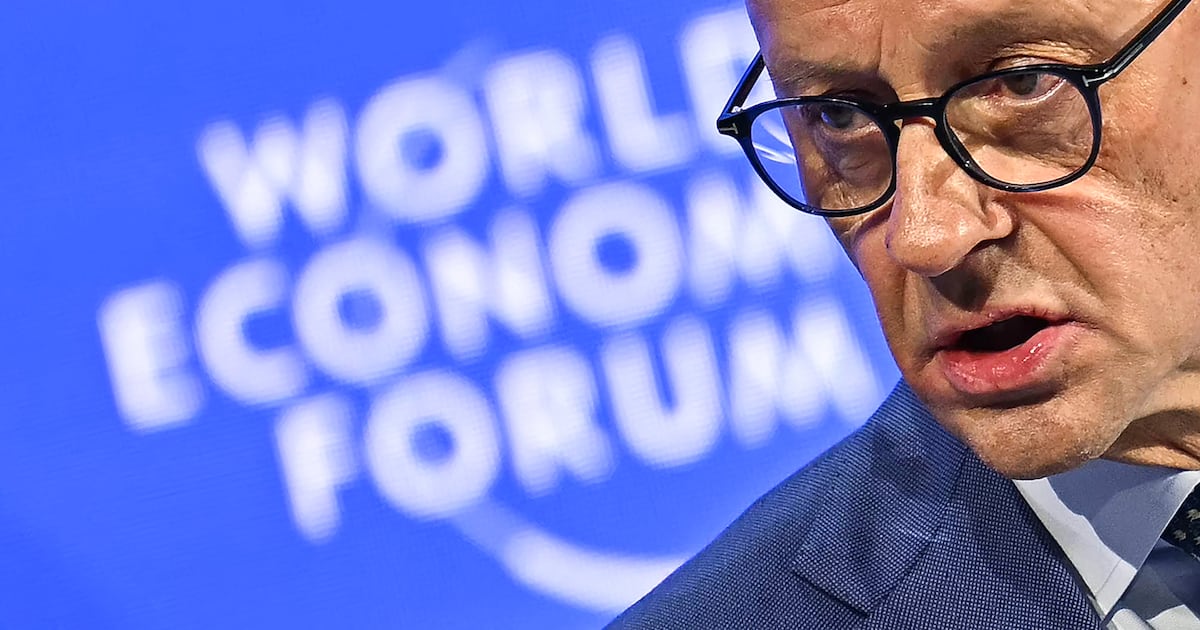
The German chancellor has warned that the rise of “great powers” is shaking the foundations of the old world order, unravelling it at “breathtaking pace”.
Addressing the World Economic Forum in Davos on Thursday, Friedrich Merz said a time of “great power politics” had begun, citing Russia’s war with Ukraine, China’s move into the “ranks of the great powers” and the radical reshaping of US foreign and security policy under Donald Trump.
“This new world of great powers is being built on power, on strength and when it comes to it, on force. It is not a cosy place,” Mr Merz said, urging leaders at Davos not to accept this new reality and to “shape the future” instead.
Mr Merz’s speech chimed with the views of Mark Carney, Canada’s prime minister, who told the forum on Tuesday that a system of intensifying rivalry between great powers was rupturing the world order.
“Two days ago, Mark Carney said in this hall, ‘We must no longer rely only on the power of our values; we must also recognise the value of our power’,” Mr Merz said. “I share that view. And when I look into this hall, I want to say: we share it. That is a good starting point.
“Our greatest strength remains the ability to build partnerships and alliances among equals based on mutual trust and respect.”
The German chancellor said a world in which only power counted was a dangerous place – first for small states, then for the middle powers and ultimately for the great ones.
“I do not say this lightly. In the 20th century, my country, Germany, went down this road to its bitter end. It pulled the world into a black abyss,” he said.
He spoke as EU leaders gathered in Brussels to discuss the volatile “new normal” in transatlantic relations, after weeks of escalating threats from Mr Trump over Greenland that were suddenly dropped over a vague deal on Arctic security.
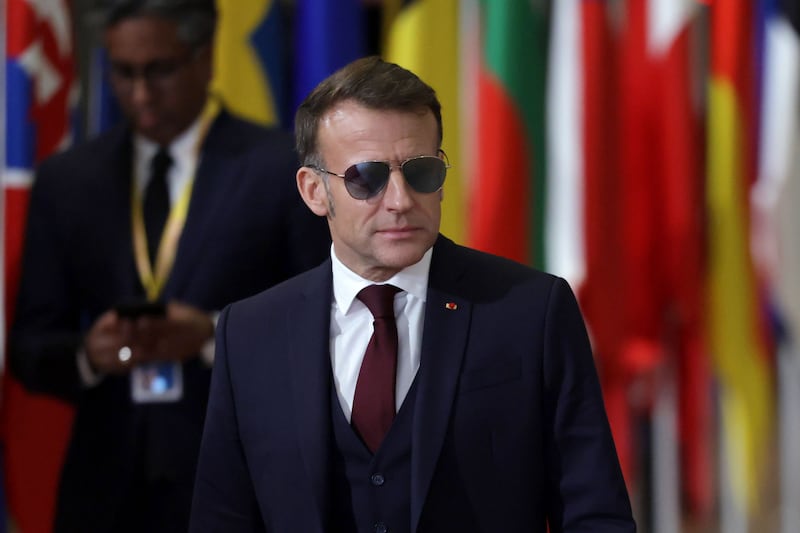 French president Emmanuel Macron arrives for a meeting of European Council members in Brussels, Belgium, on Thursday. Photograph: EPA
The emergency EU summit was hastily convened earlier this week after the US president announced he would impose 10 per cent tariffs on eight European nations that defended Greenland, an autonomous territory that is part of Denmark. Although Mr Trump abandoned his tariff threat on Wednesday, EU officials said the summit remained necessary.
Mr Trump’s decision to step back from tariffs “evidently changes a little the context of this European Council, but does not remove its interest”, said a European diplomat, who evoked shifting tectonic plates in the geopolitical order.
In the context of “profound geopolitical movements” involving powers with great military and financial means, “the Europeans must be capable of being sufficiently united and strong in defending their interests and defining their own path,” the diplomat said.
A senior EU official said leaders were meeting in a context “that was more positive than it was 24 hours ago to discuss how they understand this new reality”, citing “a new normal of this very important and structural relationship between Europe and the United States”.
The European Parliament signalled on Thursday it was ready to reconsider its decision to freeze ratification of the EU-US trade deal, one of the bloc’s strongest responses to Trump’s tariff threats so far.
MEPs had been expected to vote in February to approve 0 per cent tariffs on many US goods, a key part of the trade agreement signed at Mr Trump’s Turnberry golf resort in Scotland last summer. However, they pressed pause on the process on Wednesday in response to tariff threats.
The head of the European Parliament’s trade committee, German Social Democrat Bernd Lange, said his committee would revisit the issue next week, while stressing that the EU needed to remain vigilant.
“There is no room for false security,” he wrote on X. “The next threat is sure to come. That’s why it is even more important that we set clear boundaries, use all available legal instruments [and] apply them as appropriate to the situation.”
In response to Mr Trump’s tariff threats, the EU had been discussing levying duties on €93 billion of US goods, as well as deploying its most powerful economic sanctions weapon, the anti-coercion instrument, which would allow the bloc to impose a broad range of economic penalties on US firms.