
Greg was just 18 when he collapsed in his halls of residence.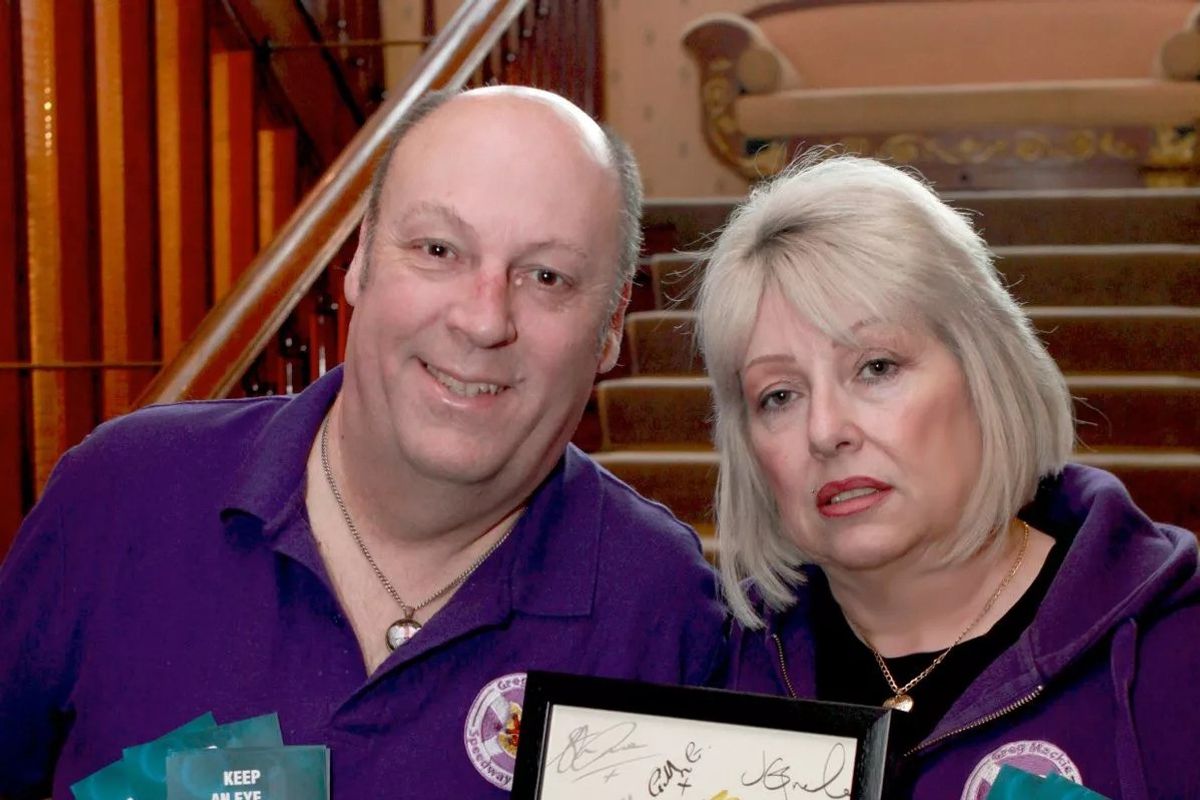
Colin and Mandy Mackie(Image: Reach PLC/Hamilton Advertiser )
The father of an Edinburgh University student who was a suspected spiking victim has said the police need greater resources to investigate cases and increased help from the licensing trade.
Colin Mackie wants more pubs and clubs supplying protective lids to put over drinks and drug testing strips for customers who may suspect their drink has been spiked.
He would also like to see a single offence of drink spiking made law in Scotland – as in England and Wales – which he believes would make it easier to prosecute offenders.
It comes after shocking new figures released by Police Scotland under Freedom of Information (FOI) show there were 799 reported spiking incidents between January 2020 and October last year, reports the Daily Record.
Of that total 85 incidents led to a detection -10.6 percent of all cases.
Colin and Mandy Mackie from Moffat in Dumfries and Galloway, lost their son Greg in November, 2017. He was just 18 when he collapsed in his halls of residence while studying Film and Media.
A toxicology report found he had the equivalent of five ecstasy tablets in his system but no trace of alcohol. No one has ever been prosecuted.
Following his death Colin and Mandy formed Spike Aware UK to support victims and prevent future spiking incidents. Colin says the majority of cases involve people spiking drinks as a prank rather than for a sexual purpose or robbery.
He added: “A lot of victims are contacting us because nothing is happening after the spiking. If there are no prosecutions then there are no deterrents.
“The police need more resources and help from the night-time industry such as lid covers and drug testing strips.
“If someone thinks their drink has been spiked then they can use the testing strips. If the strip tests positive then the drink can be held by bar staff and given to the police as evidence.
“It also means police can pinpoint the table where the spiking happened and hopefully use CCTV to identify a suspect.”
Colin would also like to see stewards and door staff used more to check for people acting suspiciously round tables and to make sure drinks are not being tampered with.
The spiking offences in the FOI figures are divided into two categories.
The first is “drugging” with 704 cases since 2020 and 60 detections. The second category is “administering a substance for sexual purposes” with 95 cases in the last six years and 25 detections.
There has also been an increase in spiking offences with 128 cases in the first ten months of last year compared to 109 in 2024.
Colin added: “Groups like ours are are urging people to report it and young men are becoming more confident in coming forward which hasn’t been the case in the past.
“Previously it has always been seen as a girls’ problem. We also do a lot of talks at colleges and universities and freshers weeks to raise awareness.
“If spiking became a stand alone offence in Scotland then I think more people would report it. It would also give police a clear way of charging people and could also lead to more arrests and convictions.”
Colin believes the lack of arrests is due to the fact that people may not realise they have been spiked for several days, by which time vital evidence will have been lost.
At the time of his death Greg was filming a documentary on drugs and Colin believes this could have made him a target.
One young Scottish victim who never saw justice said the spiking figures were “really bad news”.
The woman, from Edinburgh, was unable to talk or move after she was spiked on a night out in Glasgow in 2022. She waited 34 hours to give her sample, which she said lay in a lab untested for 11 months.
The 23-year-old, who asked not to be named, said of the figures: “This is really bad news for victims. It really aligns with my experience and what I went through when I was spiked.
“There are no proper systems in place in terms of gathering evidence or making sure that victims are taken seriously and encouraged. There is no process that supports them when going through the reporting system.
“In my case, the hospital and the police weren’t talking to each other. The evidence I gave wasn’t being tested, other than my urine sample, which took 11 months for them to test before they came back and said it was positive.
“Because you remember so little of it because of the drugs, it leaves you questioning yourself.”
Police Scotland say a detected crime is where “an accused has been identified” and there is enough evidence to justify “consideration of criminal proceedings.”
Scottish Labour justice spokesperson Pauline McNeill said: “Spiking is a disgusting and dangerous act that must be eradicated from society.
“It is clear that more must be done to not only detect incidents of spiking, but to hold perpetrators to account for this vile offence.
“We know that women are disproportionately victims of such crimes, and that is why it is so important that we take action.
“I have written to Police Scotland to get a clearer picture behind this worrying report.”
Scottish Conservative shadow minister for victims and community safety Sharon Dowey MSP added: “These figures are deeply alarming and show that victims of drink spiking are being badly let down.
“Police Scotland must have the resources to ensure perpetrators are caught and can feel the full force of the law.”
A Police Scotland spokesperson said: Every report of spiking, through whatever form, is taken seriously and subject to a robust investigation to identify the perpetrators
“People should be able to go out for a night out without fear of being spiked. We are working with a range of partners, both locally and nationally, to ensure licensed premises are safe spaces for all, through the continued delivery of bystander awareness training.
“We are also working in partnership with other emergency services, student bodies, universities, colleges and Third Sector organisations to raise awareness and provide support for anyone affected.
“Anyone who believes they have had their drink spiked or been assaulted in this way to contact Police Scotland on 101 or in an emergency 999.”
Last year a barber shop owner who spiked two women’s drinks before sexually assaulting them was jailed for nine years.
Kenan Baki, 46, drugged both women after meeting them at a nightclub in Kirkcaldy, Fife, in September 2023 and went on to abuse one and rape the other.
During the trial, prosecutors at the High Court in Edinburgh played CCTV which showed the 46-year-old throughout the course of the evening as he searched for women.
After approaching the first woman, he slipped an unknown substance into her drink.
He then sexually assaulted her while she was under the influence before she was led away from him by concerned members of the public.
Baki then went on to engage a second woman in conversation before taking her to his nearby barber shop.
CCTV showed the woman quickly losing consciousness before Baki carried her into the back of the shop where he raped her.
He was convicted of rape and sexual assault last September and jailed for nine years the following month at the High Court in Kilmarnock.
Baki was also placed on the sex offenders register indefinitely.
Detective Inspector Graeme Dursley said at the end of the trial: “Baki is a sexual predator who drugged these women so he could take advantage of them for his own sexual gratification.
His actions are despicable and he now faces the consequences.”