Fuel Poverty in the UK has become a significant issue as households struggle to afford adequate warmth and energy services, primarily due to a combination of low incomes, high energy costs, and poor home energy efficiency.
To address the issue, the UK government recently announced the £15 billion Warm Homes Plan, aimed at helping millions of families with energy-efficient improvements by 2030.
Turning up the heaters is only a preliminary solution to this problem, with heat retention inside the homes being of significant value, which is often overlooked.
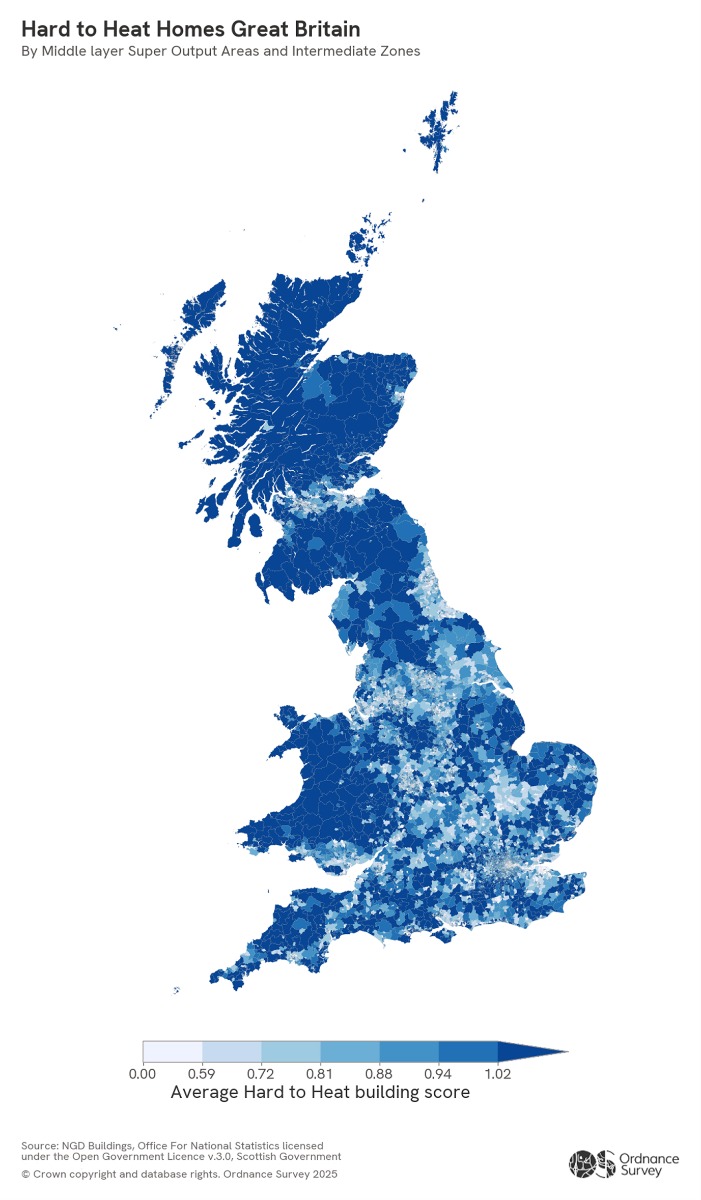
Working to identify the causes, Ordnance Survey, Great Britain’s national mapping agency, analysed 23.6 million homes using the OS National Geographic Database (NGD). Through this, OS NGD identified over 600 million features affecting the heating conditions – from identifying trends to comparing the physical characteristics of homes using a heat index to assess how easy they are to heat.
The Pros of Urban Living
According to Ordnance Survey’s data patterns, urban areas are generally warmer and have low heat-loss risk. This is influenced by a range of factors, including the urban heat island effect, higher ambient temperatures, and denser, often newer housing stock.
In London, boroughs such as Tower Hamlets rank among the easiest to heat, likely due to the high proportion of flats (21%) with shared walls, modern construction standards, and the lowest percentage of pre-1960 buildings (37%).
Glasgow has a higher proportion of flats and high-rise buildings, assuming that with shared walls, they might retain heat better. New towns such as Milton Keynes are also easier to heat, as the majority of homes (around 85%) were built after 1960, giving it the second-lowest heat index of all Local Authorities.
Changing Point
The 1960s in the UK were critical, as many earlier homes had insulation standards that were not suitable for the current weather behaviours, such as stone or timber.
Building regulations introduced in the mid-1960s began requiring insulation, and standards have tightened significantly since then. Homes built after this period tend to feel warmer and less damp, meaning they require less energy to heat. Homes built post-1960 generally have better insulation, cavity walls, and double glazing, reducing heating bills and preventing damp and condensation.
Region-wise, hilly and mountainous regions such as the Scottish Highlands, Peak District, and Lake District, and three national parks in Wales are more exposed to harsh weather and tend to have older stone farmhouses and traditional buildings. Wales also has the oldest housing stock in the UK, largely due to industrial-era terraced housing built during the 19th century.
Working towards a Solution
Using OS data, it’s possible to identify south-facing rooftops suitable for solar panels, which could help households reduce energy costs. In South Cambridgeshire, 14% of residential properties already have solar panels installed. These solar panels work throughout winter, because they rely on daylight rather than temperature, although shorter daylight hours do reduce output.
Additionally, reconstructing old houses into new ones with better insulation can also work to keep localities and areas warmer. For example, Cambridgeshire has a lower heat index likely due to a high proportion of energy-efficient new-builds from 2011 onwards.
However, not all old infrastructure is colder, as suggested by York, which is surprisingly easier to heat than Winchester and St Albans, sitting as an outlier.
“Understanding which homes are hardest to heat is critical for improving energy efficiency. Ordnance Survey data provides detailed insights into building age, construction materials, and location, enabling us to model heat-loss risk at scale,” Isabelle Chatel de Brancion, Land and Property Lead at Ordnance Survey, said.
The Methodology
By applying OS NGD building attributes to create a heat index, we can visualise areas where homes are most at risk of heat loss. These insights can help identify locations that would benefit from retrofitting, insulation upgrades, and other energy-efficiency improvements, helping to ensure warmer homes.
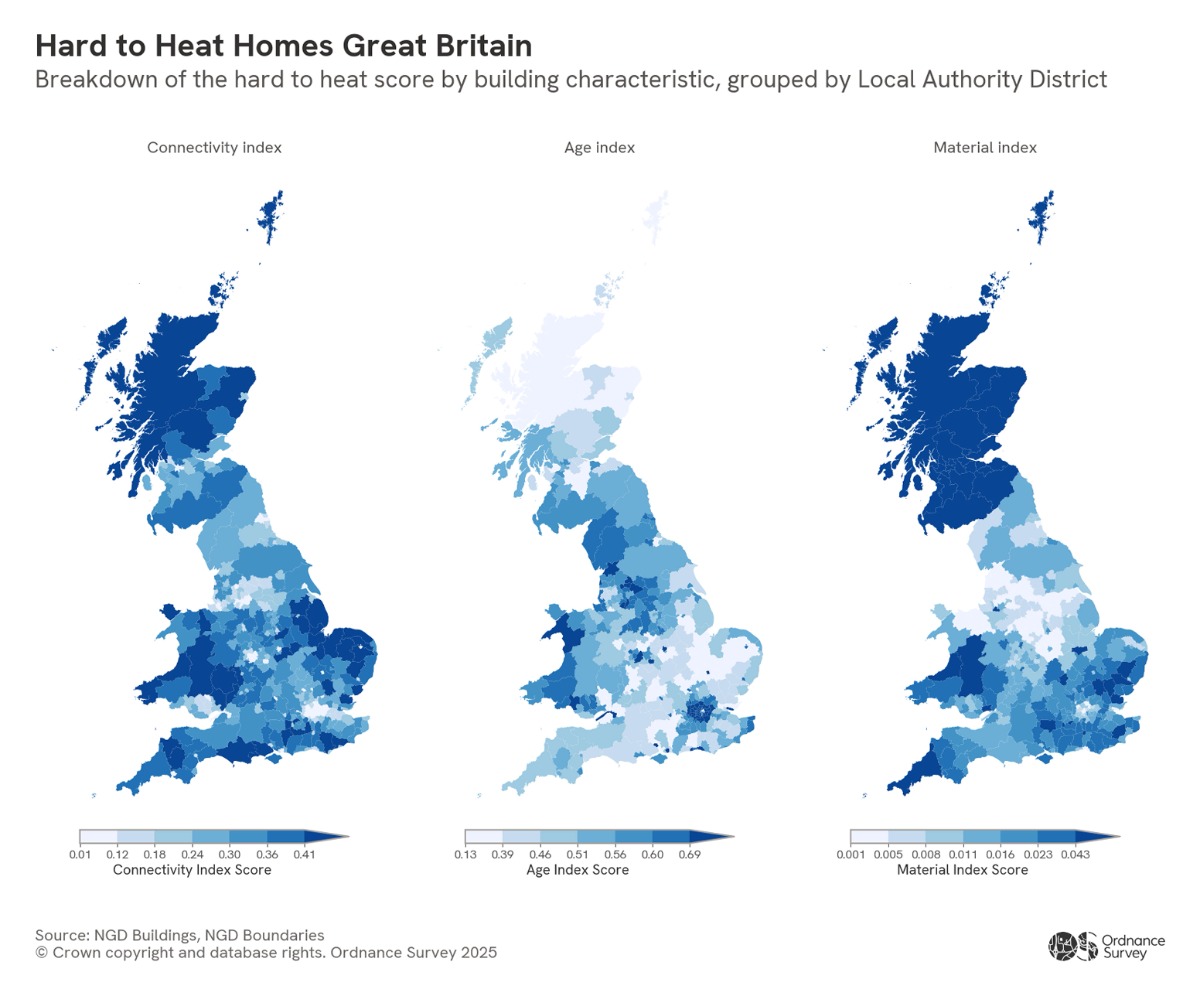
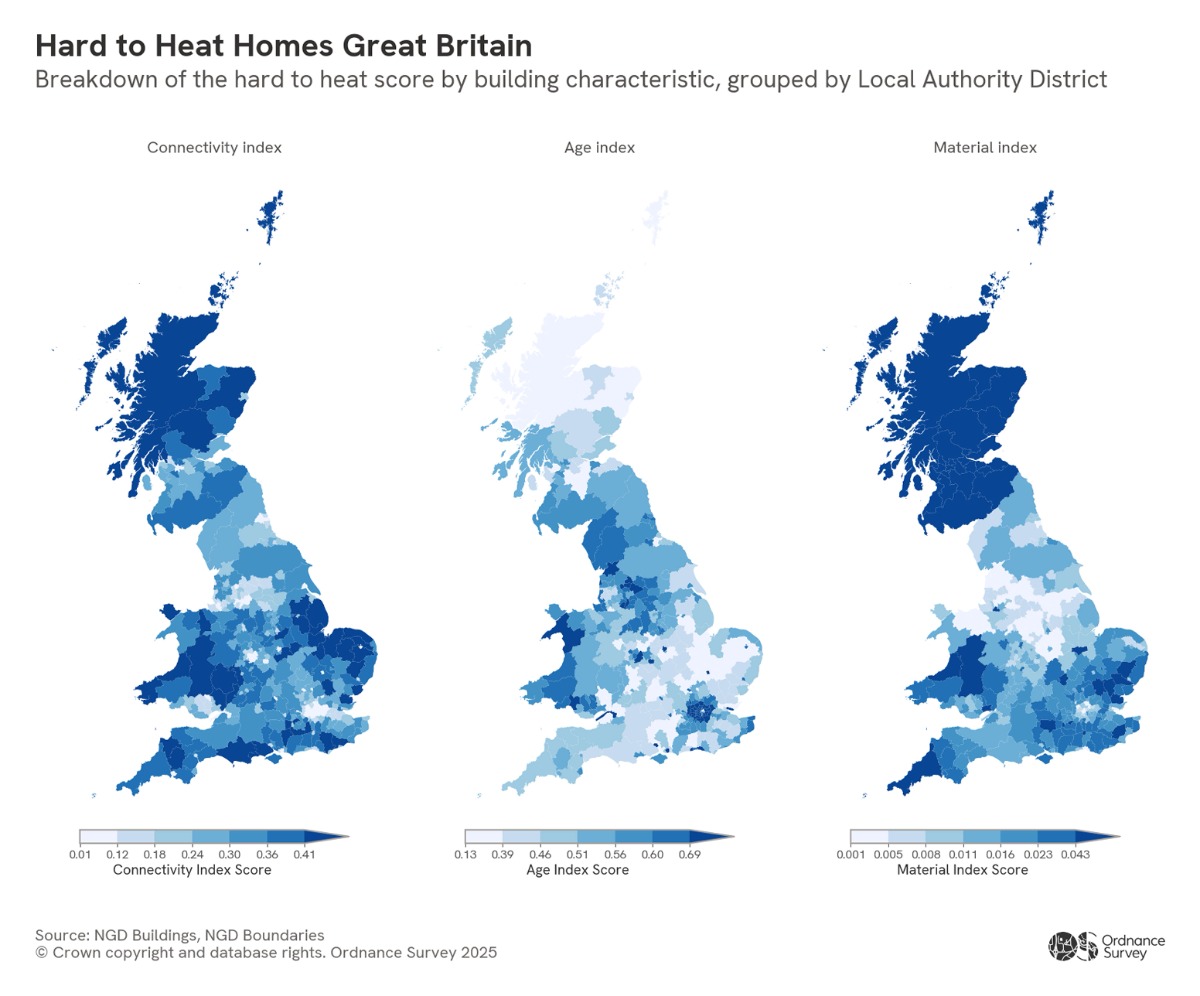
According to OS, the analysis considered:
- Connectivity – standalone properties are less likely to retain heat compared to properties that share walls with adjacent buildings.
- Building Age Period – the time period of building construction. Older properties are less likely to have good insulation compared to newer properties, making them harder to heat.
- Construction Material – properties built with more insulating material will likely retain heat more effectivity.
A score was given for each of the three building characteristics, based on their attribute values. If a property had a building attribute that was considered harder to heat, a score of 1 was given; a score of 0 was assigned.
Once assigned, the scores across the three attributes were totalled for each property, resulting in an overall score. The lower the score, the easier it is to heat. The scores were then grouped and averaged by each Local Authority District.

Sachin Awana