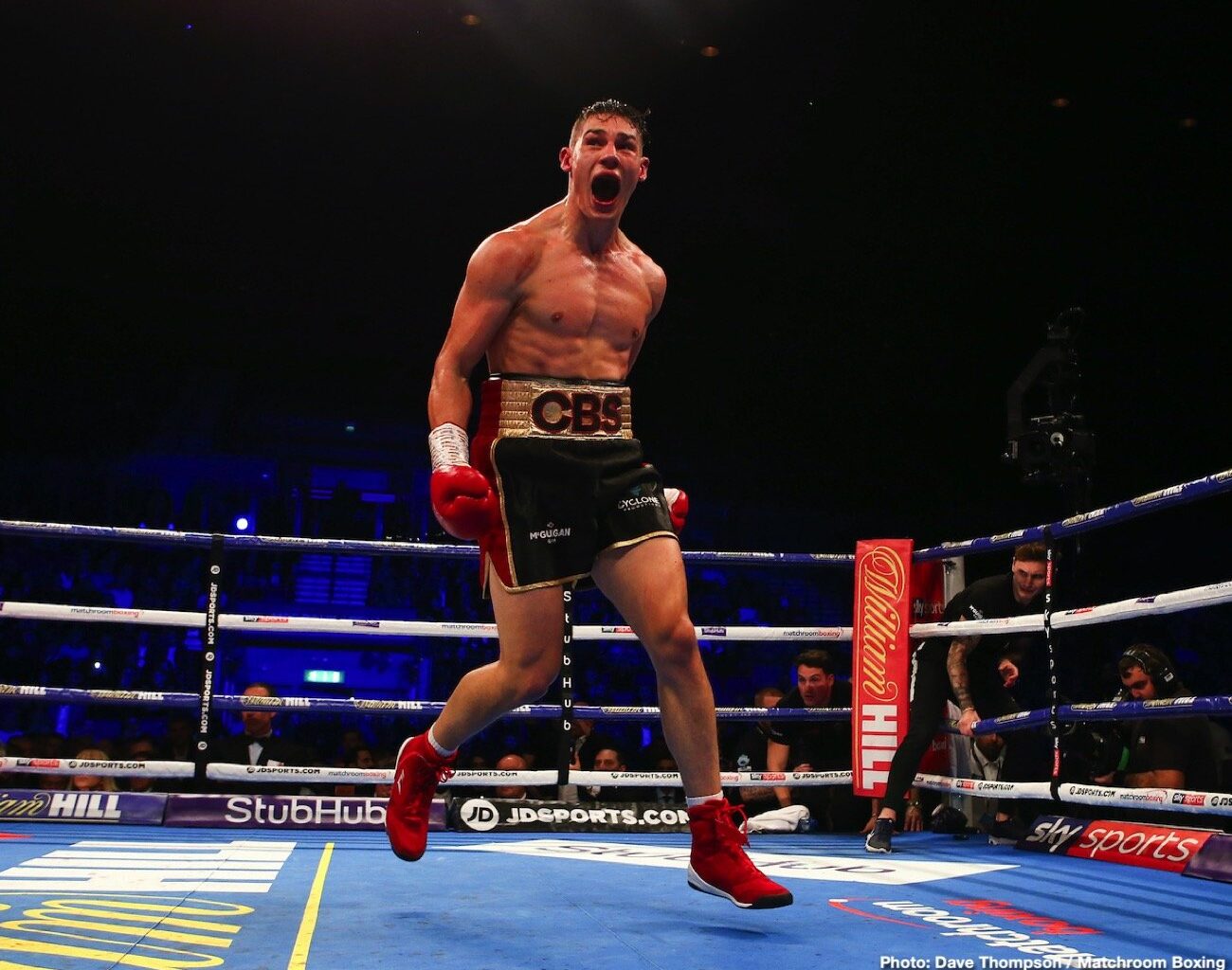
His focus remains on cruiserweight titles, even as one name outside the division continues to surface. Deontay Wilder.
Billam-Smith does not present that possibility as a division change or a broader career shift. He describes it as a specific fight and has been clear that heavyweight, as a division, does not suit him. That view has not changed. Wilder, potentially at bridgerweight, is treated as an exception rather than a rule.
“I don’t think my style suits heavyweight,” Billam-Smith said on the Toe2Toe podcast. “But I’d love that fight.”
He pointed to past bouts against punchers and fighters who rely heavily on a single power shot, arguing that those matchups have often played to his strengths rather than exposing weaknesses.
“When I’ve boxed punchers with a big right hand, I’ve done alright,” he said. “Stylistically, that would be good for me.”
That thinking does not extend to the division as a whole. Billam-Smith outlined only two scenarios that would realistically pull him out of cruiserweight.
The first involves Lawrence Okolie. Billam-Smith remains the only man to beat him as a professional, and if Okolie were to win a heavyweight title, that result would take on renewed relevance. A rematch, under those circumstances, would carry an obvious narrative.
The second is Wilder. A known risk, a known name, and a fight that still draws attention despite Wilder’s recent setbacks.
For now, Billam-Smith’s focus stays firmly at cruiserweight, where Noel Mikaelian holds the WBC title. That belt is the next target and represents a direct route back into the title picture.
The division, however, may not stay settled for long.
David Benavidez is expected to move up from light heavyweight and challenge Ramirez for the WBA and WBO titles. If that fight takes place, it reshapes the top of the weight class immediately and alters the landscape Billam-Smith is navigating.
“We want him to beat Zurdo, and we want to fight him,” Billam-Smith said. “That’s my view. That’s the team’s view.”
The logic is straightforward. If Benavidez beats Ramirez, he becomes a champion and also defeats the fighter who took Billam-Smith’s title. That connection still carries weight in boxing, even when it goes unstated.
Billam-Smith sees that matchup as close.
“I make Zurdo the favourite,” he said. “But it’s close. Very close. Benavidez has the style to beat him. Zurdo is very clever.”
He did not try to dress it up.
“What a name,” he said. “What a fight.”
Big names still matter to him, as do the stages that come with them. Las Vegas remains part of the ambition rather than something already checked off.
“If I can go to Vegas, even better,” he said. “That dream is still there.”
Above all of it sits Jai Opetaia, the IBF champion, and Billam-Smith has already mapped out how he would like to get there.
Mikaelian first. Then Benavidez. Then Opetaia. Three fights, taken in sequence, each one building toward the next.
That route would give him titles, leverage, and something to negotiate with rather than simply waiting for an opening.
“In an ideal world, that would be the route,” he said.
He does not pretend boxing usually allows ideal paths. Plans change quickly. But the direction is clear, and he is choosing his shots with an awareness that the window does not stay open forever.
Olly Campbell has been covering boxing since 2014, offering readers a clear ringside perspective and thoughtful analysis on many of the sport’s biggest nights. His work focuses on fighter tendencies, corner adjustments, and the technical details that shape high-level bouts. Over the years, Olly has reported on major cards in Las Vegas, New York, London, and across the UK boxing circuit, earning a reputation for levelheaded, detail-driven coverage.