Greg Brockman fancied being a billionaire. “[W]hat do I really want?”, the then 28-year-old president of OpenAI wrote in his diary in late 2017. “Financially, what will take me to $1B?”
Daydreams of fabulous wealth would, in most contexts, be of little consequence. Yet for Elon Musk, they are a smoking gun: proof of a “secret plot” hatched years ago to sideline the Tesla billionaire from the pioneering AI company that he co-founded and funded as a non-profit organisation, and then to turn it into a for-profit entity to enrich Brockman, chief executive Sam Altman, and his other erstwhile partners.
A federal judge in California this month rejected OpenAI’s attempt to get Musk’s $134 billion (£100 billion) lawsuit against the company thrown out, opening the way for a blockbuster jury trial that poses an existential threat to OpenAI, one of the world’s most valuable start-ups at $500 billion. It could prove decisive in the battle over who prevails in the multitrillion-dollar race for AI dominance.
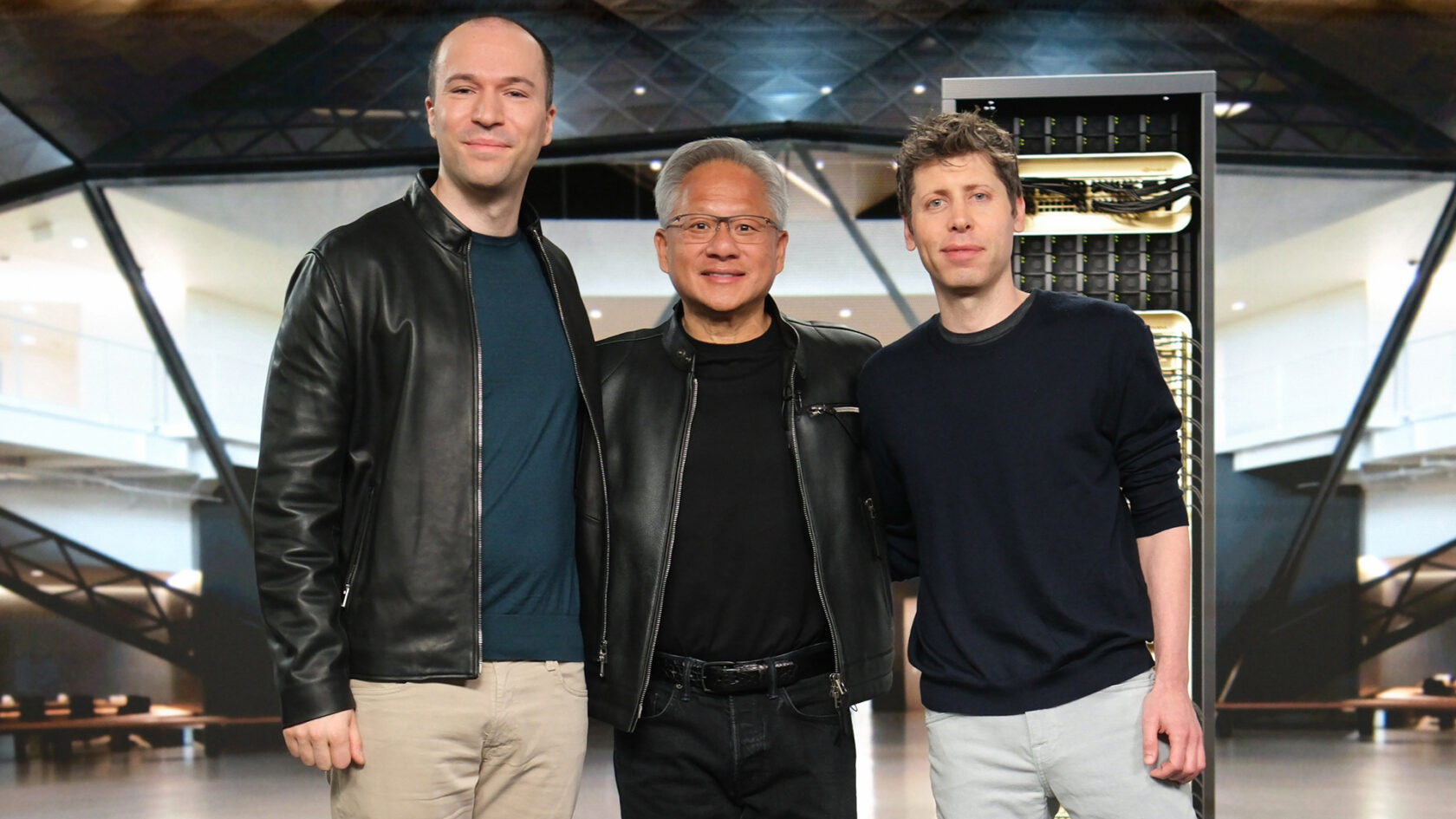
Greg Brockman, Jensen Huang, the Nvidia chief executive, and Sam Altman
NVIDIA
• How Sam Altman and Elon Musk are competing to change your brain
Musk tweeted last week: “Can’t wait to start the trial. The discovery and testimony will blow your mind.” The $134 billion figure, Musk’s suit alleges, is his former partners’ combined ill-gotten gains — made possible by his early financial and commercial support of OpenAI.
OpenAI denies all allegations, claiming that the world’s richest man is, in effect, a sore loser who abandoned OpenAI of his own accord, and is now trying to hamstring a rival to his own AI company, xAI. The jury trial, which is set to begin on April 27 in Oakland, California, is “part of a broader strategy of harassment aimed at slowing us down”, OpenAI said.
The drama centres on a torrid three months in late 2017 and early 2018, a period when Altman, Brockman and Musk tried and failed to agree a new structure for OpenAI, their fledgling non-profit.
Who knew what and when, and what information was shared during those crucial months, will prove decisive not just for the future of the company, but for the development of artificial intelligence itself. Among the potential legal remedies are OpenAI potentially being forced to unwind its corporate structure, pay vast damages to Musk, or compelling Microsoft, OpenAI’s biggest investor, to divest.
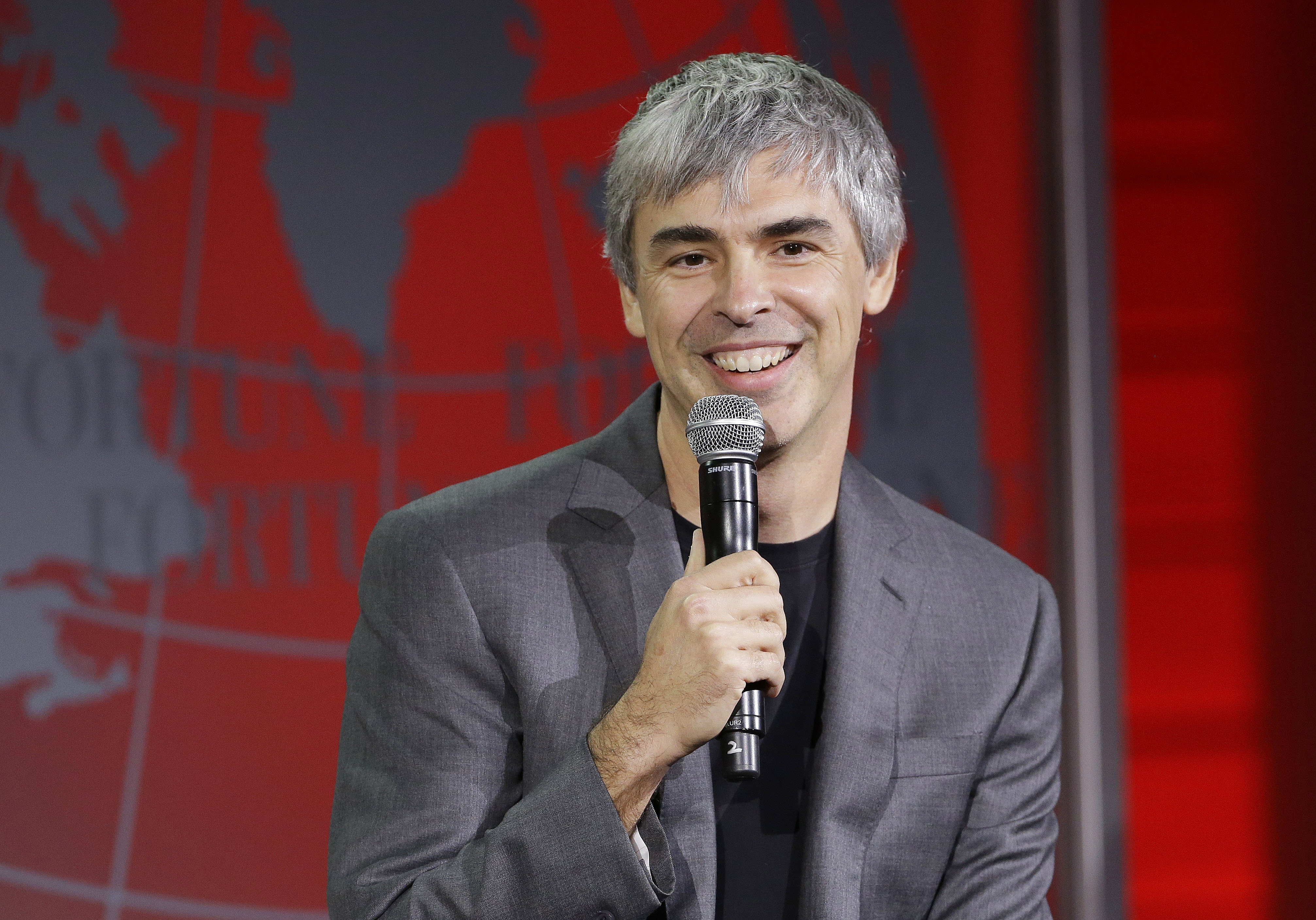
Larry Page, the chief executive of Alphabet
JEFF CHIU/AP
The roots of the conflict trace back two years earlier to the summer of 2015, at Musk’s 44th birthday party, when the Tesla founder got into an argument about AI with Larry Page, the Google billionaire. Page, Musk recalled, wanted to create a “digital god” and had dismissed Musk as a “speciesist” who was overly concerned about the threat that AI might pose to humans.
“I was like, ‘That’s it. Yes, I’m a speciesist,’ ” Musk recalled saying. “ ‘You got me. Busted. What are you?’ ”
• Supremacy by Parmy Olson review — an elegant account of the AI arms race
Concerned about Google’s AI trajectory, Musk came together with Altman, who was then running the start-up boot camp Y Combinator, and Brockman, the former technology chief of payments giant Stripe, to create OpenAI as a counterweight — a non-profit, “unconstrained by a need to generate financial return” and instead focused on “positive human impact”.
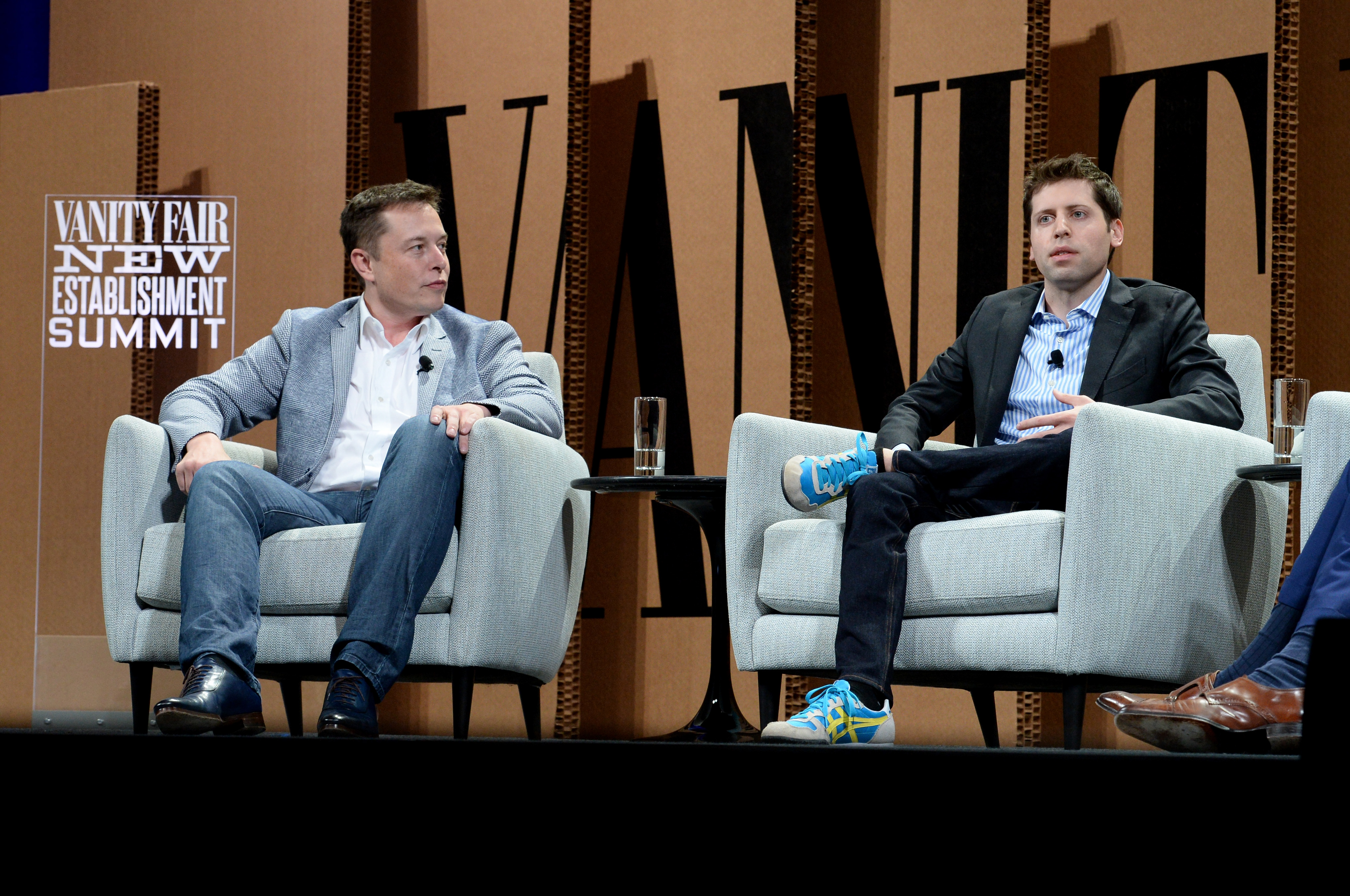
Musk and Altman in San Francisco in 2015
MICHAEL KOVAC/GETTY IMAGES FOR VANITY FAIR
They announced OpenAI’s formation in December 2015. Musk was the main funder and because it was set up as a non-governmental organisation (NGO), he received no equity in return for his investment.
As OpenAI progressed, it quickly became clear that it would need vast sums of money — tens of billions of dollars — to achieve its goal of creating artificial general intelligence (AGI), a self-improving system better than humans at all cognitive tasks and economically valuable work.
• Stuart Russell: We can coexist with superintelligent AI but who wants to?
This point, in November 2017, is where the narratives diverge. The trio began discussing ways to restructure OpenAI. Options included creating a new for-profit arm, or merging with Tesla or some other structure that would allow it to tap into deeper financial resources.
According to Musk’s legal filing, however, he “insisted that any new entity ‘support … the non-profit’s mission’ and that OpenAI remain ‘essentially [a] philanthropic endeavour’ ”. His co-founders, according to court documents, wholeheartedly agreed.
They did not, though, reach a final agreement. Talks quickly soured. In February 2018, Musk, OpenAI’s prime funder, quit in acrimony.
In his telling, his erstwhile founders had lied to him in the midst of those talks, happily taking his money and saying they wanted to maintain the business as a non-profit, while “secretly” plotting to transform into a for-profit entity such as a B Corporation, a type of company that blends profit with certain social benefit goals.
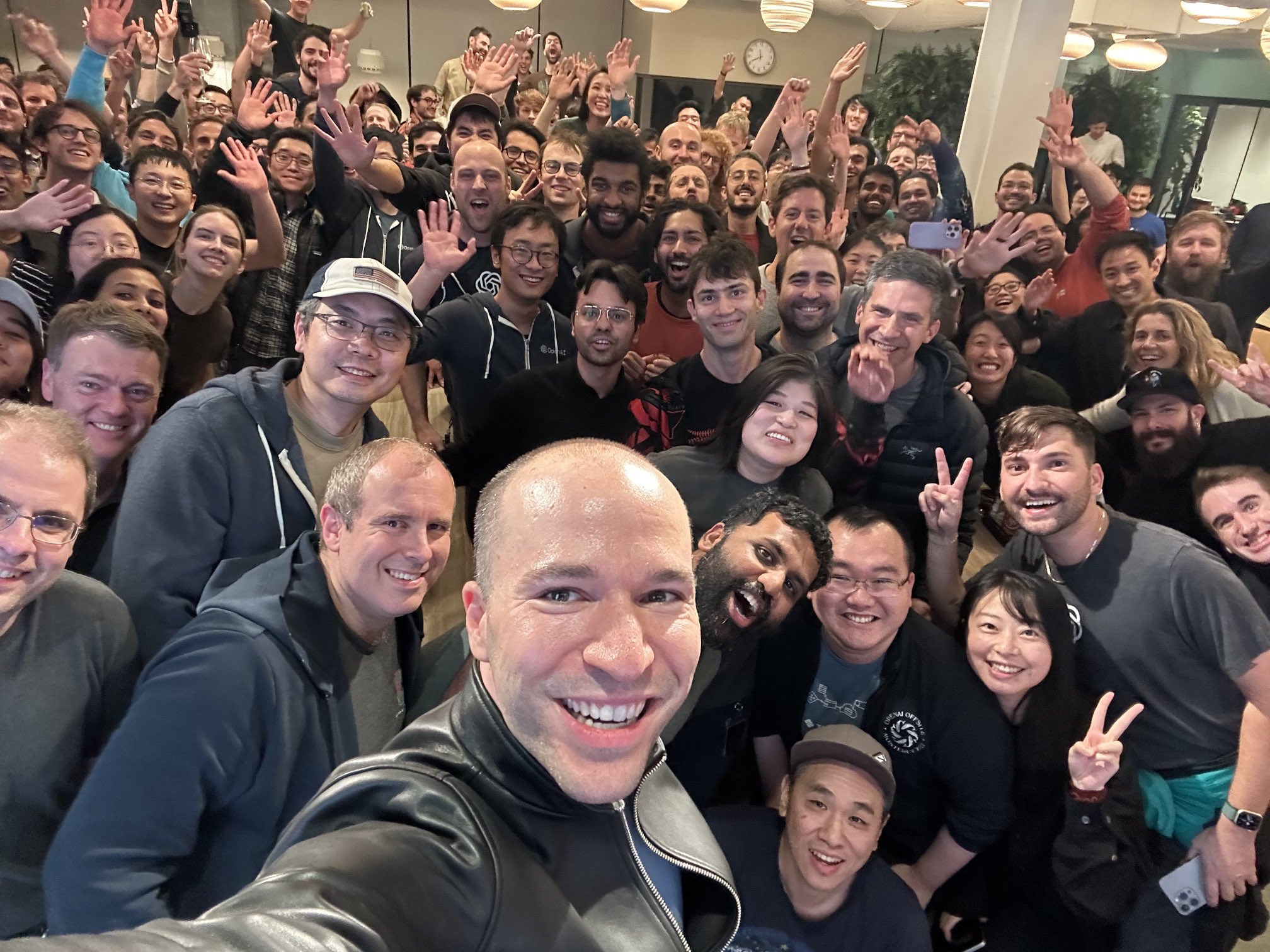
Greg Brockman with OpenAI team members
GREG BROCKMAN
Brockman appeared conflicted, according to private notes that have since been turned over as evidence. “[C]annot say that we are committed to the non-profit, don’t wanna say that we’re committed. If three months later we’re doing b-corp then it was a lie,” he wrote at the time, according to court documents. “[Musk’s] story will correctly be that we weren’t honest with him in the end about still wanting to do the for profit.”
Musk has argued that what Altman and Brockman did amounted to a “bait and switch”, in which he funded the development of a technology for a non-profit, left, and then watched his former colleagues reap the rewards by turning that NGO into a for-profit entity that raised billions of dollars and became one of the most valuable private companies on the planet.
• Elon Musk calls OpenAI chief ‘swindler’ over rejected $97.4bn bid
OpenAI, however, has said this is little more than sour grapes. In a response titled “The truth Elon left out”, the company published unredacted versions of the documents from Musk’s suit. They cast the case in a very different light: a simple negotiation for control that Musk lost.
Indeed, OpenAI argued, the “secret” plot to restructure was no secret at all. On the contrary, Musk was deeply involved, going so far as to register the proposed B Corporation himself in Delaware.
The catch? According to OpenAI, Musk insisted that he take full control of the reconstituted company. Altman and Brockman objected, arguing that his proposal would imperil OpenAI’s mission of avoiding an “AGI dictatorship”, where the power of a world-altering technology would reside with one man.
OpenAI wrote: “Negotiations ended when we refused to give him full control; we rejected his offer to merge OpenAI into Tesla; we tried to find another path to achieve the mission together; and then he quit OpenAI, encouraging us to find our own path to raising billions of dollars, without which he gave us a 0 per cent chance of success.”
After they parted ways, Altman did indeed create a for-profit arm, which raised first $1 billion, then $2 billion, and then another $10 billion from Microsoft. ChatGPT exploded onto the scene in November 2022.
Musk set up his rival xAI four months later, on March 9, 2023. He filed his suit the following year.