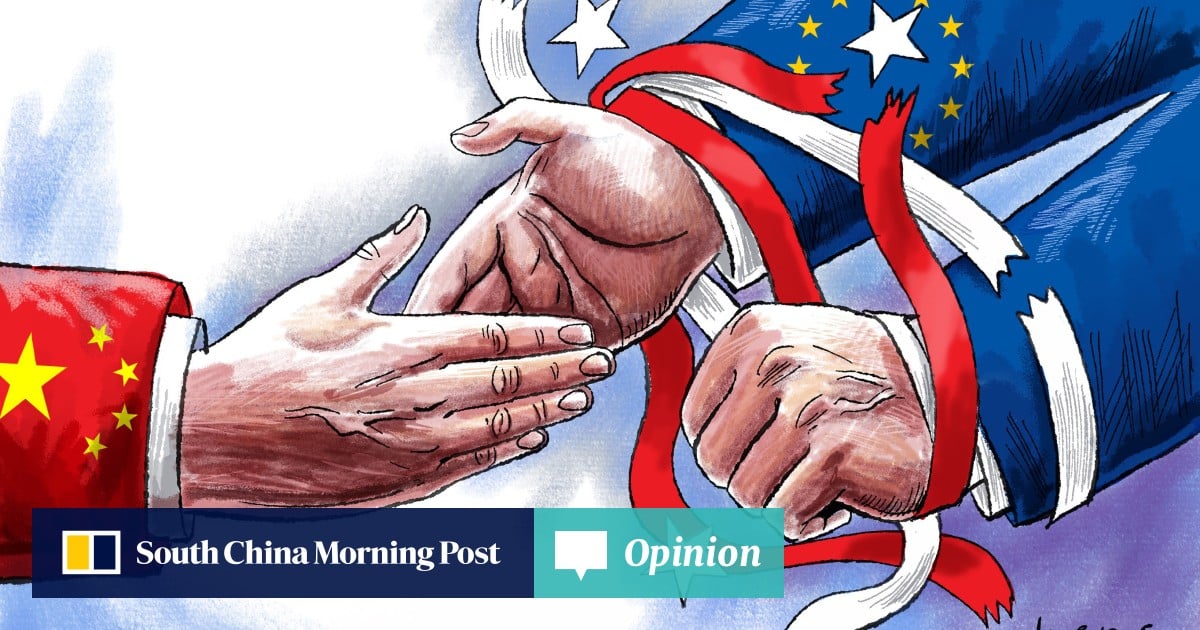
Europe’s survival as an independent political power depends on its readiness to impose costs on the United States while reopening a sustained channel with China.
The Arthashastra counsels that the enemy of one’s enemy is one’s friend. Europe has ignored this principle, absorbing repeated American bullying while refusing to leverage relations with China as a counterweight.
The Greenland episode crystallises a reality enforced through trade threats, security conditionality and territorial extortions. US President Donald Trump has declared the island “imperative” for national security and concluded that the European Union (EU) “needs [the US] to have it”.
After limited military exercises by several European Nato members, Trump threatened a 10 per cent tariff that would increase to 25 per cent unless an agreement was reached. These were elements of a coercive bargaining strategy aimed at extracting concessions.
A clear sequence of events led up to this episode. In February 2025, US Vice-President J.D. Vance used the Munich Security Conference to chastise Europe rather than affirm shared commitments. This was followed by a demand that Nato members increase defence spending to 5 per cent of economic output, persistent tariff threats and a framework that imposed EU technology export controls on China.
The central failure lies less with Washington than with European leaders who respond to pressure with appeasement. The US applies coercion because it expects tolerance of systematic exploitation. EU leverage has been abandoned across trade, technology, energy, politics and diplomacy. This is not a dispute over abstract values but a refusal to use influence.