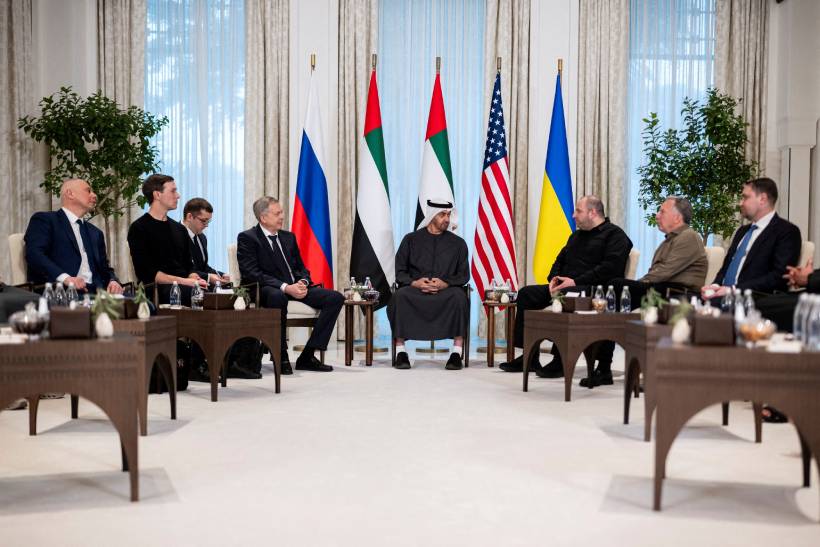
The Kremlin has reaffirmed that Ukraine must cede the entire Donbas region as a precondition for any peace deal, underscoring how entrenched Moscow’s territorial demands remain despite renewed diplomatic engagement. Speaking after U.S.-brokered trilateral talks in Abu Dhabi, Kremlin spokesman Dmitry Peskov said the territorial question was “of fundamental importance” to Russia, according to state news agency TASS.
Donbas at the Core of Moscow’s Position
President Vladimir Putin has consistently maintained that Russia will take full control of Donbas comprising the Donetsk and Luhansk regions by force if Kyiv does not concede it through negotiations. Russian forces already control around 90% of the area, but Moscow insists that anything short of total control is unacceptable. Peskov stressed that this stance reflects Putin’s long-standing position and is not open to compromise.
The ‘Anchorage Formula’
Peskov referred to what Russia calls the “Anchorage formula,” an alleged framework said to have been discussed between Putin and U.S. President Donald Trump at a summit in Alaska last August. According to a source close to the Kremlin, the formula envisages Ukraine handing over all of Donbas to Russia, while front lines elsewhere in eastern and southern Ukraine would be frozen. Neither Washington nor Kyiv has publicly confirmed such an agreement, but Moscow continues to cite it as a basis for talks.
Kyiv’s Rejection
Ukraine has repeatedly rejected any proposal that involves surrendering territory, particularly areas Russia has not fully captured militarily. Ukrainian officials argue that conceding Donbas would legitimise aggression and undermine Ukraine’s sovereignty, setting a dangerous precedent for future security in Europe.
Talks Without a Deal
Despite the hard-line rhetoric, Russia portrayed the Abu Dhabi discussions in a positive light. State agency RIA quoted Peskov as calling the talks “constructive,” even though they ended without a breakthrough. Further negotiations are expected next weekend, keeping diplomatic channels open despite the wide gap between the two sides’ positions.
Analysis
Russia’s insistence on full control of Donbas signals that Moscow still views negotiations as a means to consolidate battlefield gains rather than to reach a genuine compromise. By framing its demands as non-negotiable and anchoring them to an alleged prior understanding with Washington, the Kremlin is attempting to shift the burden of flexibility onto Kyiv. For Ukraine, accepting such terms would amount to strategic capitulation, making agreement highly unlikely in the near term. The Abu Dhabi talks reveal a familiar pattern: dialogue continues, but with maximalist positions unchanged. Unless one side recalculates its costs military, political, or economic these negotiations risk becoming a diplomatic holding pattern rather than a path to peace.
With information from Reuters.