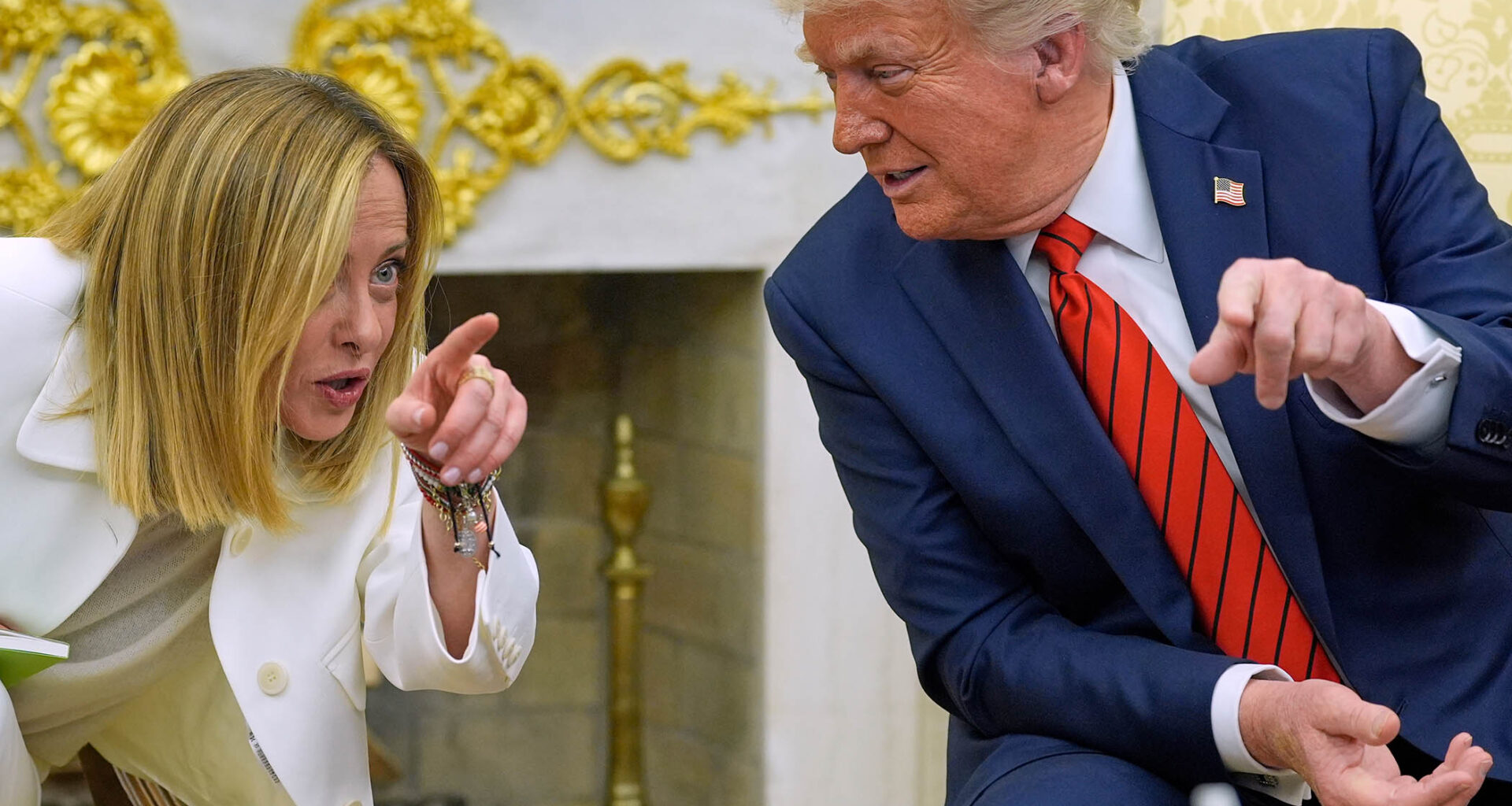
As Europe reels from Donald Trump’s sabre-rattling – this time directed at Greenland – one leader is quietly stepping into the diplomatic gap.
Italian prime minister Giorgia Meloni, a conservative nationalist with rare access to both sides of the Atlantic divide, has positioned herself as a go-between as US relations with the European Union once again slide into turmoil.
While other leaders lined up to criticise the US president over his threats to acquire Greenland, Meloni has emerged as Trump’s self-appointed spin doctor in Europe, echoing his warnings about hostile actors in the Arctic, downplaying Trump’s aggression, and urging her fellow European leaders behind closed doors to turn the other cheek. On Friday, she even said she hoped to “finally” be able to nominate him for the Nobel peace prize.
Since Trump’s re-election, European capitals have been casting around for a “Trump-whisperer” – someone capable of mediating between an unpredictable White House and an increasingly anxious Europe. Meloni has carefully cultivated that role, and is arguably the closest mainstream European leader to Trump and his imperial court.
On a personal level, Meloni got off to a good start with Trump. He welcomed her to his Mar-a-Lago estate, hailing her as a “fantastic woman” who has “really taken Europe by storm”, later praising her as an “exceptional leader.” Meloni was the only EU head of government to attend Trump’s inauguration – a visit she brandished at home as proof of Italy’s renewed clout in Washington. On a visit to the White House in April last year (pictured above), she said her goal was to work together to “make the west great again”. Unlike other European A-listers, such as Emmanuel Macron and Keir Starmer, she has expressed interest in joining Trump’s Board of Peace.
More than other European leaders, there is also genuine ideological overlap, for example on immigration, national sovereignty over multilateralism, and opposition to “woke” ideology.
“They have a good relationship based on trust,” said Nicola Procaccini, an MEP for Meloni’s Brothers of Italy party and co-chair of the European Conservatives and Reformists Group. “She is politically closer to the Republicans and the Trump administration than other leaders, which makes it easier to maintain good relations.”
Meloni has previously impressed European allies with her mediation skills, most notably by persuading Hungary’s prime minister Viktor Orbán to soften his obstructionist stance at EU summits.
She also has form when it comes to facilitating dialogue with Washington. When European Commission president Ursula von der Leyen found herself frozen out by Trump’s circle, it was Meloni who helped arrange a meeting in Rome with JD Vance, after which the US vice president publicly suggested she could serve as a bridge between the US and Europe. Meloni has also claimed credit for persuading Trump to take seriously Italian-backed proposals for Ukraine security guarantees anchored in Nato’s Article 5.
The US vice president publicly suggested she could serve as a bridge between the US and EuropeThe US vice president publicly suggested she could serve as a bridge between the US and Europe
Meloni has leaned heavily into that alignment in recent days, downplaying Trump’s aggressive rhetoric on Greenland as a misunderstanding. She has acknowledged the territory’s strategic importance and argued that Nato should do more to secure the Arctic against hostile actors. Earlier this month she insisted that Trump is not seeking to seize Greenland by force, which she said she “would not approve of”, but is using “very assertive methods” to draw attention to US security interests. Last week she even blamed Europe for escalating tensions by sending troops to Greenland – a move she claimed sent an unclear and potentially anti-American signal.
NewslettersChoose the newsletters you want to receive
Clear, calm analysis on the stories driving the day’s news.
The very best of our journalism, reviews and ideas – curated each day.
A dispatch from The Observer’s kitchen table – from Nigel Slater’s recipes to interviews, features and hot tips.
For information about how The Observer protects your data, read our Privacy Policy
Meloni was one of the few European leaders to refrain from criticising Trump after he threatened tariffs last week.
“We need to resume dialogue and avoid an escalation. I am working on this,” Meloni told reporters on Sunday, after a flurry of calls with Trump, Nato secretary general Mark Rutte and Von der Leyen.
Still, there are limits to how far personal rapport can go. Meloni’s special relationship with Trump did not spare Italy from new US tariffs last year, and analysts are sceptical that she can work the “Meloni magic” any better in the face of a more serious crisis.
Nor is Meloni’s more emollient approach appreciated throughout Europe. At an informal European Council on Thursday, Meloni urged calm, while French President Macron and German Chancellor Friedrich Merz warned that the crisis had closed a long era of transatlantic cooperation.
“It’s difficult to see how much impact she can really have”, said Raffaele Marchetti, professor of international relations at Rome’s Luiss University. “She can try to create dialogue. But on various dossiers, the US administration seems to hold very negative views about Europe.”
The Trump administration has shown growing hostility towards liberal European leaders. Last year Vance accused European governments of abandoning democratic values, and leaked internal communications have revealed deep contempt in Trump’s circle for “freeloading” Europeans. The National Security Strategy (NSS), published in December, claimed that Europe faced “civilisational erasure”.
It is an argument that many on the far-right and populist right like Meloni would echo. Indeed, the NSS praised what it described as “patriotic” parties in Europe and made clear it wanted to see them succeed.
The Greenland crisis showed the challenge of being both pro-Trump and “patriotic”. Other European nationalists such as Nigel Farage, leader of Reform UK, and Jordan Bardella, leader of France’s National Rally, who had adopted the Maga movement as a common rallying point, issued rare criticism of the US president. Bardella described the tariff threats as “blackmail” and accused Trump of attempting the “vassalisation” of Europe.
Meloni’s softly-softly approach with Trump has exposed her to criticism at home, where opponents accuse her of appeasement. For Angelo Bonelli, the spokesman for the opposition Green Europe party, Meloni doesn’t have the capacity to move the dial, and is merely seeking to boost her standing domestically.
“Rather than defending a strong and autonomous Europe, she is subjugating herself to the arbitrary will of a self-obsessed leader, who bends peace, global security and international relations to his own grievances and vision of domination,” he said.
Bonelli claimed that Meloni is actually helping Trump pursue a foreign policy objective of sowing division in the EU partly in order to water-down climate, agriculture and digital regulations. The only way out for Europe is to accelerate a unified European defence model, Bonelli said – a project Meloni has consistently opposed.
Allies of the prime minister insist there is little alternative to cultivating ties with Trump. Meloni, along with Nato secretary general Mark Rutte, has adopted the only viable strategy given the imbalance of power.
“It is an intelligent, pragmatic and realistic approach,” said Andrea Di Giuseppe, a member of Italy’s chamber of deputies from Meloni’s Brothers of Italy party who represents Italians living in the US. “Fighting with the United States makes no sense. When Meloni disagrees with Trump, she says so – but with constructive criticism.”
The US, he added: “Is the most important economic and geopolitical power in the world, and must be respected.”
Ultimately, however, geography ties Meloni’s interests to those of Europe. And as negotiations on several fronts, including Greenland, Nato and Ukraine, are thrashed out, the question is whether acting as Trump’s most sympathetic interlocutor will give Europe leverage – or simply accelerate the fragmentation Brussels fears most.
Photograph by Alex Brandon/AP