Support CleanTechnica’s work through a Substack subscription or on Stripe.
Or support our Kickstarter campaign!

File this one under B, for Be Careful What You Wish For. The US oil industry was all in favor of propelling President Donald Trump back into office for a second time, but the writing is already on the wall. The renewable energy transition is still chugging along globally, thanks in part to the US oil industry, and China is among the nations poised to reap the rewards.
How The US Industry Motivated Gulf States To Pivot Into Renewable Energy
The latest organization to underscore the topsy-turvy role of the US oil industry in the global renewable energy transition is the Qatar-headquartered organization Middle East Council on Global Affairs. That’s interesting in and of itself, considering President Trump’s close — some say inappropriately close — relationship with Qatar and its rulers.
Be that as it may, earlier today, January 26, MECGA posted a detailed policy note under the title, “The China-Gulf Green Rush: Fueling Renewable Energy Cooperation.”
MECGA Nonresident Fellow Chuchu Zhang, who authored the piece, makes the renewable energy case by noting that the US and Canada have successfully undercut the Gulf region’s status as a global center of petroleum production. “The surge in shale oil and gas production, particularly in the United States and Canada, has considerably reshaped international supply dynamics, and is diminishing the Middle East’s strategic leverage as the world’s energy hub,” Zhang emphasized.
“This shift, compounded by rapid advancements in Canadian oil sands, deep-sea extraction in the Gulf of Mexico and Brazil, and biofuels, has compelled Middle Eastern oil producers to diversify beyond fossil fuels to mitigate existential threats to their economic models,” Zhang added.
Losing The Renewable Energy War, Bigly
In years past, the Gulf economies would wither in the face of competition from US oil producers. Not any more. The clean energy transition has provided them with a powerful, economy-building alternative driven by the force multiplier of innovation.
CleanTechnica spotted the renewable energy writing on the wall more than 10 years ago. “Owning The 21st Century With Solar, Water, & Brain Power,” is one headline from a 2016 visit to Abu Dhabi.
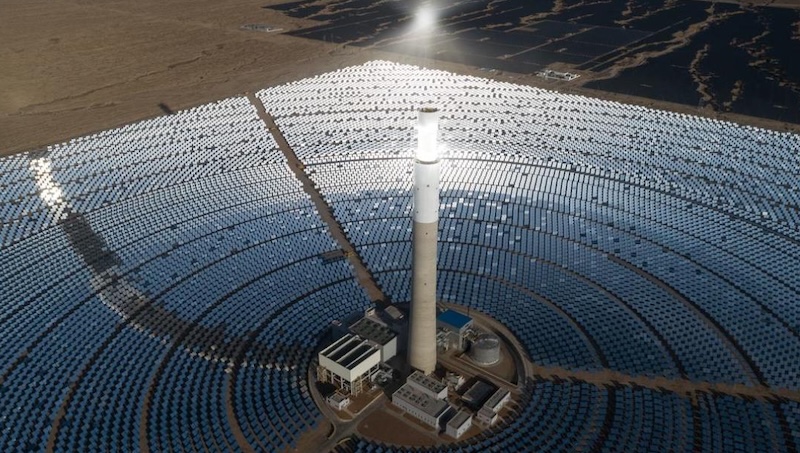
“When one of the world’s largest concentrating solar power plants rose from the desert sands in the Western Region of the Abu Dhabi Emirate back in 2013, more than a few heads exploded,” reads another piece from 2016.
In 2019 we also noted a fresh burst of renewable energy activity in MENA (Middle East and North Africa). Yet another sign of the diversification trend cropped up in 2021, when the International Renewable Energy Agency — which is headquartered in Abu Dhabi — engaged China in a Memorandum of Understanding aimed at helping China reach its decarbonization goals.
And…What Does This Mean, Exactly?
The big question is what China expects to gain from wind and solar resources in a distant region. The investor dollars and workforce opportunities alone are substantial, but Zhang has a more hands-on relationship in mind. As the Gulf states transition to a decarbonized economy, China aims to complement the region’s intermittent wind and solar resources with its energy storage products and other clean tech gear.
“Unlike fossil fuel extraction, which relies primarily on resource availability, renewables hinge on precision equipment (e.g., lasers and vacuum deposition for high-efficiency batteries and photovoltaic cells) and intelligent grid management to accommodate variable wind and solar inputs,” Zhang notes.
“For the Gulf states, which possess substantial resource wealth alongside varying levels of high-tech research and development, manufacturing and infrastructure capabilities, partnering with China provides a practical route to industrial upgrading, enabling deeper integration into supply chains through joint ventures and technology transfers,” she emphasizes.
Meanwhile, The Epstein Files
Presumably another attraction of cementing ties with the Gulf states is the potential for engaging in rational, predictable, reliable, long term engagement in the economic development space.
The US has effectively taken itself out of the picture, considering the seat-of-the-pants clusterf–k that passes for federal policymaking nowadays, with foreign relations being just one among many examples of dysfunction if not outright criminal behavior.
If you’re hoping for a return to normalcy any time soon, don’t hold your breath. The President of the United States has focused all of his remaining energy on grasping for one straw after another, seeking anything and everything that might distract public attention from his relationship with the late Jeffrey Epstein.
It’s not going to work, of course. Even though the US Department of Justice has failed to deliver the Epstein files as required by law, slivers of evidence are already public. In the latest development, Democratic members of Congress are a step closer to obtaining public testimony from Epstein’s lawyer Darren Indyke, his accountant Richard Kahn, and Les Wexner, who is described as Epstein’s “billionaire financial client and longtime benefactor.” All three men were reportedly identified as “critical to the investigation.”
As for the energy transition here in the US, well, US presidents come and go. This one is scheduled to go on January 20, 2029 — peacefully one hopes, this time — and the sun will continue to rise every morning. The wind will still continue to blow, as well.
Besides, global renewable energy investors haven’t given up on the US. To cite just one example, check out today’s CleanTechnica interview with Jim Spencer, the president and CEO of Exus Renewables North America.
In sharp contrast to the gloomy-doomy environment in some areas of the clean tech space, Spencer said, “We’re very bullish on new renewable energy development — because the fundamentals have never been stronger.”
Another factor is Trump’s own Department of Energy, which has been propping up old coal power plants over the short term while continuing to play the long game on energy efficiency and other pillars of the energy transition.
For that matter, upon taking office last year Trump himself pulled a fast one on his friends in the fossil energy business. He tasked administration with supporting biomass, hydropower, and geothermal energy, three forms of renewable energy that can stand in for oil, natural gas, coal, or any combination thereof.
All three resources face structural limitations, but the geothermal industry has plenty of room to grow into new territory in the US, while the nation’s hydropower industry can exploit new opportunities to generate more power from existing dams and hydro facilities, and expand its pumped storage portfolio.
Keep an eye on forthcoming activity in the marine energy space as well, meaning devices that harvest electricity from the kinetic energy of waves, currents, or tides. Although much of the field is still in R&D stage, apparently the Trump administration considers it part and parcel of the hydropower industry, and therefore worthy of taxpayer support.
Go figure…
Image: US energy policy notwithstanding, China is seeking new opportunities to accelerate the global energy transition among Gulf states (cropped, courtesy of International Renewable Energy Agency).
Support CleanTechnica via Kickstarter
Sign up for CleanTechnica’s Weekly Substack for Zach and Scott’s in-depth analyses and high level summaries, sign up for our daily newsletter, and follow us on Google News!
Advertisement
Have a tip for CleanTechnica? Want to advertise? Want to suggest a guest for our CleanTech Talk podcast? Contact us here.
Sign up for our daily newsletter for 15 new cleantech stories a day. Or sign up for our weekly one on top stories of the week if daily is too frequent.
CleanTechnica uses affiliate links. See our policy here.
CleanTechnica’s Comment Policy