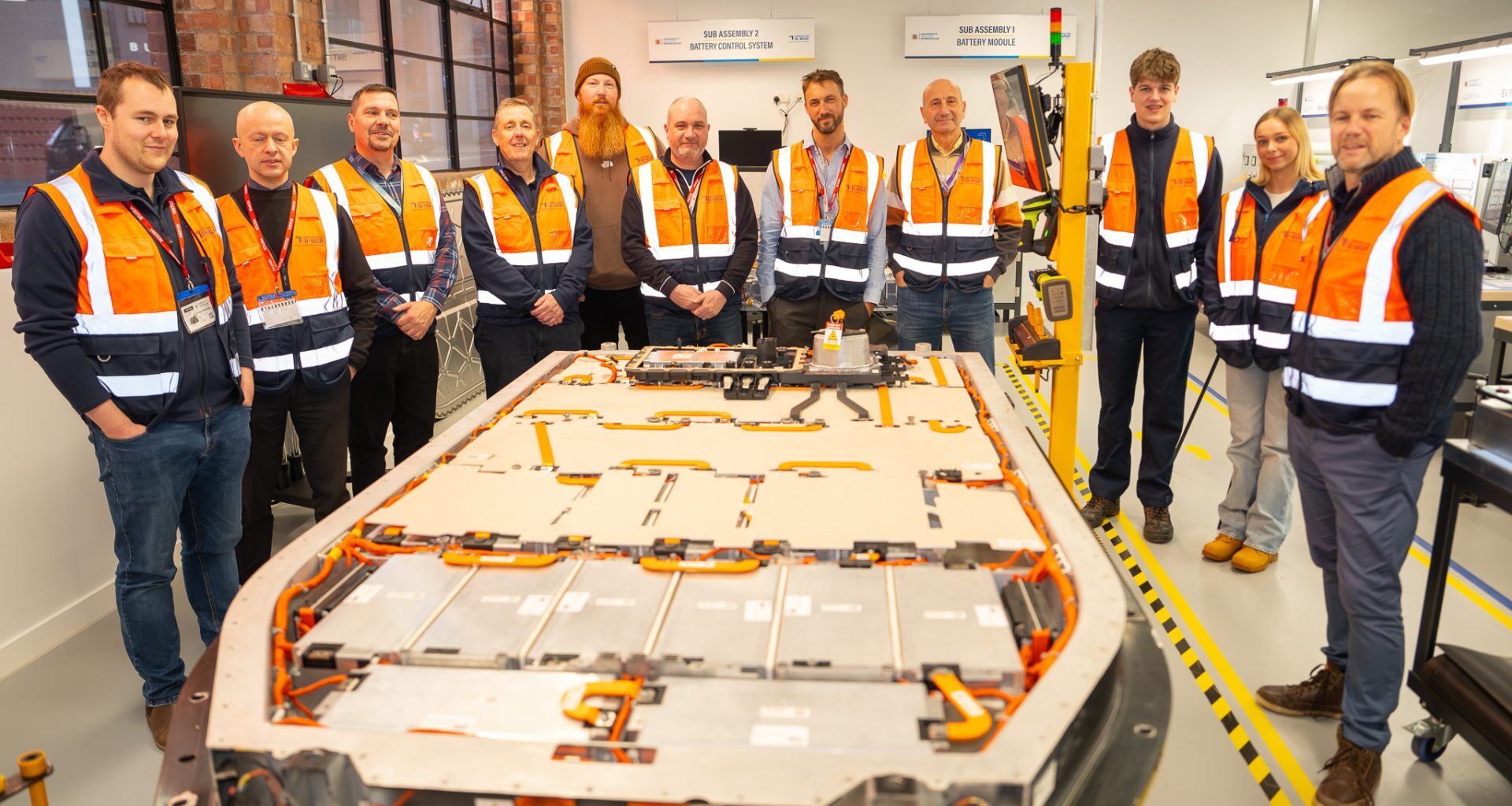
University College Birmingham (UCB) has marked a significant step forward in the UK’s battery manufacturing ambitions with the first graduates from a new, fully accredited advanced high-voltage battery training programme.
Delivered over five days at UCB’s dedicated learning facility, the Advanced High Voltage (HV) Battery Assembly and Gigafactory Operations course saw participants from Jaguar Land Rover, Atlas Copco and Autocraft complete what is being described as the first advanced course of its kind in the UK. The programme forms part of the Birmingham Battery Manufacturing Skills Pathway (B-MSP), launched in March 2025.
The milestone comes as the UK Gigafactory Commission warns the country is at a “critical stage” in its pursuit of global leadership in automotive and battery manufacturing. Its Britain’s Battery Future report highlights the urgent need for a skilled workforce as demand for electric vehicles accelerates.
Designed to reflect real-world production environments, the course provides hands-on training spanning the full battery manufacturing lifecycle, from gigafactory cell production to high-voltage battery pack assembly. Training also covers safe systems of work and the behaviours required for battery manufacturing and cell production.
The B-MSP has been developed in collaboration with a group of major employers, including Jaguar Land Rover, Microsoft, Rockwell Automation, Atlas Copco, Pi-Kem, Delta Cosworth and Yazaki, ensuring the curriculum aligns closely with industry needs.
Professor Rosa Wells, Dean for STEM at UCB, said the pathway was designed to deliver immediate value to employers while strengthening long-term skills development. “Reduced onboarding time means the workforce presents with real-world competence and technical expertise that directly aligns with their production environment,” she said. “At the same time, accessible pathways are created for new talent to come through and for recruitment to thrive.”
She added that employees also benefit from nationally recognised qualifications alongside practical experience. “Through the courses’ hands-on delivery, learners develop the skills and confidence to effectively contribute from day one.”
Industry partners have welcomed the initiative. James McAllister, General Manager at Atlas Copco UK, said the programme closely aligned with the company’s workforce development strategy. “From a workforce development perspective, this course aligns perfectly with our strategic goals: building a highly skilled team that can support customers in the transition to sustainable energy solutions,” he said.
The need for such programmes is underscored by figures from The Faraday Institution, which estimates that 1.4 million electric vehicles will be required by 2040, alongside a further 70,000 workers to meet demand. The government’s Department for Energy Security & Net Zero has also highlighted the scale of the clean energy skills challenge, noting that rapid reskilling will be essential to support growth across EV manufacturing and other low-carbon sectors.
Graduates of the course reported immediate benefits.
Molly Masters, Inside Sales Representative at Atlas Copco UK, said the programme had strengthened her understanding of EV battery assembly. “It’s given me a much clearer understanding of the challenges manufacturers face, which has already helped me feel more confident when talking to customers about battery-related applications,” she said.
Isaac Stock from Autocraft added that the collaborative nature of the course was particularly valuable. “It was beneficial interacting with people from different companies and seeing how they do things in their workplace, and the potential of implementing their techniques and processes into my own.”
UCB said the B-MSP will continue to offer structured, scalable training pathways to support workforce development, career progression and innovation across the UK’s growing battery manufacturing and advanced manufacturing sectors.