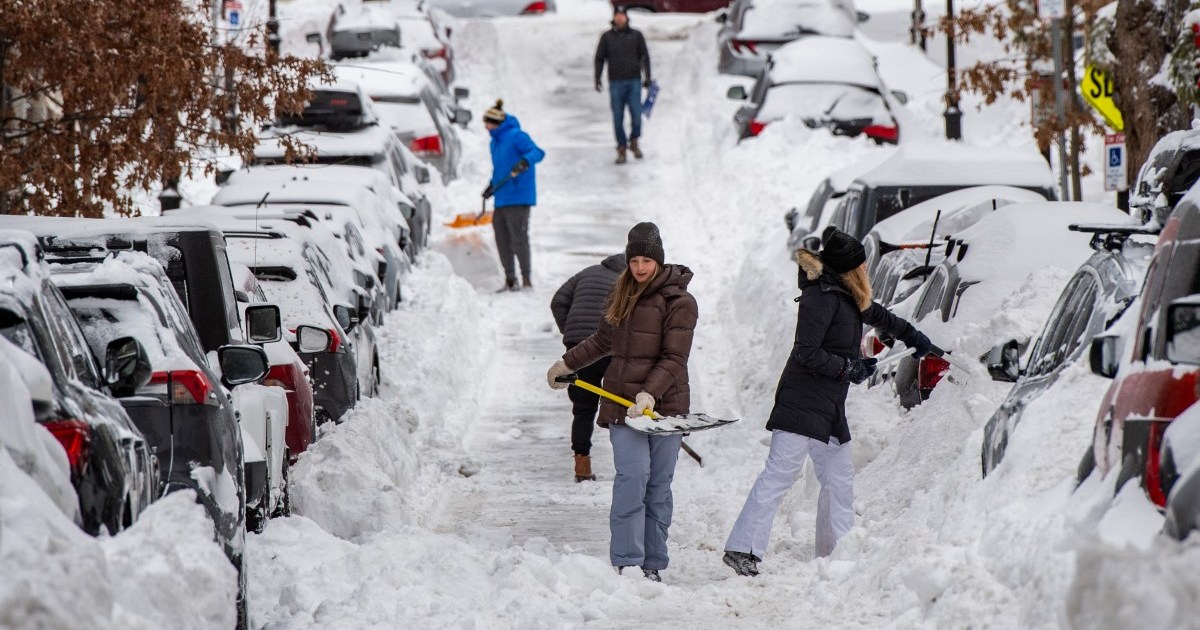
Many in the United States faced another frigid night of freezing temperatures, power outages, and transportation issues as a colossal winter storm was blamed for the deaths of some 30 people across several states in the country.
The Associated Press news agency reports that the storm has been linked to the deaths, with causes ranging from hypothermia to weather-related traffic, sledging, and snowplough accidents.
Recommended Stories list of 3 itemsend of list
The deaths, according to a compilation of state government and local media reports late on Monday, included eight people who were found outdoors in the course of the freezing weekend in New York City.
Two people were reported as having been run over by snowploughs in Massachusetts and Ohio, while sledging accidents killed teenagers in Arkansas and Texas. A woman was also found dead by police after she was last seen leaving a Kansas bar.
Health authorities in the Southern state of Louisiana reported that two people had died from hypothermia, and icy weather brought down power lines in Tennessee.
At least 20 states and the capital, Washington, DC, were under states of emergency to deploy emergency personnel and resources.
More than 12,000 flights were delayed or cancelled nationwide on Monday, according to flight tracker flightaware.com. About 285 more scheduled flights on Tuesday have already been cancelled, according to the website.
On Sunday, 45 percent of flights were cancelled, making it the highest day for cancellations since the COVID-19 pandemic, according to aviation analytics firm Cirium.
The storm was set to become the US’s costliest severe weather event since the Los Angeles-area wildfires in early 2025, with preliminary damage and economic losses estimated at $105bn to $115bn, AccuWeather said.
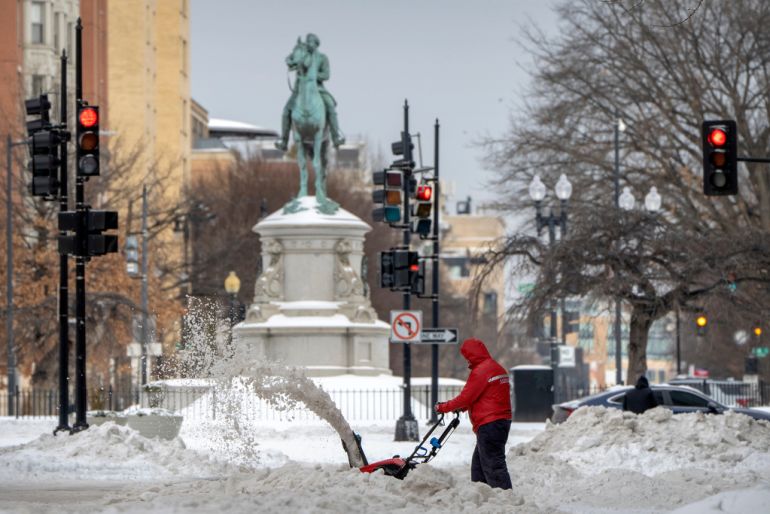 A worker uses a snowblower to clear a snow-covered pavement in downtown Washington, DC, a day after a snow and ice storm on Monday, January 26, 2026 [Mark Schiefelbein/AP Photo]Flight cancellations are expected to increase
As of Monday evening, the website poweroutage.com reported that more than 630,000 houses and businesses were without electricity across the US, most of them concentrated in the South, where the storm brought freezing rain and temperatures.
White House Press Secretary Karoline Leavitt told reporters on Monday that President Donald Trump had approved 12 federal emergency disaster declarations, freeing up additional resources in states such as Arkansas, Georgia, Indiana, Kentucky, Louisiana, Maryland, Mississippi, North Carolina, South Carolina, Tennessee, Virginia, and West Virginia.
“These declarations will help state-led efforts of turning power back on, clearing roads for emergency services, and keeping communities safe,” said Leavitt.
The AFP news agency reported that about 190 million people in the US were under some form of extreme cold alert, citing a statement from the National Weather Service (NWS).
Heavy snow has also filled roads, impeding local travel and prompting warnings from the Federal Emergency Management Agency and local authorities for residents to stay inside if possible.
The New York state branch of the NWS said on Monday that temperatures are expected to remain below freezing throughout the week, but any remaining snowfall would be light and was expected to end on Monday morning or early afternoon.
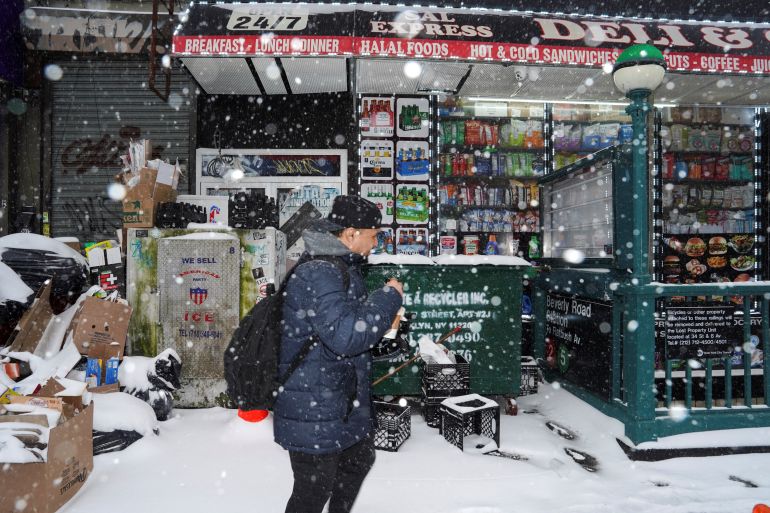 A pedestrian walks past a deli and grocery store in Brooklyn during Winter Storm Fern [Bing Guan/Reuters]
The storm system was the result of a stretched polar vortex, an Arctic region of cold, low-pressure air that normally forms a relatively compact, circular system but sometimes morphs into a more oval shape, sending cold air pouring across North America.
Scientists say the increasing frequency of such disruptions may be linked to climate change, though the debate is not settled, and natural variability plays a role.
Dave Radell, an NWS meteorologist based in New York, told AFP that the character of this storm’s snow was “very dry” and “fluffy”, meaning the wind could lash it around with ease, impeding roadway-clearing efforts and visibility.
“That makes it even more challenging,” he said.