ARE WE READY FOR WAR?
For the British Army, the balance between mass and capability has too often been treated as a binary
Are we ready for war? Welcome to The i Paper’s opinion series in which our writers tackle a grim question that, until recently, few had thought to consider.
• Ray Mears: This is the golden rule of preparing for war
• Britain is closer to nuclear war than you think. This is how it will unfold
• This generation of Britons couldn’t handle the death toll of a modern war
• Russia is aiming to control the UK. It would tear society apart
As the threat of war grows daily, questions about whether we’re ready to fight are getting more and more pointed. Our unseemly haste to spend the “peace dividend” at the end of the Cold War has left us with our smallest standing Army since Waterloo and barely 150 tanks of the last century’s vintage. Victory is far from assured.
But I will try and unpack where we are with our tanks. I have spent thousands of hours in them during my Army career and many more studying and writing about them.
A hundred and eleven years after Cambrai, where the machines helped win a key battle in the First World War, it surprises many that we are still debating the tank. Superficially, it has changed little. In reality, it has adapted continuously, and it must continue to do so if it is to remain relevant to the British Army for the remainder of this century and beyond.
We now operate in a battlespace where capability evolves in days and weeks, not the decades normally associated with defence procurement. Against that backdrop, it is fashionable to argue that a complex system such as the tank, historically slow to develop and expensive to field, has had its day. I disagree. In an era dominated by cheap, expendable drones and off-the-shelf munitions, the physical resilience, firepower, and psychological effect of the tank will endure long after the latest £500 drone has been neutralised.
The enduring “holy trinity” of tank design – firepower, protection, and mobility – remains valid. But it must be applied with a clear-eyed understanding of today’s threats. It is of little use for Challenger 3 to outgun a T-90 if it cannot defend itself against Russian first-person view (FPV) drones.
Our most likely foe in the next war is Russia and if we do not increase our military numbers and adapt our tactics, techniques and procedures they could indeed destroy one of the backbones of our defence: our tanks and armoured manoeuvre capabilities. But it does not have to be like this, and we still may have just enough time if we act now.
The current focus, rightly, is defeating FPV drones, which account for the majority of tank losses in Ukraine. Active protection systems, hard-kill solutions which can destroy multiple attacking drones simultaneously, and emerging laser technologies are already working on the problem. It will not be long before the image of a cheap drone dropping a hand grenade through an open hatch is consigned to history, restoring freedom of movement and battlefield dominance to armoured forces.
For the British Army, the balance between mass and capability has too often been treated as a binary. History reminds us that “quantity has a quality all of its own”. Technically superior platforms, from the Tiger tanks of the Third Reich onwards, have captured the imagination, but wars are rarely won by excellence alone. The 49,000 American Sherman tanks, and the tens of thousands of Russian T-34s, ultimately decided the Second World War.
The modern battlefield, however, is different. Western tanks such as Leopard 2 and Challenger 2, though few in number, have had a disproportionate impact in Ukraine. Sophistication, when properly employed, still matters. At the same time, we see mass re-emerging through drones: cheap, simple systems deployed in their thousands, overwhelming defences through sheer volume.
This raises a critical question: is a fleet of 150 Challenger 3s sufficient for Britain? History suggests it may not be. With approximately 100 additional Challenger 2 hulls available, a force of around 250 Challenger 3s begins to approach credible mass. This would involve putting the new Challenger 3 turret on the Challenger 2 hull and doing the necessary technical upgrades to ensure they work seamlessly together.
Beyond that lies the question of autonomy. An unmanned or optionally crewed tank, accepting greater risk in survivability, may offer the flexibility and scalability required for future conflict. In other words, if there are not humans in the tank, we do not have to spend so much effort in terms of heavy armour to protect them.
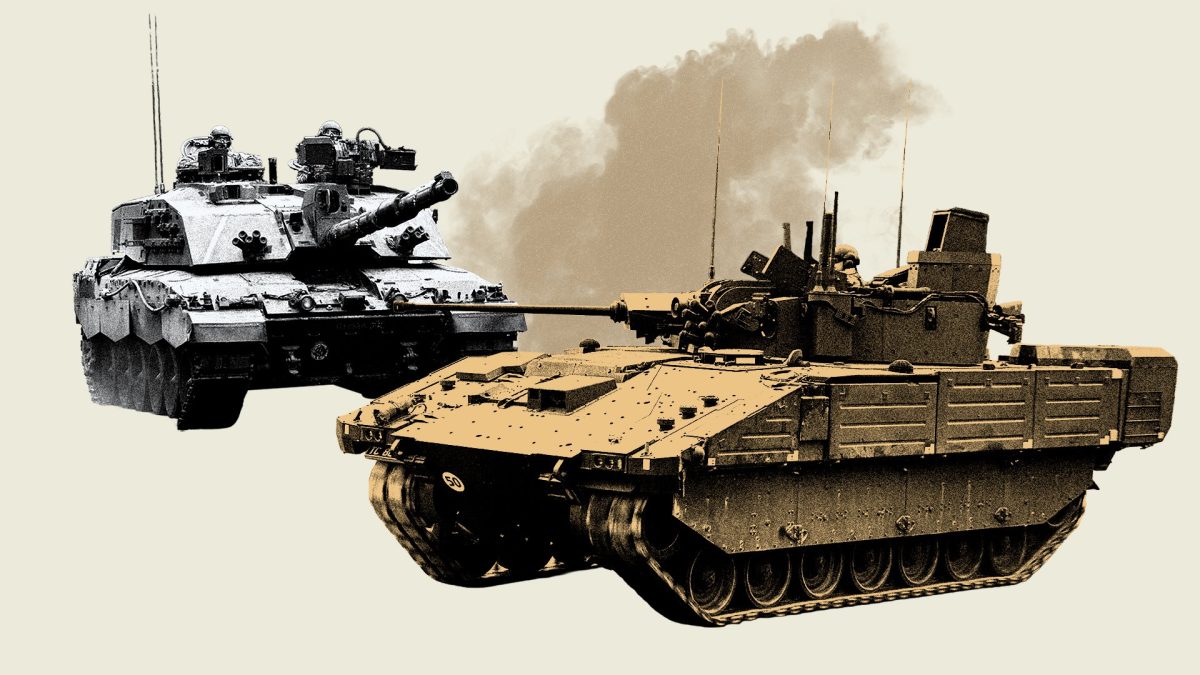
However, the new Ajax armoured recce platform, also a tank killer, combined with Challenger 3, airpower, drones and modern gunnery, restores a genuine all-arms armoured manoeuvre capability, so lacking for our Armed Forces for the last decade or so.
Ukraine is a case study in rapid innovation, driven by seasoned frontline soldiers who can quickly distinguish between genuine capability and technological distraction. Much of the criticism aimed at our ability to absorb these lessons is misplaced. The British Army is adapting, quietly, but carefully.
I have deliberately described Ajax, the much talked about new recce-strike capability, as a light tank as well as a reconnaissance platform, a characterisation that will irritate historians and some retired tank commanders (including, perhaps, myself). It would be designated a medium to heavy tank in the Second World War as it happens. But facts matter.
The 40mm cannon, firing advanced armour-piercing, high-explosive and air-burst anti-drone ammunition at up to 160 rounds per minute, delivers lethality that exceeds much of what we are currently seeing on the Ukrainian battlefield. Anti-armour may not be its primary role, but as a secondary function it is formidable. The performance of the US Bradley against Russia’s T-90s underlines the point: well-sensored, well-armed platforms are killing tanks.
Claims that drones alone herald the death of the tank are nothing new. Similar arguments accompanied the advent of airpower a century ago. My predecessors in the Royal Tank Regiment faced top-attack, aerial observation, and early aircraft, and yet the tank endured. Drones are simply airpower by another means.
Today’s tank will operate with its own ecosystem of drones: for reconnaissance, targeting, battle damage assessment, and counter-drone operations. Integration, not replacement, is the lesson.
Finally, it is astonishing that we have not embraced electric or hybrid propulsion for armoured vehicles. Electric motors were explored over 80 years ago; today they underpin everything from cars to aircraft. Reduced thermal and acoustic signatures, improved torque, and logistical advantages make hybrid or electric tanks not only feasible, but desirable. Coupled with autonomy, they could fundamentally reshape armoured warfare.
When it comes to armoured manoeuvre warfare, which is still the gold standard for the land battle as being proven in Ukraine, Britain is strong. All our component parts are excellent: our new tank, Challenger 3, our new recce-strike platform, Ajax, our drones, airpower and artillery. But we just do not have enough of them or dedicate the training time we should to perfecting this most challenging art of war. This is all possible but will require us spending 5 per cent of GDP, today, not in some distant date, which at the moment appears reckless in the extreme.
The tank is not obsolete. But complacency would be fatal. Adaptation, rapid, ruthless, and informed by real combat, is the price of relevance.
Hamish de Bretton-Gordon is a former commander of the 1st Royal Tank Regiment and the author of ‘Tank Command’, published 4 June, 2026
Your next read