Years before the war in Sudan began, a young man stood in a street and read a poem. He was taking part in one of the many pro-democracy demonstrations that would eventually lead to the fall of long-time dictator Omar al-Bashir in 2019. The young man’s poem is about his mother making coffee: how she roasts beans, how she boils water. She asks him about people he knew who had been killed in the demonstrations. He tells her: “Yesterday I had coffee with them”.
“It’s very important for us to show people our culture. A lot of people don’t know about Sudan”
“Coffee is more than a drink in Sudan,” says artist Isra Elhag. It’s one of the first things she says to me shortly after I arrive at her exhibition ‘Senses of Sudan’ at the MShed. She shows me the video clip from the demonstration and tells me that the poet, like many young activists, was killed by the Sudanese army.
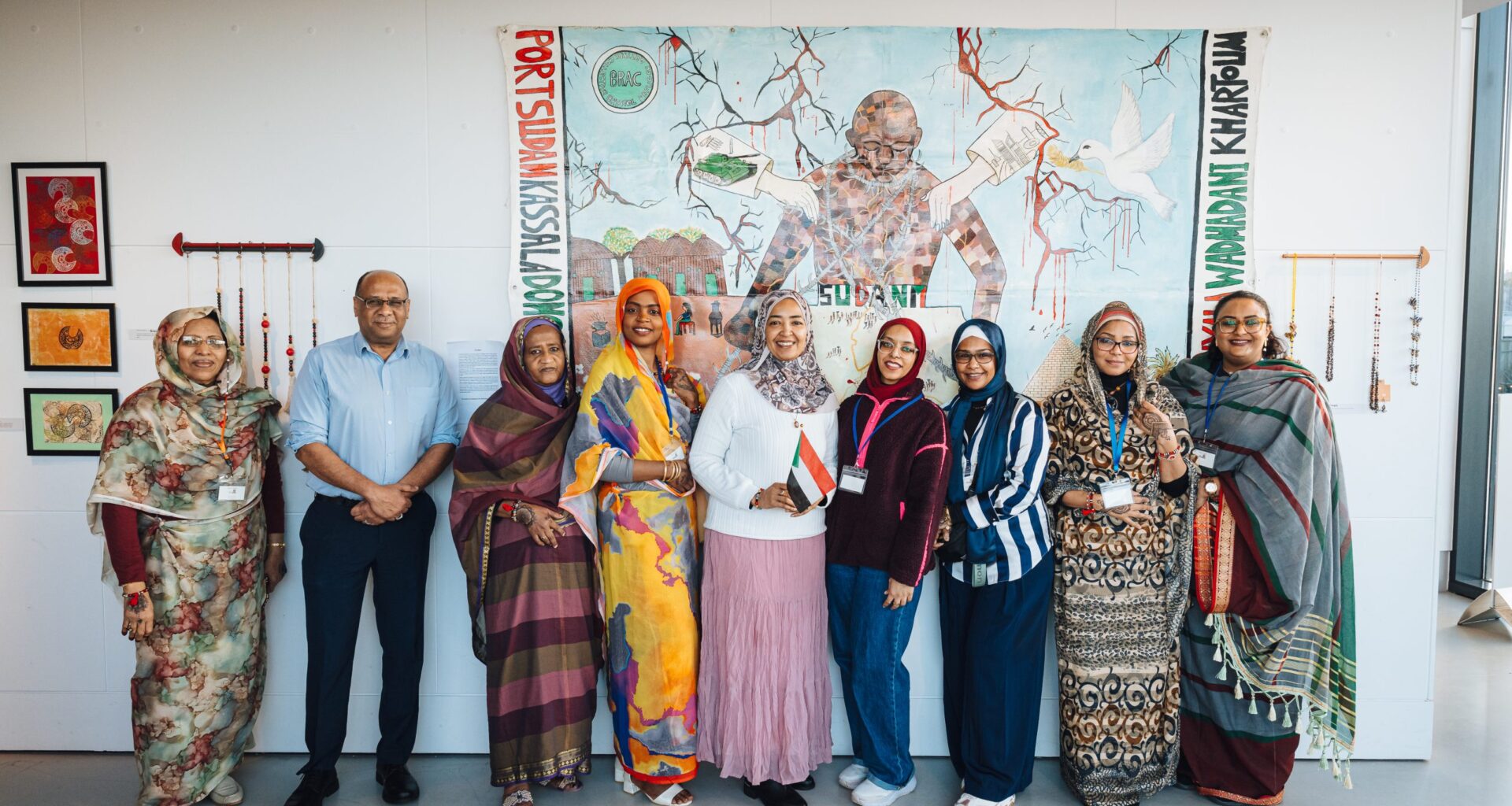
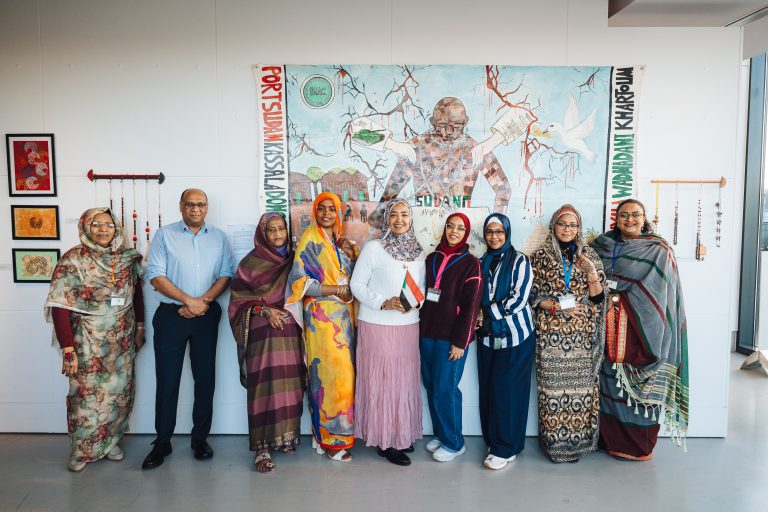
Elhag is a member of the Bristol Refugee Arts Collective (BRAC) and a mother of two. We meet in the M Shed to talk about her work and the exhibition she created alongside six Sudanese artists based in Bristol to reflect their feelings, thoughts and hopes regarding the ongoing war in their home country.
But before our interview begins, Elhag hands me a date and invites me to have some coffee.
Connecting over coffee
We sit down on a colourful carpet that stands out against an otherwise sober gallery space on the M Shed’s first floor. Large windows look out over the harborside. Another Isra, Isra Ibrahim, who makes traditional Sudanese coffee for a living and is also part of the collective, hands me a small cup. The coffee is spiced with ginger, cinnamon, cloves and cardamon. Two visitors join us on the floor and try the coffee as well.
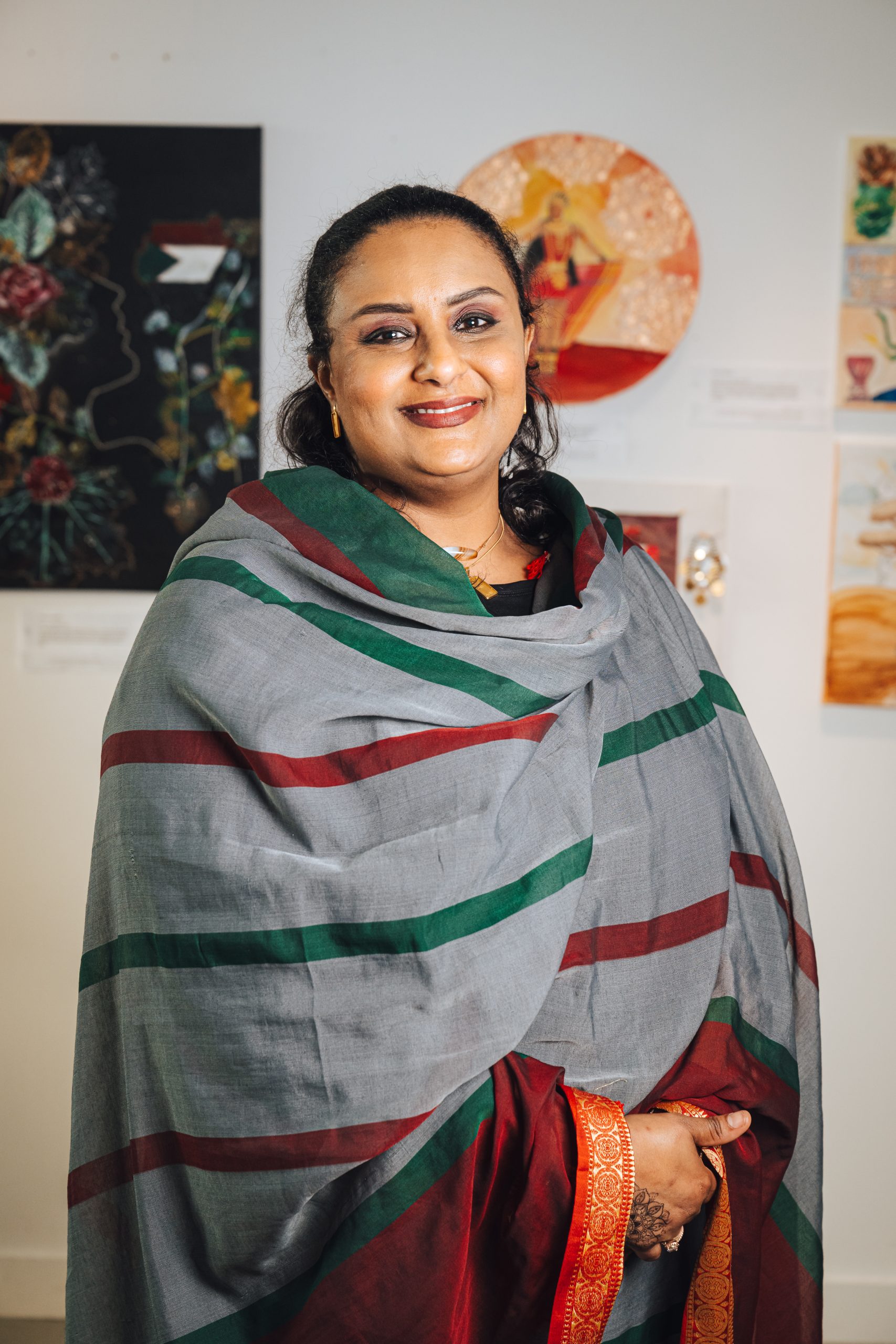 Isra Elhag at the M Shed exhibition.
I’m trying it for the first time. Although I have an Arabic name that is quite common in Sudan, among other places, I come from a white German family. I know very little about the country and, apart from reports of a worsening humanitarian crisis, very little about the war. Why is my attention to deadly conflicts around the world so selective? I wonder and listen.
The jabana, the preparation and drinking of coffee, is a traditional ceremony and social gathering in Sudan, Ibrahim explains. “It takes patience,” she says. The beans must be roasted, the spices ground by hand, and the water boiled. People in different regions of Sudan use different types of pots. Three cups of coffee must be drunk.
It is mostly women who gather, invite guests, and spend hours talking about their worries and hopes, Isra Elhag adds. “Even when life is rushed, it’s not the end of the world,” she says. “You can sit, you can have coffee, you can talk, and you can leave. And you feel, ‘oh my God, it meant a lot to me’”.
For generations, the coffee ritual has been a space for connection. Now, it has also become a space for the Sudanese diaspora to cope with the war back home.
Fabrics, dresses, spices and herbs
That’s why Isra Elhag, Isra Ibrahim, Nijood Hassenin, Nafesa Elmahina, Sana Elgoraish, Shadia Idriss Elbanna and Sherien Elsheikh decided to have the coffee ceremony at their exhibition. They are artists, designers, an architect, a photographer. Some have lived in Bristol for several years, others have just arrived. Besides the coffee corner, their exhibition contains very diverse pieces, from a huge canvas banner to fabrics, wedding dresses, spices, herbs and rugs.
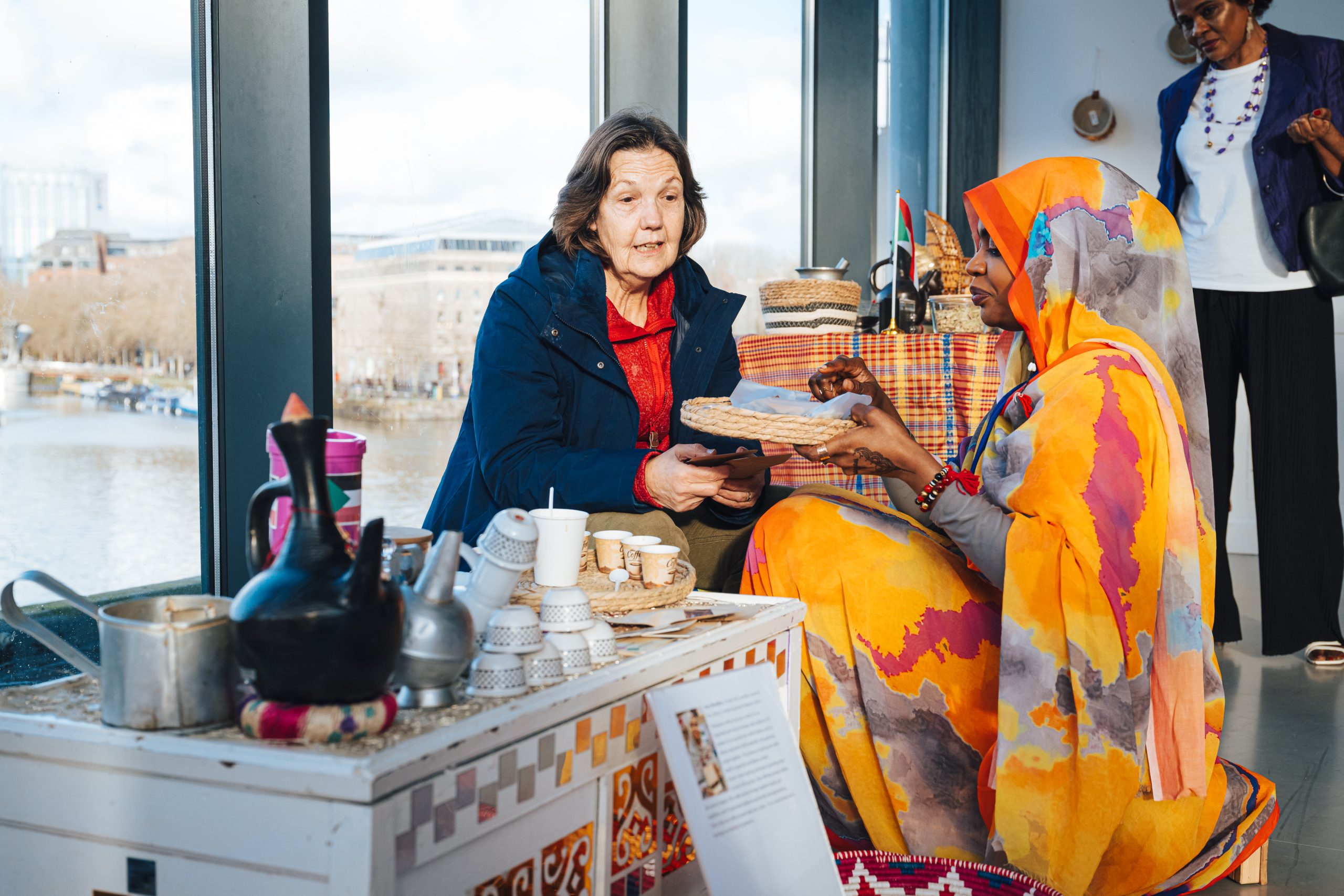 Two women at the coffee corner, M Shed.
“It’s very important for us to show people our culture. A lot of people don’t know about Sudan” says Sana Elgoraish, a designer of traditional Sudanese clothes and a member of BRAC. Her contribution to the exhibition is a handcrafted red wedding dress.
The wedding ceremony, called jertik, has become more important since the war, Sana tells me, as millions of forcibly displaced Sudanese people try to maintain their traditions. “People still do the traditional way of the wedding… in Saudi Arabia, Egypt, Ethiopia, or Bristol — wherever they are.”
“Due to the war in Sudan, our families are torn apart. Two of my daughters are now in Egypt. My son is in Dubai. Me, I was evacuated to the UK”, says Shadia Idriss Elbanna, an accessories designer. “Art and creativity became a way for me to express my difficult experiences, topics like parenthood, and to express identity”.
Isra Elhag, who originally studied banking, but got involved in drawing at a young age, says she focused on drawing faces, mostly women, when the war started. “It’s important for me to draw people who look like me”, she says. “It reminds me of the place I lived in, of the people I knew.”
‘The exhibition is about awareness’
Another BRAC member, Sherien Elsheikh, who studied graphic design and interior design in Sudan, says the exhibition is about holding on to memories of a country “that is being destroyed in front of our eyes”.
“Imagine all your memories destroyed. All your parents’ memories destroyed — everything they have.” She tells me she lost several family members in the war. “When you lose someone, you can feel it more than anything”, she says and stops speaking for a moment.
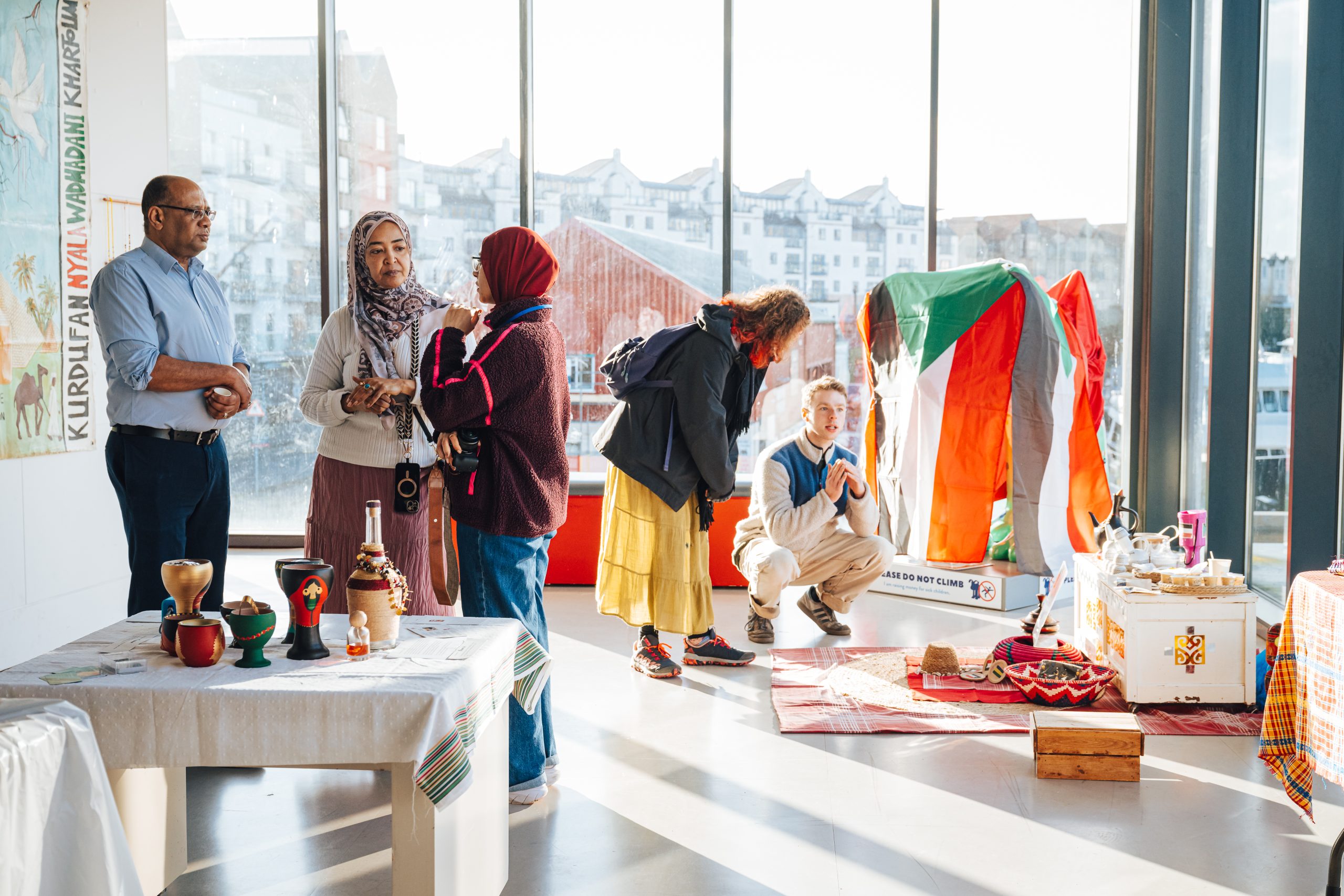 Artists and visitors at the Sense of Sudan exhibition, M Shed.
“This exhibition is about awareness”, says Nafesa Elmahina, a street photographer who just moved to Bristol from Belfast. “People know there is a war going on there, but there is not good coverage in the media. Here they can hear the story from the people from Sudan.”
The gallery space is crowded with visitors. Many of them are chatting with members of the art collective, laughing and drinking coffee.
In the middle of the exhibition space a comment book is prominently displayed on a narrow table. Nijood Hassenin, an interior and textile designer newly arrived in Bristol, designed it. Covered in traditional fabric, it’s a work of art in itself. “It’s a special fabric we use for wedding dresses,” Hassenin explains. “It’s a symbol for happiness”.
Amira Klute is a journalist with the German newspaper taz, based in their local desk in Hamburg. She spent two months working with the Cable in early 2026.
Independent. Investigative. Indispensable.
Investigative journalism strengthens democracy – it’s a necessity, not a luxury.
The Cable is Bristol’s independent, investigative newsroom. Owned and steered by more than 2,600 members, we produce award-winning journalism that digs deep into what’s happening in Bristol.
We are on a mission to become sustainable, and to do that we need more members. Will you help us get there?