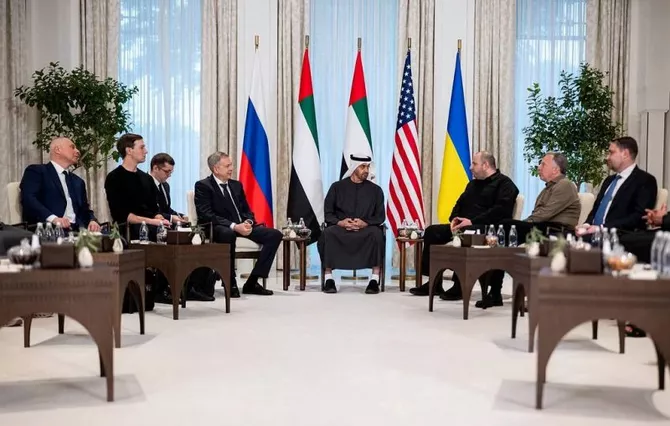
On February 1, 2026, a second round of peace talks involving Russia, Ukraine, and the United States is set to open in Abu Dhabi, the capital of the United Arab Emirates, according to official statements from Moscow. The meeting follows an initial trilateral dialogue held in the same city in late January and represents one of the most significant diplomatic efforts to date aimed at ending the war triggered by Russia’s full-scale invasion of Ukraine in February 2022.
Nearly four years into the conflict, the talks arrive against a backdrop of entrenched military positions, enormous human and economic losses, and deep mistrust between the parties. While the very fact that senior representatives from all three countries are again meeting at the same table is notable, expectations remain cautious. The first round produced no tangible agreements, and the war has continued unabated. As the second meeting approaches, the central question remains whether this diplomatic track can realistically evolve into a pathway toward peace or whether it will remain a limited exercise in crisis management during an ongoing war.
The First Trilateral Meeting: A Symbolic Breakthrough With Limited Results
The inaugural trilateral peace talks between Russia, Ukraine, and the United States took place in Abu Dhabi on January 23-24, 2026. These discussions were widely described as historic, not because of any immediate outcomes, but because they marked the first time since the start of the war that representatives from all three parties engaged in direct, structured dialogue in a single forum. For much of the conflict, communication had been fragmented, indirect, or conducted through intermediaries, making sustained negotiations difficult.
During the two-day session, delegations addressed a broad range of issues related to ending the war. These included potential ceasefire mechanisms, post-conflict security arrangements, humanitarian concerns, and the long-term political framework that might underpin a settlement. The United States acted as the primary mediator, facilitating exchanges between Russian and Ukrainian negotiators who, despite years of hostility, remained engaged throughout the talks.
One of the central topics was territory. Russia reiterated its claims over parts of eastern Ukraine, particularly the Donbas region, and emphasized proposals it has previously advanced in various diplomatic settings. Among these was what Russian officials describe as a framework that would formalize control over territories currently occupied by Russian forces. Ukraine, for its part, categorically rejected any arrangement that would legitimize the loss of its internationally recognized territory, reaffirming its position that sovereignty and territorial integrity are non-negotiable.
Despite these sharp disagreements, all sides characterized the talks as “constructive.” This language reflected not progress on substance, but rather the tone and continuity of the discussions. Importantly, the meeting concluded with a mutual decision to reconvene, paving the way for the second round scheduled for February 1. In a conflict where dialogue has often broken down entirely, the agreement to continue talks was itself seen as a modest but meaningful step.
At the same time, the absence of concrete outcomes underscored the limitations of the first meeting. No ceasefire was announced, no joint statement outlining agreed principles was issued, and no roadmap toward a political settlement was adopted. The talks demonstrated that dialogue was possible, but they also highlighted how deeply divided the parties remain on the core questions that have driven the war since 2022.
Diplomacy Under Fire: Negotiations Amid Continuing Hostilities
The Abu Dhabi talks unfolded while the war on the ground continued with intensity. Even as negotiators met, Russian forces carried out missile and drone strikes against multiple Ukrainian cities, including Kyiv and Kharkiv. These attacks damaged critical infrastructure, disrupted electricity supplies for hundreds of thousands of civilians, and caused casualties. Ukrainian officials accused Moscow of deliberately escalating military pressure to gain leverage and to signal that negotiations would not constrain its battlefield strategy.
The continuation of large-scale military operations during diplomatic engagements highlights a defining feature of this conflict: diplomacy and warfare are proceeding simultaneously rather than sequentially. Unlike conflicts where negotiations follow a clear military stalemate or ceasefire, the Russia-Ukraine war has seen talks attempted while both sides continue to seek advantages on the battlefield. This dynamic complicates trust-building and raises doubts about the sincerity of diplomatic efforts.
Casualty figures illustrate the scale of the conflict and the urgency of any peace initiative. Various assessments suggest that losses on both sides have been severe, with some estimates pointing to extremely high numbers of killed and wounded personnel. These figures are contested and difficult to verify independently, but there is little dispute that the human cost has been immense. Ukrainian civilian casualties, displacement, and infrastructure destruction continue to shape public opinion and political calculations in Kyiv, while Russia faces its own social and economic pressures from prolonged mobilization and sanctions.
The persistence of violence during talks sends mixed signals. On one hand, it reinforces skepticism among observers who argue that negotiations are being used tactically rather than as a genuine attempt to end the war. On the other, proponents of continued dialogue contend that sustained talks are necessary precisely because the fighting shows no sign of stopping on its own. From this perspective, Abu Dhabi represents an effort to prevent further escalation and to explore whether incremental diplomatic progress is possible even in the absence of a ceasefire.
What the Talks Have Delivered So Far – and Where They Fall Short
An assessment of the first trilateral meeting reveals a clear divide between symbolic achievements and substantive limitations.
On the positive side, the talks broke a prolonged period of diplomatic stagnation. For months prior, engagement had been limited to bilateral or indirect channels, with little prospect of coordinated dialogue involving all key actors. The Abu Dhabi meeting re-established a formal framework in which territorial, security, and political issues could at least be discussed openly. It also demonstrated a shared willingness to keep talking, an important prerequisite for any eventual settlement.
The involvement of the United States as a mediator was another notable outcome. Washington’s role signaled that it continues to see diplomacy as a necessary complement to military and economic support for Ukraine. By facilitating direct exchanges, the U.S. helped reduce the risk of miscommunication and provided a platform for exploring potential compromises, however distant they may currently appear.
However, these achievements remain largely procedural. Substantively, the talks fell short on every major issue. The absence of a ceasefire means that civilians and combatants alike remain exposed to ongoing violence. No agreement was reached on confidence-building measures, such as humanitarian corridors or localized pauses in fighting, that might have signaled a shift in the conflict’s trajectory.
Territorial disputes remain the most intractable obstacle. Russia’s demands and Ukraine’s red lines are fundamentally incompatible, and the first meeting did little to narrow that gap. Security guarantees, another crucial element of any settlement, were discussed only in broad terms, reflecting the difficulty of reconciling Ukraine’s desire for robust international guarantees with Russia’s opposition to arrangements it views as threatening its own security interests.
Perhaps most significantly, the continuation of hostilities during and after the talks reinforced perceptions of a disconnect between diplomatic language and military reality. While all sides spoke of constructive engagement, actions on the ground suggested that none were prepared to prioritize negotiations over battlefield considerations.
February 1 and Beyond: Prospects, Constraints, and the Long Road Ahead
As the second round of talks approaches, analysts and officials alike caution against inflated expectations. Few anticipate a breakthrough agreement in Abu Dhabi on February 1. Instead, the meeting is widely seen as another step in a protracted diplomatic process that may take months or even years to yield results, if it does at all.
There are reasons for cautious optimism. The decision to hold a second round indicates that none of the parties have abandoned the diplomatic track. Continued engagement suggests a recognition that a purely military resolution remains elusive and that the costs of prolonged war are mounting. The talks also provide a structured setting in which proposals can be refined, misunderstandings clarified, and potential areas of compromise explored, even if agreement remains distant.
At the same time, formidable obstacles persist. Territorial claims continue to define the core impasse, and neither side has shown willingness to fundamentally alter its position. Ongoing combat undermines trust and raises questions about whether negotiations are being pursued in good faith or primarily as a means of managing international perceptions.
Domestic political considerations further complicate the picture. Leaders in Moscow, Kyiv, and Washington must contend with constituencies that are skeptical of compromise or that demand accountability for the war’s immense toll. Any agreement perceived as conceding too much could carry significant political risks, limiting negotiators’ flexibility at the table.
Looking ahead, meaningful progress may require several additional elements. A reduction in active combat, even on a limited scale, could help build confidence and demonstrate commitment to diplomacy. The involvement of additional stakeholders, including European partners, international organizations, and possibly the United Nations, may be necessary to support and legitimize any eventual framework. Addressing security guarantees in a way that balances Ukraine’s need for protection with broader regional stability concerns will also be critical.
In sum, the Abu Dhabi talks represent neither a clear turning point nor an empty gesture. They occupy an uneasy middle ground: a forum for dialogue in the midst of a war that shows little sign of ending soon. The first meeting demonstrated that engagement is possible but insufficient on its own. The second round on February 1, 2026, will test whether sustained diplomacy can gradually move beyond symbolism toward substance – or whether it will remain overshadowed by the realities of a conflict that continues to reshape Ukraine, Russia, and the wider European security landscape.