 Company Logo
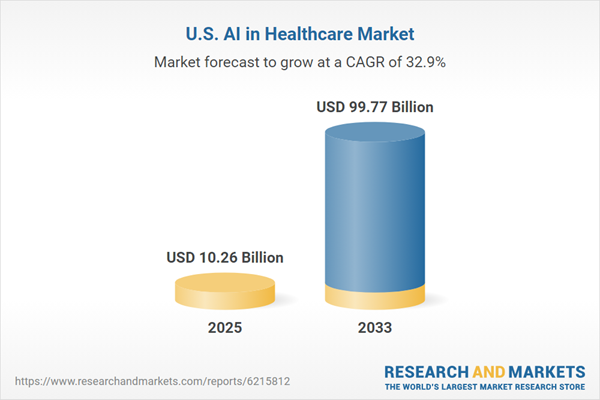
The United States AI in Healthcare Market is projected to soar from US$ 10.26 billion in 2025 to US$ 99.77 billion by 2033, growing at a CAGR of 32.88%. This growth is driven by digital transformation, precision medicine demand, government support, and the need for cost-effective healthcare. AI applications like predictive analytics and medical imaging improve care efficiency and accuracy. The industry’s expansion benefits from AI-enhanced clinical decision-making, personalized medicine, and NLP advancements. Key challenges include data privacy, regulatory compliance, and high costs. California, Texas, New York, and Florida lead in adoption, bolstering U.S. AI healthcare innovation.
U.S. AI in Healthcare Market
U.S. AI in Healthcare Market · GlobeNewswire Inc.
Dublin, Jan. 28, 2026 (GLOBE NEWSWIRE) — The “United States AI in Healthcare Market Report by Offering, Technology, Application, End User, States and Company Analysis 2025-2033” has been added to ResearchAndMarkets.com’s offering.
The United States AI in Healthcare Market is expected to reach US$ 99.77 billion by 2033 from US$ 10.26 billion in 2025, with a CAGR of 32.88% from 2025 to 2033. Rapid digital transformation, growing demand for precision medicine, robust government support, and the need for affordable healthcare solutions are the main factors propelling the U.S. AI in healthcare market. National adoption is further accelerated by expanding healthcare applications and increasing investments in AI innovation.
In order to enhance patient care, diagnosis, and treatment planning, artificial intelligence (AI) in healthcare uses sophisticated algorithms, machine learning, and data analytics. AI gives doctors the ability to rapidly evaluate complicated medical data, providing insights for early disease detection and tailored treatment suggestions. Predictive analytics, drug development, virtual health assistants, and medical imaging are a few examples of applications. AI lowers costs while increasing access to healthcare by automating repetitive tasks and boosting clinical accuracy. AI is emerging as a key instrument for enhancing productivity, patient outcomes, and creativity in medical and administrative operations as American healthcare organizations continue to embrace digital transformation.
The demand for better diagnosis accuracy, the growing use of digital health technology, and developments in machine learning and data integration are driving the growth of the AI in healthcare market in the United States. AI is being used by hospitals and research facilities for customized medicine, predictive analytics, and medical imaging, which improves results and lowers expenses. The FDA’s support for AI-based medical devices and government programs encouraging healthcare digitization further accelerate industry growth. The United States is becoming a global leader in healthcare innovation as a result of the acceleration of AI integration brought about by rising healthcare costs and the expansion of big data availability.
Growth Drivers for the United States AI in Healthcare Market
Expanding Integration of AI in Clinical Decision-Making
The integration of AI into clinical decision-making is transforming how healthcare is delivered in the United States. Advanced algorithms support physicians in diagnosing diseases, predicting treatment outcomes, and identifying at-risk patients with greater speed and accuracy. AI-driven systems enhance clinical workflows by processing vast datasets – including imaging scans, lab results, and patient histories – to deliver actionable insights in real time.
In April 2025, Tempus partnered with Illumina to merge AI-driven clinical data with genomic sequencing, strengthening precision medicine and enabling more personalized treatment decisions. This integration of genomic and clinical intelligence represents the next step in AI-driven healthcare. Hospitals and research institutions increasingly rely on AI for decision support, ensuring improved efficiency, reduced diagnostic errors, and optimized care pathways. As AI becomes deeply embedded in healthcare ecosystems, it is redefining evidence-based medicine by transforming data into precise, patient-centered insights that enhance both outcomes and system performance.
Growing Adoption of Personalized and Precision Medicine
The rapid advancement of personalized and precision medicine is a major driver of AI adoption in the U.S. healthcare market. Artificial intelligence enables the analysis of genetic, environmental, and lifestyle data to design individualized treatment plans tailored to each patient’s unique profile. By integrating genomic sequencing with machine learning, clinicians can better predict disease risk, select targeted therapies, and monitor treatment efficacy in real time.
AI-powered precision medicine platforms are being deployed across oncology, neurology, and cardiology to identify molecular markers and optimize care delivery. The ongoing digitization of health records and genomic data provides a robust foundation for predictive modeling. As healthcare shifts from reactive to preventive and personalized care, AI tools empower providers to move beyond “one-size-fits-all” approaches. This data-driven, patient-focused model not only improves therapeutic accuracy but also reduces costs and enhances long-term healthcare outcomes across the United States.
Advancements in Natural Language Processing (NLP)
Advancements in Natural Language Processing (NLP) are accelerating AI adoption across the U.S. healthcare sector by transforming how unstructured clinical data is utilized. NLP algorithms can interpret physician notes, medical transcripts, and patient communications to extract valuable insights for diagnosis, treatment, and patient monitoring. These capabilities streamline documentation, enhance care coordination, and improve decision accuracy. Additionally, NLP supports conversational AI tools that assist clinicians with real-time information retrieval and patients with symptom checking or post-care guidance.
In December 2024, California enacted Assembly Bill 3030, requiring providers to disclose when generative AI is used in patient communication – highlighting the growing integration of AI-driven language tools in healthcare. This legislation underscores both the potential and responsibility of NLP technologies. As hospitals and digital health platforms continue deploying AI-enabled communication systems, NLP plays a crucial role in bridging human and machine understanding, improving efficiency, compliance, and patient engagement across the care continuum.
Challenges in the United States AI in Healthcare Market
Data Privacy and Regulatory Compliance
One of the major challenges in the U.S. AI in Healthcare market is ensuring data privacy and compliance with complex regulations such as HIPAA and emerging state-specific laws. AI systems rely on vast amounts of sensitive patient information, creating potential risks of data breaches and unauthorized access. Ensuring transparency and maintaining ethical AI practices are also critical as algorithms increasingly influence medical decisions. Healthcare organizations face difficulties balancing innovation with stringent compliance requirements.
Additionally, the lack of standardized data-sharing protocols limits interoperability between systems, hindering AI’s full potential. Strengthening cybersecurity infrastructure, implementing robust consent mechanisms, and developing clear AI governance frameworks are essential to mitigate these challenges.
High Implementation Costs and Skill Gaps
The high cost of implementing AI technologies and the shortage of skilled professionals pose significant barriers to market growth. Integrating AI into healthcare systems requires substantial investment in software, hardware, and staff training. Many small and mid-sized hospitals struggle to afford these technologies, leading to uneven adoption across regions. Moreover, the healthcare workforce faces a steep learning curve in using AI-driven tools effectively, creating a gap between technical innovation and clinical application. Limited collaboration between technology providers and medical practitioners further slows deployment. Addressing these issues through affordable AI solutions, educational programs, and cross-sector partnerships is crucial to ensure equitable access and sustainable growth across the healthcare ecosystem.
Key Attributes:
Report Attribute
Details
No. of Pages
200
Forecast Period
2025 – 2033
Estimated Market Value (USD) in 2025
$10.26 Billion
Forecasted Market Value (USD) by 2033
$99.77 Billion
Compound Annual Growth Rate
32.8%
Regions Covered
United States
Key Topics Covered:
1. Introduction
2. Research & Methodology
2.1 Data Source
2.1.1 Primary Sources
2.1.2 Secondary Sources
2.2 Research Approach
2.2.1 Top-Down Approach
2.2.2 Bottom-Up Approach
2.3 Forecast Projection Methodology
3. Executive Summary
4. Market Dynamics
4.1 Growth Drivers
4.2 Challenges
5. United States AI In Healthcare Market
5.1 Historical Market Trends
5.2 Market Forecast
6. Market Share Analysis
6.1 By Offering
6.2 By Technology
6.3 By Application
6.4 By End-User
6.5 By States
7. Offering
7.1 Hardware
7.2 Software
7.3 Services
8. Technology
8.1 Machine Learning
8.2 Context Aware Computing
8.3 Natural Language Processing
8.4 Others
9. Application
9.1 Robot-Assisted Surgery
9.2 Virtual Nursing Assistant
9.3 Administrative Workflow Assistance
9.4 Fraud Detection
9.5 Dosage Error Reduction
9.6 Clinical Trial Participant Identifier
9.7 Preliminary Diagnosis
9.8 Others
10. End-User
10.1 Healthcare Providers
10.2 Pharmaceutical and Biotechnology Companies
10.3 Patients
10.4 Others
11. Top States
11.1 California
11.2 Texas
11.3 New York
11.4 Florida
11.5 Illinois
11.6 Pennsylvania
11.7 Ohio
11.8 Georgia
11.9 New Jersey
11.10 Washington
11.11 North Carolina
11.12 Massachusetts
11.13 Virginia
11.14 Michigan
11.15 Maryland
11.16 Colorado
11.17 Tennessee
11.18 Indiana
11.19 Arizona
11.20 Minnesota
11.21 Wisconsin
11.22 Missouri
11.23 Connecticut
11.24 South Carolina
11.25 Oregon
11.26 Louisiana
11.27 Alabama
11.28 Kentucky
11.29 Rest of United States
12. Value Chain Analysis
13. Porter’s Five Forces Analysis
13.1 Bargaining Power of Buyers
13.2 Bargaining Power of Suppliers
13.3 Degree of Competition
13.4 Threat of New Entrants
13.5 Threat of Substitutes
14. SWOT Analysis
14.1 Strength
14.2 Weakness
14.3 Opportunity
14.4 Threats
15. Key Players Analysis
15.1 Overviews
15.2 Key Person
15.3 Recent Developments
15.4 SWOT Analysis
-
Amazon Web Services Inc.
-
General Vision Inc.
-
Google Inc.
-
Intel Corporation
-
Medtronic
-
Micron Technology Inc.
-
Microsoft Corporation
-
Next It Corporation
-
Nvidia Corporation
-
Siemens Healthcare
For more information about this report visit https://www.researchandmarkets.com/r/dr9rcc
About ResearchAndMarkets.com
ResearchAndMarkets.com is the world’s leading source for international market research reports and market data. We provide you with the latest data on international and regional markets, key industries, the top companies, new products and the latest trends.
Attachment
CONTACT: CONTACT: ResearchAndMarkets.com Laura Wood,Senior Press Manager press@researchandmarkets.com For E.S.T Office Hours Call 1-917-300-0470 For U.S./ CAN Toll Free Call 1-800-526-8630 For GMT Office Hours Call +353-1-416-8900