Households across England and Wales are facing another rise in water bills, adding an extra £33 a year to the average household, despite rising public anger over sewage spills.
From April, water bills will rise by an average of 5.4%, which is two percentage points above inflation.
The rise comes as public anger mounts about the amount of sewage being released into waterways, despite firms saying they are increasing bills to pay for upgrades after decades of underinvestment.
Regulator Ofwat has allowed water firms to put up bills by 36% between 2025 and 2030, with most of that – 20%, or an average of £86 – front-loaded on to last April’s annual rise.
How much you pay will depend heavily on where you live and, for some customers, the jump will be far steeper than the national average.
Why are water bills going up?
According to Water UK, bills need to go up to raise extra money to fund major infrastructure upgrades, including securing future water supplies and reducing sewage discharges into rivers and seas.
Water companies are preparing to invest around £20bn over 2026–27, following years of criticism over underinvestment and pollution.
Water UK says companies are only allowed to use income from bills for infrastructure projects that have been independently approved as necessary and value-for-money.
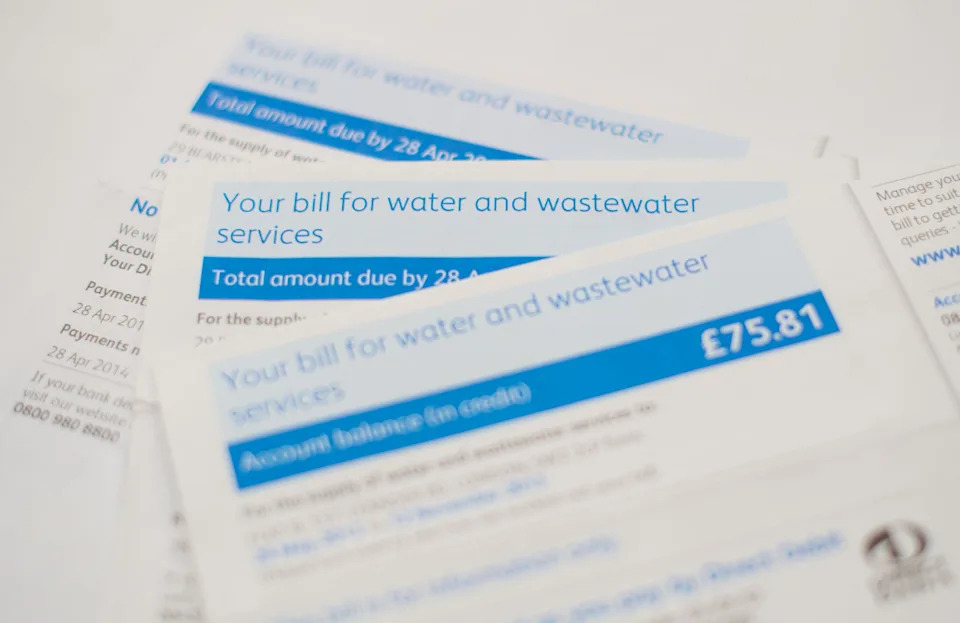
Water bills are going up above inflation from April.
(PA)
It also points to a “money-back guarantee”, under which customers would be refunded if promised improvements are not delivered.
However, campaign groups have criticised the rises, arguing that too much customer money is still being diverted to debt servicing and dividends, rather than frontline improvements.
Rob Abrams, campaign manager at Surfers Against Sewage, said: “Nearly a third of our water bills are swallowed up servicing the water company debt pile and shelling out dividends whilst we get sick from sewage.
“So why should we believe this time will be any different?”
River Action chief executive James Wallace added: “When the water sector brags about ‘record investment’, what it really means is that bill-payers, not water companies, are being forced to pick up the tab for decades of failure.”
How much will my water bill go up?
Regional differences will see some customers pay only a small amount more, while others will see a stark jump in their water bills.
Severn Trent customers will see a 10% increase, while Affinity Water (central region) customers have been warned to expect a 13% increase.
Below is a full list of the average water bills in 2026/27 for households in England and Wales, published by Water UK, followed by the price rise and the percentage change in the average bill from 2025/26:
Can I get help with my water bill?
Support is available for households struggling to keep up with rising water costs – more than two million households already receive help through schemes such as social tariffs, the WaterSure scheme and other affordability measures.
That figure is expected to grow by around 300,000 more households over the next year.
WaterSure is aimed at customers on low incomes who have high essential water use, while social tariffs offer discounted bills for people who meet certain criteria, such as receiving benefits.
Those who qualify could see an average of around 40% off their bills.
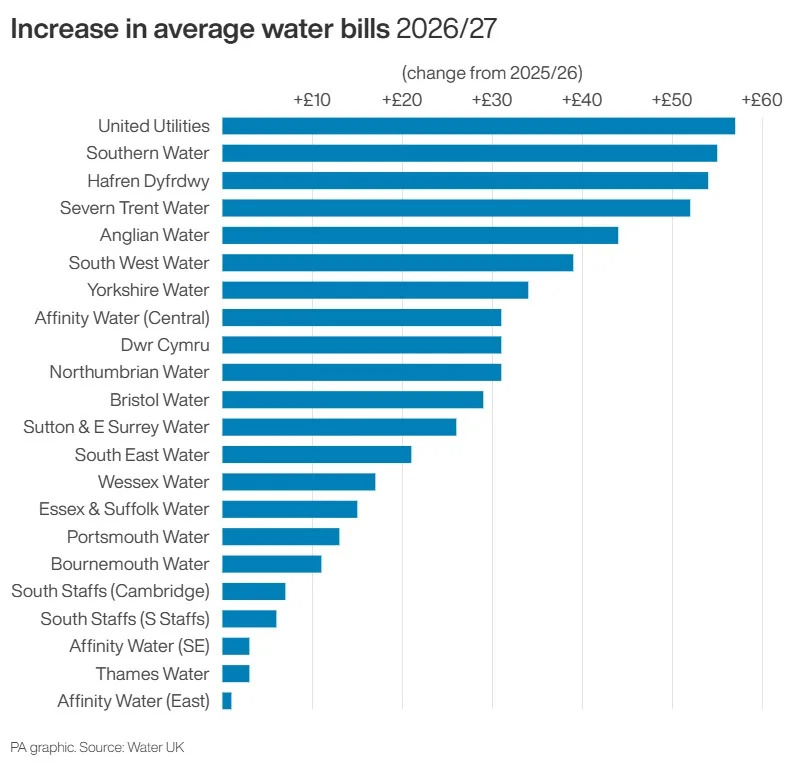
Increase in average water bills in England and Wales in 2026/27, by water company.
(PA)
Water companies say they are expanding support, but the Consumer Council for Water (CCW) has warned that the current system creates a “postcode lottery”, with help varying depending on which company supplies your area.
CCW chief executive Mike Keil said there should be a single, nationwide social tariff to ensure support reaches those who need it most as bills continue to rise.
He added: “The postcode lottery of financial assistance created by existing water company social tariffs is unfair and unsustainable in the face of rising water bills.”
If you’re worried about paying your bill, you’re encouraged to contact your water company directly to ask what help is available, as support schemes differ by region.