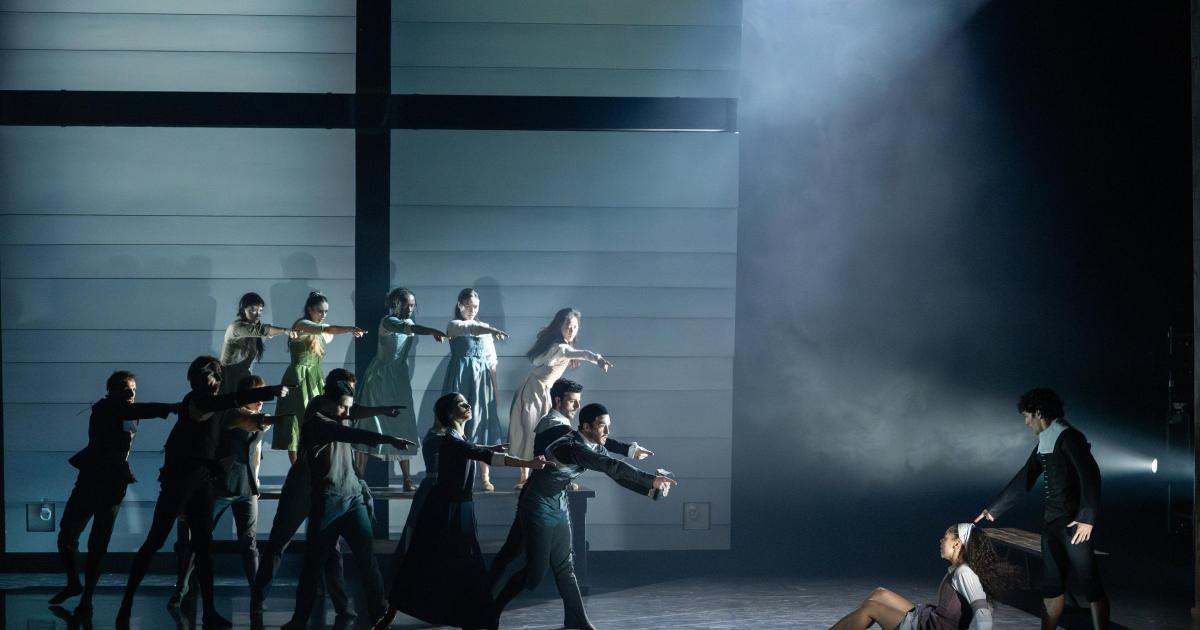
Scottish Opera, Scottish Ballet, the Royal Scottish National Orchestra, the Scottish Chamber Orchestra and the National Theatre of Scotland are said to have been “managing decline and papering over the cracks” for the last 15 years.
Read more:
MSPs were also told that the companies are embarking on a further round of “cost-cutting” after being left on standstill for up to two more years.
Speaking on behalf of the five companies at Holyrood, Scottish Ballet chief executive Steven Roth also raised the prospect of them having to drop their community engagement programmes which currently run across the country.
Scottish Ballet performed Mary Queen of Scots at last year’s Edinburgh International Festival.
He revealed that Scottish Ballet had already been forced to cut the size of its touring companies in half, and raised concerns of a talent drain because of poor levels of pay.
The government has been accused of going back on a promise to increase their funding in the next financial year under its commitment to spend an additional £100m on arts and culture.
The five companies, which currently get overall funding of £24m in direct funding from the government, issued a rare joint statement earlier this month accusing ministers of “inexplicable” treatment of “award-winning brand ambassadors” after their pleas for a funding rethink were snubbed.
Mr Roth was speaking days after finance secretary Shona Robison came under fire from fellow SNP MSPs Kenneth Gibson and Michelle Thomson over why the national companies had been hit with ”real-terms reductions” when the government was increasing spending on arts and culture.
Scottish Greens MSP criticised the government for a “vague and unspecific” promise of additional funding for the national companies in future years.
Giving evidence to the culture committee, Mr Roth said: “We have 15 years of flat funding and now potentially have another two years.
“We’ve had to manage decline. The five national companies have done that extremely well and that’s part of the problem. We have been very successful in managing decline and papering over the cracks.
“We’ve been doing that by cutting our core business, basically. For instance, Scottish Ballet now doesn’t tour to Inverness as much as we did pre-pandemic because the costs of touring have gone through the roof.
“Accommodation, in particular, is ridiculous. Scottish Ballet is now spending more than £200,000 on accommodation in Edinburgh alone. It is a huge amount of money and is almost triple what it was before the pandemic. There is also a five per cent bed tax coming in Edinburgh from July.
“We’ve been cutting our core programmes at the same time as our community engagement programmes have been increasing dramatically.
“All five companies deliver programmes into our communities which are funded separately through trusts, foundations and private donations. But those programmes wouldn’t exist without a solid core programme and a sold company that is financially viable. We are getting to the cusp now.
“If our core business starts to fail or fracture it will be very difficult to continue with those programmes.
“It is a fragile house of cards. If one part of it starts to decline it then drags onto everything. We don’t want to see that. We want to see a robust organisation that can deliver programmes right across the nation.”
Mr Roth said Scottish Ballet had already been forced to make significant cuts due to the “every increasing costs” the company has faced in recent years.
He said the company had seen a real-terms reduction of around 36 per cent over the last 15 years.
Mr Roth said: “We’ve cut our orchestra back. We used to tour with 65 freelance musicians who had sustained work throughout the year. Sometimes we are only touring with 20 players now.
“We have cut our whole company in half when we tour. We used to tour with the entire company of 40 dancers and rotate the cast so that everybody got the chance to be on stage. More often than not we are now touring with 25 dancers.
“There are consequences to static funding and they are really cuts. We don’t want to cut our core programmes. We are national companies which are there to present works of scale at the very highest world-class standard.
“I think we do achieve that, but we have got the point now that if we keep cutting there is very little extra to cut.
“We have been making efficiencies for the last 15 years. Now we are faced with another two years of having to make more efficiencies to get us through to what may come our in 2018-29.”
Mr Roth said efforts by the five companies to ensure accessibility to the arts was already being “constrained” by their prolonged standstill funding.
He said: “We are all looking at ways to cut out core programmes. It is essentially touring that gets cut.
“If we are still on static funding in five years time and nothing has changed we will only be in the central belt only, I can guarantee that, or we will be taking very small groups of people out on tour.
“It won’t be the national companies. It will be something much less than that.”
The five national companies had previously warned they faced a “perfect storm” of financial problems without a major rethink of their funding, including securing three-year agreements for the first time, as companies and organisations supported by Creative Scotland have.
In their response to the government’s budget announcement, the companies said they were “at a loss to understand” why they had been “singled out for flat funding”.
Culture secretary Angus Robertson, who described the companies as “internationally acclaimed” in the aftermath of the budget announcement, has suggested they may have to wait until 2028 to see any additional funding.