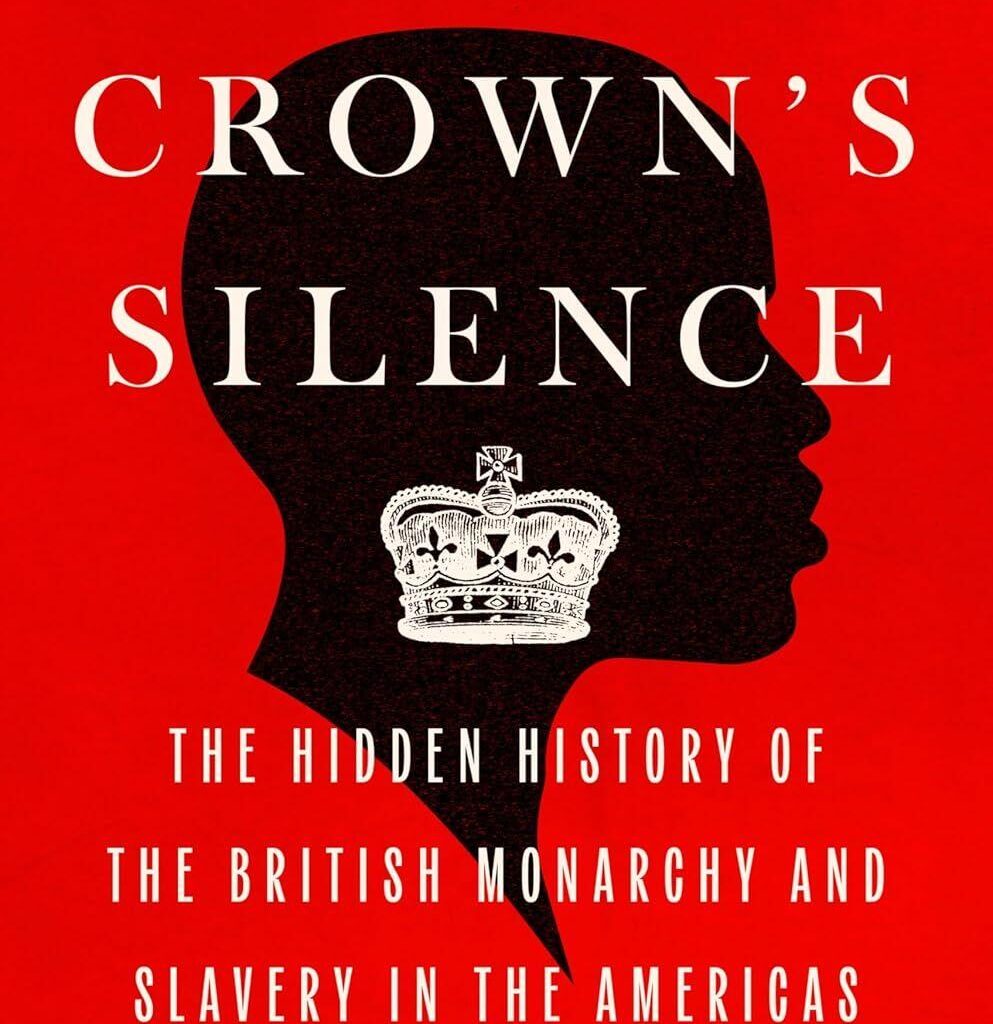
Brooke N. Newman’s ‘The Crown’s Silence’ dives into the long history of transatlantic atrocities committed by Charles III’s ancestors in the name of empire.:quality(75)/https%3A%2F%2Fassets.lareviewofbooks.org%2Fuploads%2FThe%20Crown's%20Silence.jpg)
The Crown’s Silence: The Hidden History of the British Monarchy and Slavery in the Americas by Brooke N. Newman. Mariner Books, 2026. 464 pages.
Did you know LARB is a reader-supported nonprofit?
LARB publishes daily without a paywall as part of our mission to make rigorous, incisive, and engaging writing on every aspect of literature, culture, and the arts freely accessible to the public. Help us continue this work with your tax-deductible donation today!
I RECENTLY READ three biographies of King James I, who ruled England from 1603 to 1625. The 400th anniversary of his death last year produced a wave of new books reassessing his legacy, including his foreign policy, his literary pretensions, and his role in the Protestant Reformation. Yet, in three hefty volumes of frequently illuminating scholarship—Clare Jackson’s The Mirror of Great Britain: A Life of King James VI and I, Anna Whitelock’s The Sun Rising: King James I and the Dawn of a Global Britain, 1603–1625, and Gareth Russell’s The Six Loves of James I—I counted just two pages (both in Whitelock’s book) on the English slave trade, which arguably began under James’s reign. Tobacco emerged early in the 17th century as the signal cash crop of England’s Caribbean colonies, and English ships started bringing enslaved Africans to Bermuda to work the fields. By 1619, slaves made up five to 10 percent of the colony’s population. That same year, the privateer White Lion infamously brought the first African slaves to North America, near England’s colony in Virginia. A triangle with England at its apex was drawn.
Three books, but just two pages? The point is not that the relationship of the Crown to slavery is unknown; the point is that it is rarely front and center. In fairness, James was not an outspoken defender or personal beneficiary of slavery like many of his successors; his biographers could only say so much. What, then, about more openly proslavery sovereigns that followed, like George I (1714–27) or William IV (1830–37)? To ask this question is to expand the frame from individual monarchs to the monarchy itself. Complicating things is England’s proud self-image at the vanguard of abolitionism. Parliament outlawed the slave trade in 1807—a watershed moment in world history—and emancipated all slaves in England’s colonies and territories in 1833. These reforms occurred sooner than similar steps by other European powers and well ahead of the Americans. Getting out early is certainly better than hanging on too late. Yet is England’s national mythology as an abolitionist pioneer with clean royal hands perhaps a bit smug in light of the centuries of oppression that came first?
Historian Brooke N. Newman says yes. She observes that England was the leading slave power for generations, far surpassing Spain, Portugal, or France at the height of its trade. More pointedly, she takes direct aim at the monarchy’s “instrumental role in launching and expanding past coercive systems of forced migration and labor that enriched the Crown, facilitated Britain’s rise as a global power, and perpetrated violence on millions of enslaved Africans, Indigenous people, and their descendants.” In The Crown’s Silence: The Hidden History of the British Monarchy and Slavery in the Americas, Newman describes centuries of royal entanglement in the slave trade and urges King Charles III—himself the descendant of slave owners—at last to apologize formally.
The “hidden history” of the book’s subtitle warrants unpacking. The Crown’s involvement in slavery is more like an open secret. Charles has blessed a historical inquiry into the issue, due out later this year, and embarrassments over his or his sons’ carefully evasive words of contrition occur regularly. Two years ago, Suzanne Schwarz of the University of Worcester published a substantial essay on slavery and the family of George III (1760–1820) in The English Historical Review. Scholars including David Eltis, Catherine Hall, and David Brion Davis have for years examined the transatlantic slave trade from every angle, including the monarchy’s opposition to abolition. Yet Newman’s comprehensive focus on the way the monarchy facilitated and profited from slavery is new and well pitched for a Crown-obsessed public. On one hand, there is no great surprise in learning that English royals are guilty old hypocrites who refuse to say sorry. On the other hand, there is real value in presenting the monarchy’s dreadful complicity, prince by prince, in one accessible book. The Crown’s Silence offers a powerful resource to readers who have long suspected manacled skeletons in Buckingham Palace’s closets. The details are all here, and they are appalling.
¤
The English slave trade found its form under James I, but his predecessor, Elizabeth I (1558–1603), had her own pernicious role in its rise. She was, Newman writes, “the first English monarch to invest directly in the transatlantic slave trade” by sponsoring a private slaving venture. John Hawkins was a merchant-adventurer who kidnapped Africans from Portuguese slavers off Sierra Leone in 1562 and then sold them to Spanish colonists in the Caribbean. Liking what she saw, Elizabeth sponsored Hawkins’s next expedition in return for a one-sixth share of its profits—fully aware of the nature of the enterprise. At Cape Verde in 1564, Hawkins sent raiding parties “every day on shore to take the inhabitants, […] burning and spoiling their towns,” as an accompanying merchant recounted. Ultimately, Hawkins seized some 400 Africans, whom he sold to colonists in the Spanish Caribbean in defiance of Philip II of Spain, who jealously guarded trade in his colonies. Elizabeth brushed off Spain’s diplomatic protest and underwrote another raid—but this time, Hawkins’s ships were attacked and destroyed by the Spanish Navy.
Slavery grew and expanded until, in the mid-17th century, it exploded in the Caribbean, especially the so-called “sugar islands” of Jamaica and Barbados. That crop, even more than tobacco, had a huge consumer demand in England. It required intensive cultivation; African slaves provided the labor. English conglomerates, granted monopoly rights by the Crown, conducted this business. The first of them was the Guinea Company, chartered by Charles I in 1631. Formally, its mandate was to pursue and trade African gold, redwood, ivory, and grains, but its leaders soon found that slavery was more profitable; the company’s participation in the slave trade was well known. By 1641, there were more African slaves on Providence Island in North America than there were English colonists. By the time of the Commonwealth’s establishment in 1649, Newman writes, England had become a “slave empire.” Between 1663 and 1668, over 27,000 African captives were sent in English company ships to the Caribbean. A quarter perished before arriving.
Subsequent state monopolies followed the Guinea Company, with slave trading their primary raison d’être. They included the Company of Royal Adventurers in the 17th century, which re-formed as the Royal African Company and operated alongside the South Sea Company (SSC) into the 18th. The common seal of the Royal Adventurers featured Black Africans on one side and Charles II (1660–85) on the other; the king charged the company with “buying and selling Bartering and Exchanging of for and with any Negroes Slaves Goods wares and Merchandizes whatsoever.” The Royal African Company, chartered in 1672, branded slaves as a matter of company policy and traded in more enslaved Africans than any other single institution during the transatlantic slave trade. From 1672 to 1688 alone, it shipped some 100,000 slaves. The SCC for decades enjoyed a contract with Spain known as the “asiento,” which required the company to deliver an annual quota of 4,800 slaves to Spanish colonies. The company was so large at one point that it proposed taking on the entire British national debt.
Over the generations that these monopolies conducted the English slave trade, members of the royal family were among their biggest patrons, stockholders, and beneficiaries. Charles II and his brother James, the Duke of York and future James II, were major shareholders of the Royal Adventurers and later the Royal African Company; they bought and sold stock and collected regular dividends. Queen Anne (1702–14) had a huge personal stake in the SSC of three-quarters of a million pounds—nearly $200 million in today’s currency. The behemoth company operated like a bank, and Anne used interest payments on her shares as income. George I bought so many SSC shares that he contributed to a bubble in company stock that burst in 1720. Over the years, royal family members also received opulent gifts from the major slaving interests to keep them onside—cash payouts, silver-cast “Jamaica service,” and other shiny encomiums. The monarchy’s support was vital to slavery, so the industry kept its patrons happy.
In addition to these corporate holdings and payoffs, Newman explains that the English monarchy benefited from slavery in other ways. The Crown collected substantial import duties on colonial sugar and tobacco. These were not mere percentage points poured into a larger treasury; by the Glorious Revolution of 1688, such duties made up a full third of the Crown’s revenue. The English monarchy itself also owned slaves—either through purchase (“Crown slaves”), capture from other vessels (“prize Negroes”), or forfeiture (the slaves of English subjects who died intestate). The English government directly trafficked in these persons, selling them at auction in the king or queen’s name. Royals also purchased slaves for use as domestic servants, outfitted in garish livery, and for military service. Between 1795 and the Abolition of Slave Trade Act of 1807, for instance, the Crown bought 13,400 enslaved men to serve as troops in the West India Regiments.
Because the slaves that England trafficked lived mainly in the colonies rather than in the metropole, domestic debate over the morality and ethics of the practice was surprisingly muted. One exception was the dispute over baptism stirred up by the Catholic monarchs Charles II and his successor James II (1685–88) in the late 17th century. With blazing hypocrisy, they argued that slaves should have access to the kingdom of heaven as Christians while continuing to endure subjugation. Their campaign to baptize slaves met resistance in the colonies, where plantation owners and overseers feared the practice would undermine the Africans’ status as chattel. “Although he professed a deep commitment to Catholicism, James’s conscience was not troubled by his investment in human trafficking or African bondage,” Newman writes.
A more pointed debate over the Crown’s support for slavery took place during the American Revolution, when the practice became a wedge issue. The hypocrisy on both sides ran thick and fast. George III refused to allow the Virginia legislature to curtail slavery but later offered freedom to African descendants in North America who fought on the British side. The move terrified colonists, who feared an uprising around every corner. “Glossing over their nation’s preeminent role in the transatlantic slave trade, British commentators denigrated Americans as venal enslavers,” as Newman puts it. Americans bit back: Benjamin Franklin, himself a slave owner, pointed out England’s role in the slave trade “while it piques itself on its virtue, love of liberty, and the equity of its courts in setting free a single negro.”
The court case Franklin mentioned was actually far more significant than this barb implied. In Somerset v. Stewart (1772), the Court of King’s Bench ruled that an African slave visiting England who escaped his master during the trip could not be returned to Jamaica as a slave. The case—which did not order full emancipation—nevertheless caused a sensation and helped spur Britain’s abolition movement. Franklin’s jibe about “a single negro” is therefore misleading and shortsighted; it also misunderstands how the common law works. Individual cases produce judicial decisions, which themselves become precedents: that is how courts make law. For a comparison about the potential ramifications of a high court’s treatment of an individual slave, we need only look to the US Supreme Court’s later ruling in Dred Scott v. Sandford (1857), which denied citizenship to Black Americans, nullified the Missouri Compromise, and helped spark the American Civil War.
England’s abolition movement had the support of one critical royal, Prince William Frederick—the Duke of Gloucester and Edinburgh and the nephew of George III. He spoke against slavery in the House of Lords and helped found the African Institution, a pro-abolition—but patronizingly racist—organization that advocated on behalf of Africans. Yet Gloucester was swimming upstream; his cousin, Prince William Henry, Duke of Clarence and St Andrews, spoke for the family as a shill for corporate slave interests and a fierce opponent of abolition. The only British royal to visit the American colonies and see slavery for himself, Clarence somehow found it a humane, efficient, and altogether worthy enterprise. After the Slave Trade Act passed Parliament in 1807, he continued to resist slavery’s regulation and further diminishment. Newman writes that, as King William IV, he dragged his feet in giving the royal assent to full emancipation in 1833. Even that signal reform was diminished by the £20 million payout the Crown made to slave owners who would lose their property.
¤
In telling this profane story, The Crown’s Silence is briskly paced and admirably clear in delineating the numerical morass (all those Georges and Jameses and Charleses) and opaque finances of the English monarchy. Newman’s indignation at centuries of complicity also burns pleasingly bright throughout the book’s pages. Yet The Crown’s Silence is not without faults. By focusing so relentlessly on the royal family, Newman takes readers away from other culpable actors in business and government who share the blame. Newman’s pages on the economics of slavery also feel decidedly pitched toward a general audience, with a tendency to oversimplify. Repeatedly, she tells readers that the English treasury was empty, so monarchs turned to slavery to make money: a basic one-to-one equation. Yet as economic historians like David Richardson have established, the transatlantic slave trade was a highly complex market driven by the availability of uncultivated land in the sugar islands, trends in labor productivity, the variability of slave prices, foreign competition, and the effect of war on British naval development. As Richardson shows in his 2022 book Principles and Agents: The British Slave Trade and Its Abolition, these factors contributed to the various incentives that made slavery first profitable and eventually indispensable.
Newman’s endgame is clear. She wants King Charles to apologize formally—not merely in general terms for his country’s past involvement in the slave trade but also specifically for the Crown’s. She also wants the British government to consider reparations. The former outcome seems likelier than the latter, with the upcoming release of the Crown-approved historical inquiry a potential inflection point. The Crown’s Silence will also add pressure for a full, genuine, and official apology for the monarchy’s role in slavery. Yet whether that occurs or not, a clear and accurate historical accounting is its own reward. Those who venerate the British royal family need to know whom they are fawning over. And what they have done.
LARB Contributor
Michael O’Donnell is the author of Above the Fire (2023), and his next novel, Concert Black, will be published in April 2026. His work has appeared in The New York Times, The Atlantic, The Wall Street Journal, and The Economist.
Share
Copy link to articleLARB Staff Recommendations
-
On two cases of national amnesia about slavery — one British, one American.
-
J. R. Kerr-Ritchie reviews Randy M. Browne’s “The Driver’s Story: Labor and Power in the World of Atlantic Slavery.”
Did you know LARB is a reader-supported nonprofit?
LARB publishes daily without a paywall as part of our mission to make rigorous, incisive, and engaging writing on every aspect of literature, culture, and the arts freely accessible to the public. Help us continue this work with your tax-deductible donation today!