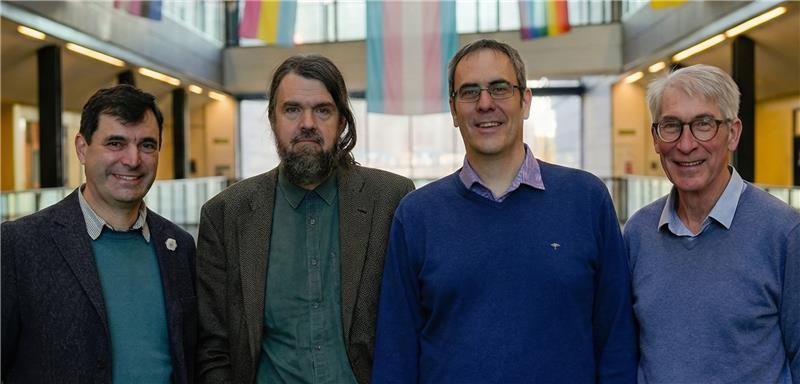
Four researchers from the Faculty of Science and Engineering (FSE) have been appointed as inaugural Fellows of the Academy for the Mathematical Sciences, a new national body established to bring together the UK’s strongest mathematicians to help solve some of the UK’s biggest challenges.
The appointments place Manchester researchers among a cohort of around 100 Fellows drawn from academia, business, industry and government.
The Academy’s Fellowship will work collectively to address major national challenges including pandemic preparedness, economic transformation, national security, climate change and the safe development of artificial intelligence.
The Fellows will continue to perform their roles at Manchester and at the other institutions they support, but will come together through the convening power of the Academy to help benefit the whole UK. Areas of focus will likely include:
- Working with experts across government, industry and the third sector to model the impact of climate change and advise on mitigations
- Supporting cross-disciplinary modelling to prepare for future diseases and pandemics
- Developing and championing investment in the new mathematics required for ensuring AI and the quantum technologies of tomorrow work safely and to the benefit of all
- Bringing together industry, academia and educators to design maths curricula fit for tomorrow’s economy and society
- Keeping the UK safe through advances in cryptography and the mathematical foundations of national security
- Guiding the UK’s green energy transition, advising on everything from grid capacity and system resilience to safe, large-scale energy storage
- Helping businesses and entrepreneurs harness mathematics to drive innovation, new products and sustainable growth
- Strengthening national resilience by using mathematics to optimise infrastructure, improve public services and forecast risks
The four Manchester appointees are:
Professor Paul Glendinning FRSE, FIMA and Beyer Professor of Applied Mathematics, whose research focuses on applied dynamical systems, particularly piecewise smooth systems. A former President of the Institute of Mathematics and its Applications (IMA), Professor Glendinning has played a leading role in shaping the UK mathematical community and was closely involved in the design of Manchester’s Alan Turing Building.
Professor Ian Hall OBE, Professor of Mathematical Epidemiology and Statistics and Director of the Christabel Pankhurst Institute for health technology research and innovation. Professor Hall previously led modelling work at Public Health England and played key advisory roles as part of Department of Health and Social Care’s scientific pandemic influenza modelling subgroup (SPI-M), as the academic chair of the Social Care Working Group for SAGE and by supporting UKHSA Joint Modelling team and advising the Ministry of Justice. He was awarded an OBE in 2024 for services to public health, specifically epidemiology and adult social care during Covid-19.
Professor Mark Kambites, Professor of Pure Mathematics, whose research focuses on semigroup theory and its connections to areas such as theoretical computer science, tropical geometry and geometric group theory. He is currently Manchester Associate Chair of the Heilbronn Institute for Mathematical Research and also serves as Chair of EPSRC’s Strategic Advisory Team in Mathematical Sciences.
Professor Lasse Rempe, Professor of Pure Mathematics, whose research focuses on complex dynamics and analysis. He is a Fellow of the American Mathematical Society and has been awarded a Whitehead Prize and a Philip Leverhulme Prize. He is a former member of EPSRC’s Strategic Advisory Team in Mathematical Sciences and will serve as Pure Mathematics Research Lead at Manchester from February 2026.
Professor Dame Alison Etheridge DBE FRS, the President of the Academy for the Mathematical Sciences, said: “I’m delighted to welcome our inaugural Fellows – individuals of exceptional distinction who collectively advance the mathematical sciences through discovery, leadership, education and real-world application.
“As Fellows of the Academy, they will come together in service of the wider public good: bringing independent expertise to bear on national priorities, championing excellence in mathematics education, strengthening the UK’s research and innovation base, and helping to ensure that mathematics continues to deliver opportunity, resilience and prosperity across our four nations.”
‘;