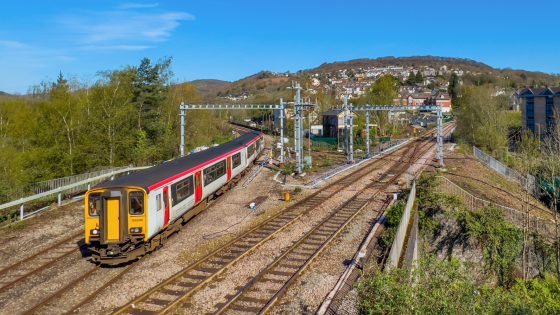
A proposed amendment to the Railways Bill that would devolve power to Wales over its own railways has been denied amidst Westminster and the Senedd’s continued arguing over whether the nation is receiving its fair share of funding for its rail network.
The Railways Bill is currently passing through Parliament as it looks to reform the UK’s railway, bringing management of network infrastructure and train operation under one organisation – Great British Railways (GBR) – as part of sweeping reforms to the sector. In December, during its second reading in Parliament, Welsh MPs claimed that it “does not work for Wales”.
The proposed clause to be added to the Railways Bill would have sought to remove rail transport from the list of powers reserved to Westminster and to require the transfer of responsibility for rail in Wales to ministers in the Senedd within two years.
The Bill is currently in its committee stage in the House of Commons, where it undergoes detailed scrutiny by cross-party MPs. At a recent committee debate, Liberal Democrat MP for Didcot and Wantage Olly Glover said: “In practical terms, [this clause] would mean responsibility for rail infrastructure, investment decisions and long-term strategy in Wales sitting with the Welsh Government, rather than being controlled by the UK secretary of state or Great British Railways (GBR).
“It would put Wales on the same constitutional footing as Scotland, which already has those powers.”
Glover went on to explain how he believes the reason this clause matters is that under current arrangements “Wales has consistently lost out”.
“Because rail is not devolved, Wales has no protection when England-only rail projects are classified in ways that deny Wales consequential funding,” he said.
“That has resulted in Wales missing out on billions of pounds of investment from projects such as HS2, Northern Powerhouse Rail and East West Rail, while the Governments in Scotland and Northern Ireland have received consequential funding to spend on their own rail projects.”
Glover’s sentiments relate to the government’s conclusion of its Spending Review last year where it pledged £10.2bn for major rail projects across the country and £23bn for High Speed 2 (HS2). A total of £15.6bn was also apportioned to England’s city regions for transport projects.
From the £10.2bn for rail enhancements, Wales will receive £300M. The Spending Review also recognised “Wales’ long-term infrastructure needs and deliver £445M of rail enhancements to realise them”.
A further £48M has been apportioned to the Welsh government for enhancements of the Core Valley Lines rail network via the Spending Review.
Welsh ministers and members of the Senedd have continually expressed unease with their portion of funding. Rail is an increasing priority of the Welsh government as it looks to move the public away from car use and into public transport. These tensions have boiled over to the point where Plaid Cymru has criticised the government’s “historic underinvestment” in Welsh rail and demanded that powers over the nation’s railways be devolved to the Senedd.
Added to this, the government has classified HS2 as an “England and Wales” project, despite none of its infrastructure being located near Wales. This classification has been a point of contention as it means Wales does not receive Barnett Formula consequentials. These funding allocations would typically be triggered by government spending in England. Rail minister Lord Hendy appeared in the Senedd in October last year to defend the portion of rail funding reserved for Welsh rail in the Spending Review and the fact the nation is considered as receiving consequential benefit from HS2.
Discussing the proposed amendment, transport undersecretary Keir Mather stated that the point of the Railways Bill and GBR is to bring as much of the rail network as possible under one banner, but devolution of rail to Wales would do the opposite.
“The new clause would introduce new statutory boundaries into a network when we most need to simplify governance and reduce fragmentation,” he said.
“By reopening the devolution settlement and mandating the transfer of responsibilities that are already being addressed through strengthened partnership working, it risks diverting attention from implementation and delivery.
“The Bill already enhances joint working.”
Continued tensions
The Railways Bill committee was not the only place where tensions about the funding of Wales’ rails have been expressed in recent weeks.
Speaking in the Senedd on 20 January, Plaid Cymru member Delyth Jewell said: “Wales is owed billions from HS2, we are owed billions more from Westminster because, not just HS2, but the Oxford to Cambridge Line and Northern Powerhouse Rail, these English projects have been designated as England and Wales projects.
“Not an inch of the tracks will be in Wales and yet we help to foot the bill while our railway lines go without that money.”
Jewell stated that many projects politicians in Wales are calling for would be possible if they were given the funding they believe they deserve.
“Think of all the stations we could reopen if we had the money we are owed,” she said.
“Things I’ve called for, things other member haves called for: reopening the Nelson to Ystrad Mynach line, the spur to Abertillery.
“There will be examples across our nation where communities could be better connected with those billions.
“These are facts, they are not opinions. The people of Wales deserve what we are owed.”
Responding on social media platform X, Labour MP for Rhondda and Ogmore and minister for trade Chris Bryant said that Jewell’s statements were “another lie”.
He said: “Wales spends more than it pays in tax. So we in Wales don’t pay anything for railways in England. We are net beneficiaries. Last year’s settlement for the Welsh government was the biggest ever.”
Plaid Cymru raised serious qualms with Bryant’s claims to NCE.
A spokesperson for the political party said: “This is yet another attempt by a Labour politician to muddy the waters to distract the people of Wales from his party’s woeful record of depriving Wales of the funding we deserve
“The MP knows full well that Wales is owed billions from projects such as HS2, Oxford-Cambridge, and Northern Powerhouse Rail, just like his colleague the Secretary of State for Wales before she got into the Wales Office.”
The spokesperson continued to question how Labour politicians are seemingly pushing an “absurd argument” that Wales gets more than it deserves.
“Plaid Cymru knows that Wales has been underfunded, left behind, and ignored by Chris Bryant’s party time and time again, and we won’t stand for it,” the spokesperson said.
“Plaid Cymru is the only party that has the interests of Wales at our hearts, we are the only party that will always fight for what our nation deserves – and that is exactly what a Plaid Cymru government would do after May’s election.”
The Department for Transport (DfT) replied to Plaid Cymru’s comments in a statement sent to NCE discussing how heavy rail is primarily classified as “England and Wales” because the majority of these projects are delivered by the UK government on behalf of both England and Wales.
Current examples of “England and Wales” rail projects based in Wales include the regeneration of Cardiff Central Station, upgrades to the line at Padeswood in Flintshire and planned new stations for South Wales.
The government spokesperson further outlined how this means that projects to upgrade or enhance the heavy rail networks in both countries are classified as “‘England and Wales’ whether the track is in Wales, England or both”, unless devolved and therefore would not result in Barnett consequential funding for Wales.
The UK Government spokesperson said: “Following years of underinvestment in Welsh infrastructure, the Government has recently announced £445M in direct funding to modernise and upgrade Welsh rail.
“This investment will deliver new stations, faster journeys and better services as well as connecting people to jobs and driving growth.”
Like what you’ve read? To receive New Civil Engineer’s daily and weekly newsletters click here.