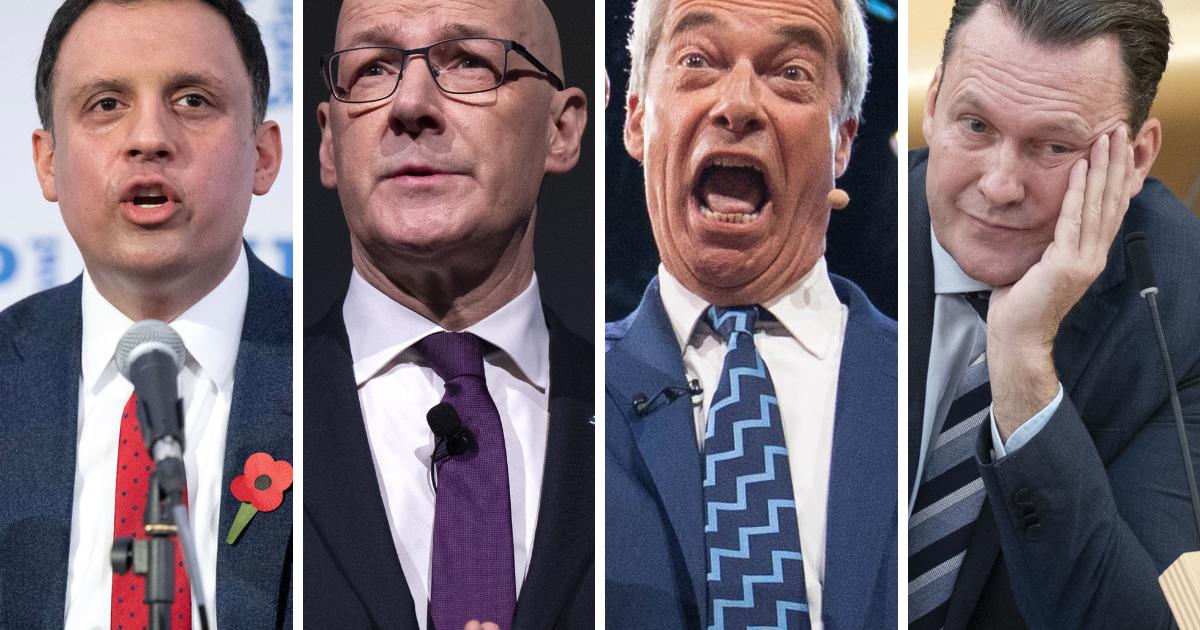
The survey – which comes just three months away from the Scottish parliament election – makes for better reading for some parties than others. It also delves into where things stand for Scottish independence.
Here are five things we have learned from this new poll.
SNP remain firmly ahead in spite of loss of support
The SNP are now on 34% of the constituency vote, down 14 points since the 2021 election, and are on 29% of the list vote, down 11 points.
This would be their lowest share of the regional vote since 2003, before they were in power.
John Swinney
But this drop doesn’t particularly matter as other parties are struggling. Scottish Labour were on 15% for both votes amid Keir Starmer’s unpopular government and the advent of Reform UK as a political force, who took second place on the poll.
How independence supporters are leaning
The polling revealed that, among those who voted Yes in 2014, Reform UK are the second most popular party. 16% of 2014 Yes voters said they would back Nigel Farage‘s party, while 61% said they would back the SNP.
Among 2014 No voters, Labour were narrowly the most popular party, on 24%. Reform were also second in that category, on 24%.
It’s an awful poll for Anas Sarwar
Scottish Labour have matching 15% vote shares for both parts of the election, relative to a 22% constituency share and an 18% regional share in 2021.
If repeated in May, this would be their worst result in either a Westminster or Holyrood election in 116 years, according to YouGov.
Just 32% of people who voted for Labour in 2024 said they expect to do so again in 2026.
That would certainly jumpstart questions as to whether Anas Sarwar should remain as leader.
The Scottish Greens may be on cusp of first-ever constituency win
A less noticeable detail from this poll is that the Scottish Greens have gone from a paltry 1% to 9% in the constituency vote.
Co-leaders Ross Greer and Gillian Mackay (Image: NQ)
The party have typically relied on the list vote, where voters often rank them second after the SNP, for its share of MSPs.
But times appear to be changing.
I am told that the party are hopeful they could pick up their first ever Holyrood constituency win in either Edinburgh Central or Glasgow South in May.
John Swinney most popular leader with Prime Minister languishing at the bottom
John Swinney remains the most popular party leader in Scotland, with a third of Scots (33%) having a favourable opinion of the SNP leader while half (50%) see the first minister unfavourably.
At face value, that doesn’t look great, but such is the unpopularity of elected officials.
READ MORE: Meeting notes highlight ‘political pressure’ to open hospital, Anas Sarwar says
For example, just 17% of Scots have a positive view of Keir Starmer, while three quarters (74%) see the Prime Minister in a negative light. This includes 2024 Labour voters being twice as likely to see the party’s leader unfavourably (64%) as favourably (32%).
Other UK-wide party leaders are also not popular north of the Border, with Scots seeing Nigel Farage unfavourably by a margin of 69% to 24%, Kemi Badenoch by 58% to 17%, and Ed Davey by 37% to 22%.
Just 18% of Scots hold a favourable opinion of Anas Sarwar, while 52% see the Scottish Labour leader in a negative light, including nearly half (45%) of 2024 Labour voters, more than the 31% who see him favourably.