
‘No one needs to be left behind’
18:43, 29 Jan 2026

The departure of migrant workers, along with their families, who have propped up the system could wreak havoc on an NHS trying to cut waiting lists – especially in Manchester(Image: KBP)
There are still 58 people in Manchester hospitals alone that could face deportation over a ‘£1-a-week change’.
Changes to UK immigration rules last year saw an increase in the minimum annual salary threshold of ‘skilled work’ jobs, which allow for sponsorship of migrant workers, to £25,000. However, this is higher than the salaries of NHS ‘band three’ staff – which include jobs such as emergency care assistants and dental nurses and assistants.
It means some NHS staff members and their families now face the prospect of deportation, with the Manchester Evening News previously reporting the difference in the highest figure a band three worker can earn and the new £25,000 threshold is just £63-a-year.
And the departure of migrant workers who have propped up the system could wreak havoc on an NHS trying to cut waiting lists – especially in Manchester, host to the country’s largest NHS organisation and hospital trust.
Demonstrators spoke out in a board meeting yesterday (January 28) of Manchester University NHS Foundation Trust (MFT), which runs all of the Manchester hospitals, including Manchester Royal Infirmary, Royal Manchester Children’s Hospital, Trafford General Hospital, North Manchester General, and Wythenshawe Hospital. Protesters demanded any workers for the trust whose status has not yet been secured are ‘not left behind – by any means necessary’.
“You can do it for them, no one needs to be left behind, and we expect this authority to do everything immediately to make sure every one of those migrant workers are secured in their jobs,” the demonstrators said. “They are members of our community, they are essential workers. You have a duty of care.”
Band three workers include emergency care assistants, dental nurses and assistants, maternity support workers, and senior healthcare support workers who cover tasks like monitoring blood pressure, checking blood glucose levels, and wound dressings.
Meera Nair, the trust’s chief people officer, responded in the meeting: “This is a really difficult set of circumstances, highly sensitive, really emotional for all the affected staff.
“Our health care support workers are a really vital and valued part of our workforce. They are absolutely significant in the quality of care that we provide. They’re directly in contact with our patients. And so, the work they do is fundamental and really pivotal, and central to the work that we do in the hospitals. It’s of real significance to us.
“The reason I say that is because that means the changes to the immigration rules are of huge significance to all of us as leaders across the organisation, and managers, staff, and colleagues working in wards across the organisation impacted by this. And, of course, it’s important to recognise that it’s also the reason why, as a board, leaders across the trust, and our immigration, have been supporting many of these colleagues since July of last year.
“It’s quite natural that they are distressed, it’s completely understandable, I would be too if I was in that position. And it’s important that as this continues, managers, colleagues, and leaders are supported.
“These are not changes that MFT has introduced. These are changes which are the result of national changes to immigration rules that came between April and July of 2025.
“At the time, we had 180 staff who were affected by these changes. None of these staff had been sponsored by the trust. They were all individuals who had been recruited in the UK, were already residents of the UK, and had the right to work already existing in the UK.
“The majority of them, probably around 130 or so, were healthcare support workers. Others were in clinical support and other administrative kinds of roles, with visas that were expiring, at that time, over the course of about 12 to 18 months.”
The trust gave the latest update on the 180 staff who had been affected, adding the position ‘might change again later today, it might change again next week. It just changes on a day-by-day basis’.

Manchester Royal Infirmary(Image: Sean Hansford | Manchester Evening News)
Ms Nair continued: “From the original 180, many staff have obtained indefinite leave to remain, so they are now able to stay permanently, which means they have received settlement rights. Some have got extended visas through their family members in exactly the same way they originally obtained their right to work. So where they would be on a dependent visa, they have had an extension to that so they are no longer at risk.
“At present, we have 23 members of staff who have made their applications to UKVI (UK Visa and Immigration), and as long as those applications are being considered, they can continue to have the right to work. So we’re hopeful that those will come through, the typical time that it takes for the UKVI to respond can be any time from eight weeks to six months.
“And we have 58 that are still in process, and that could be because their visas are going to expire in 12 months time so there’s more time before it actually comes to that.
“Three people so far have had their employment terminated, sadly, it’s really, really tragic. 16 individuals have left the organisation – a combination of people going to other jobs, further study and onto study visas. As far as we understand, they are all still in the UK.”
Ms Nair listed the different measures the trust has been taking to shore up their threatened workforce, saying senior leaders have been ‘working very, very proactively at various levels’, including speaking to NHS Employers, UKVI, and NHS England.
“We have raised these issues with all of these groups, in various settings, in various forms,” continued the chief people officer.
“We are engaged with a number of MPs who have reached out to us, who have raised these matters with all of the Greater Manchester trusts, and the wider NHS HR community and leadership, to ensure our actions are in line with legal advice and to keep on track as any new developments and changes come into play.
“We know that the rules will change again this year in 2026, and the pay threshold is due to rise again shortly. We also know that this category of visa is expected to be removed entirely by the government in this calendar year. So we’re also tracking our long-term position to assess what the impact will be.”
The chief people officer said the trust is also looking at where staff with ‘relevant experience’ can be given higher bands to bridge the £63-a-year gap.
She said: “We are very hopeful that the overwhelming majority of staff will be able to extend their visas. We are continuing to support them in the way that we have been doing over the last few months – making sure that they have the right advice, the right information, signposting them to the right mental health support, as well as the legal advice we have to support them in terms of their immigration status.”

(Image: PA)
In November, Home Secretary Shabana Mahmood announced other changes to immigration rules, including that the qualifying period for indefinite leave to remain will be extended from five to 10 years, and will apply to the estimated 2.6 million who arrived since 2021.
The changes have prompted outrage in Greater Manchester, where around 30 per cent of social carers are working on a visa, higher than the national average of around 21 per cent.
Settlement, also known as indefinite leave to remain (ILR), allows someone to live in the UK permanently, work without restrictions and access public services. It is also a key step towards British citizenship. Currently, most work and family visa holders can apply for settlement after five years.
Under the proposed changes the standard wait will be 10 years – with a range of criteria that would lengthen or shorten that period. Doctors and nurses working in the NHS will be able to settle after five years, according to reports.
But people who arrived on post-Brexit health and social care visas would have to wait 15 years, up from five years currently. That includes social care workers, health care assistants, and other staff that hospital leaders say are essential to keeping services running.
The government plans to roll out changes from spring 2026, after a consultation ends on February 12.
Kathy Cowell CBE, who was present for this week’s board meeting, last spoke out in December railing against the changes. In a public meeting of the Greater Manchester Integrated Care Partnership, she told chair and Greater Manchester Mayor Andy Burnham, that her trust has tried every way to resolve the issue, but are bound by the legally-enforced pay structure of the NHS, Agenda for Change. The only route to change is through the Home Office, she explained.
Ms Cowell told the meeting: “If you’re at the top of your band, it is £63. We are bound by Agenda for Change and we cannot move those staff out, and give them an increase to accommodate that. We share the frustration, we’ve trained staff, invested in them. They’re incredibly important to us and the running of our trust, and we can’t find a way round it.
“We’ve taken legal advice asking ‘how do we do it?’ And we are absolutely confined within the restrictions within the law on this. If you can find us a way through this, we’d be eternally grateful.”
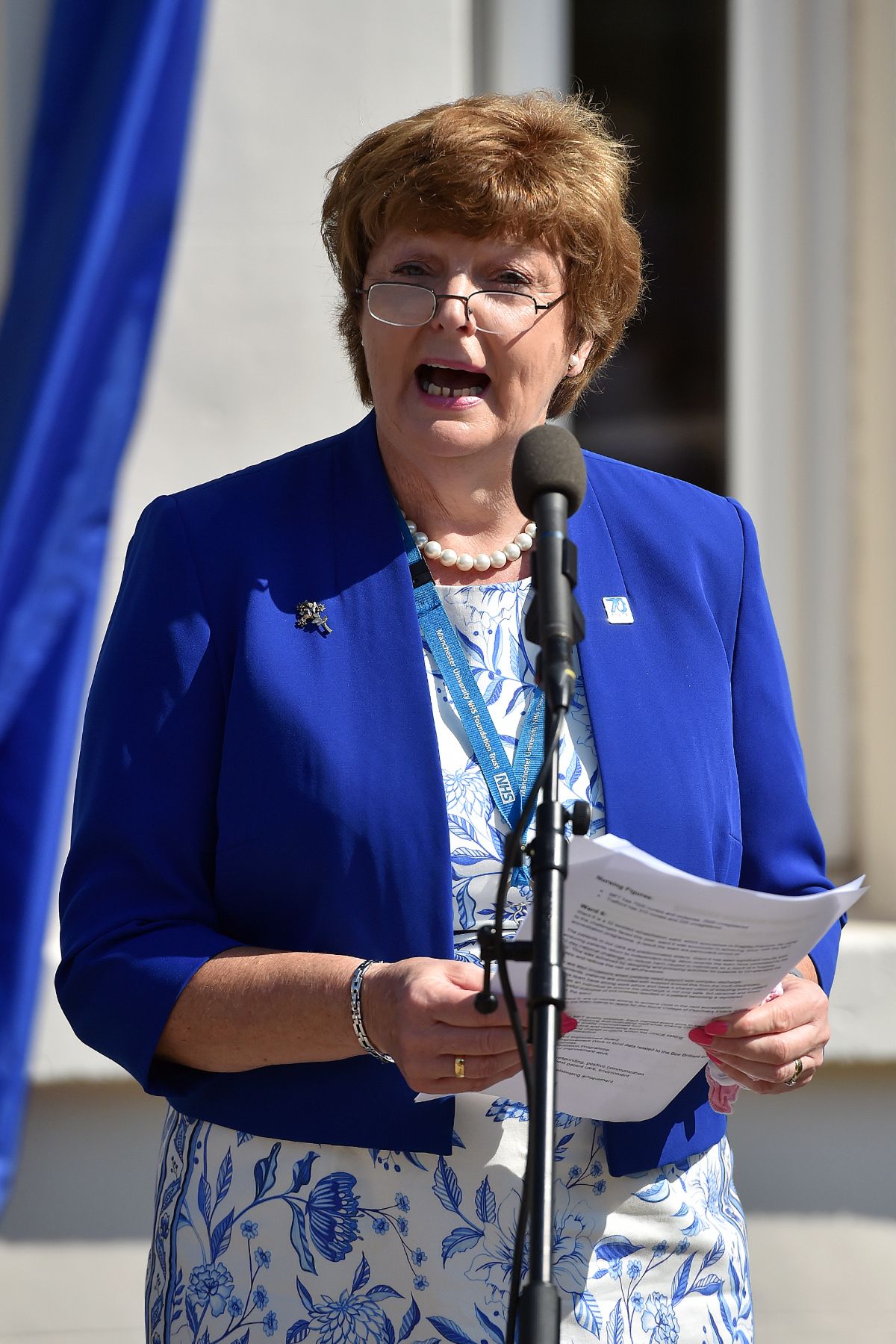
Kathy Cowell, Manchester University NHS Foundation Trust chair(Image: Eddie Garvey)
“There’s a very simple way to do it,” suggested Ms Cowell, when asked by Mayor Burnham. “All that needs to be said is that this rule is not retrospective, it applies to all new staff you bring in. Don’t apply it retrospectively to staff already here. That would solve it in an instant.
“We have looked at every possible avenue on this, and we are bound by the law. We’ve got visas for this cohort of people, but across the organisation.
“The important thing is not to break the law in any of this, and find a solution to help these people within the law. I’ve got some heartbreaking stories, I could have you all in tears around some of the stories I’ve heard.
“We’ve offered legal and holistic advice to people, and wellbeing support. But we need to find a solution to this because this is our people, who look after our patients and our families, who we are not treating well.”
A government spokesperson said: “We hugely value our international care workers – but too many have seen unacceptable levels of abuse and exploitation.
“To stamp this out and to reduce reliance on international care workers, the government has put an end to overseas recruitment. We are focusing on boosting domestic recruitment and retention by launching the first ever adult social care fair pay agreement, improving training and qualifications and creating the first universal career structure for carers.”