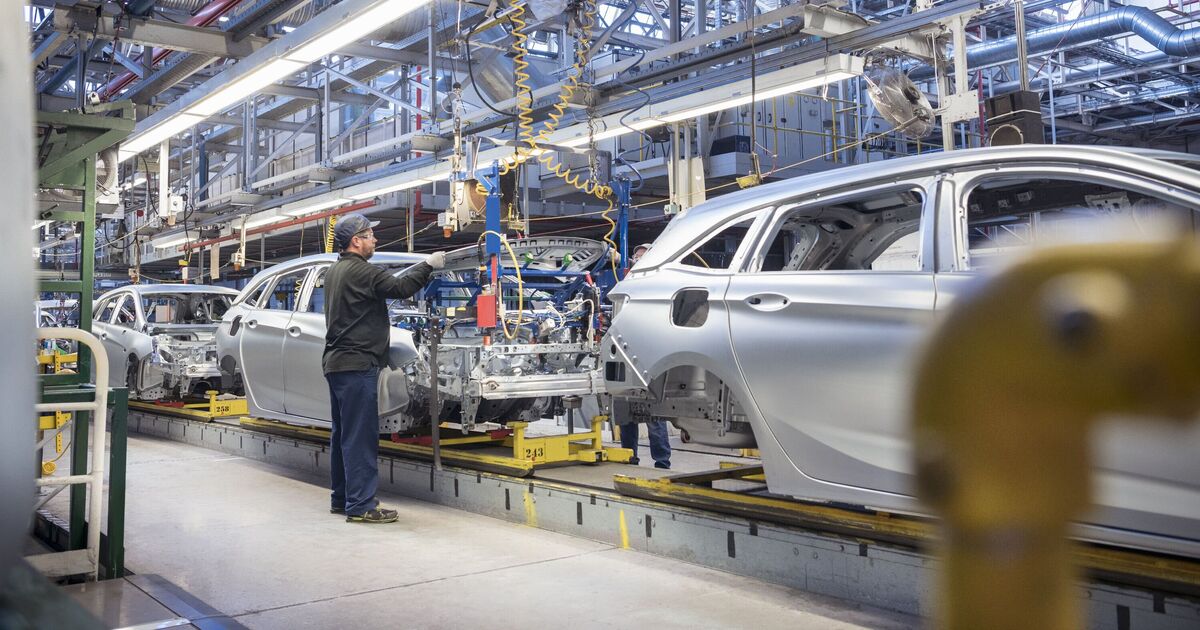
New EU rules could massively impact the UK car market (Image: Getty)
The European Union was always going to find ways to wreak havoc in revenge for Brexit. And so it is that the UK car industry faces the sort of hammer blow that suggests leaders in Brussels have completely lost the plot. First, it was new customs and border requirements, with regulatory and tariff barriers in place. That was bad enough.
But now the EU is set to go a step further, with officials considering strict new ‘Made in Europe’ rules. The move is likely to put UK car manufacturers at a major disadvantage when selling in Europe. Britain’s car industry has considered the move a “significant threat”, with proposals outlining that only vehicles “made in Europe” would qualify for subsidies.
Large companies managing more than 100 cars or vans would also be forced to buy a certain number of EU vehicles, cutting demand for vehicles made at plants in the UK. The move is clearly aimed at stopping the rise of China who can continually undercut European brands with cheaper costs. But Britain gets caught in the crossfire.
UK car firms currently provide a host of components to EU manufacturers with around 14million crossing the border every year.
Engines and powertrains, electrical parts, brake components and headlights built in Britain are being fitted on EU cars every day of the week. The UK’s Society of Motor Manufacturers and Traders (SMMT), who oversee the car market, have blasted the EU’s move as a “protectionist” play.
READ MORE: ‘Keir Starmer just slapped drivers round the face again – he’s laughing at us’
READ MORE: UK’s dependency on China puts 90,000 jobs at risk as grim warning issued

UK firms export millions of parts to the UK every year (Image: Getty)
Mike Hawes, the SMMT’s chief executive, said: “Unless the UK can be seen as part of that [the European car market that would be protected], these proposals could have the effect of delivering what Brexit didn’t deliver – and that’s making it much harder for UK-produced vehicles to access the European market. So this is a significant threat.”
The EU’s move is a slap in the face for UK manufacturers and could be considered more than a tad hypocritical. The Brexit process was blighted by EU chiefs blasting the UK for supposedly being petty and unreasonable.
Back in 2020, EU negotiators accused the UK of having “no willingness to compromise” in trade talks, pushing the UK to get “more realistic”. However, it is now the EU that can be accused of turning its back on one of its closest neighbours to adopt its own singular approach. Oh how the tables have turned.
Forcing manufacturers to ditch what they know to buy EU-branded products isn’t right. The market should be open to all and it’s surely the EU’s hatred of Brexit that has got us to this point. The EU is also facing accusations that the strategy could undermine the free trade deal signed by the UK and the EU.
The European Commission is also set to double down with a series of measures aimed at prioritising EU firms and cutting off the UK. From 2035 onwards, EU carmakers will need to comply with a 90% reduction in tailpipe emissions compared to 2021. However, the remaining 10% of emissions would need to be compensated for through the use of e-fuels, biofuels or low-carbon steel made inside the European Union.
The EU is also working on a new Automotive Omnibus, a plan that is set to ease administrative burden and cut costs for car brands. The Commission said businesses are expected to save approximately €706 million (£611million) per year which could radically boost their competitiveness.
The EU is also working on a new battery alliance, providing up to €1.5 billion (£1.3billion) to support European battery cell producers through interest-free loans. And the EU has already agreed a deal allowing 250,000 European-made vehicles to enter India at preferential duty rates, far above the 37,000-unit limit India has provided to the UK.
Crucially, manufacturers receive reciprocal access, with India securing duty-free entry for up to 625,000 vehicles into EU markets.
None of this helps the UK car industry, and today it was revealed that British car, van, truck and bus production fell to its lowest level last year since 1952. Just 764,715 vehicles were built in 2025, which was 15.5% fewer than in 2024.
The major cyberattack at Jaguar Land Rover, the closure of Vauxhall’s plant in Luton and deep uncertainty over US trade policy have all been major factors.
But make no mistake – the EU trying to protect its own car giants at any cost is of no help. European leaders need to accept the decision of the British public to leave the EU and come up with some sensible trading decisions. Throwing their toys out of the pram looks desperate and weak.