In this week’s column from Glasgow City Archives, archivist Curstaidh Reid looks into the history of one of the city’s most famous and important streets.
Often, names of areas or streets hint at their location’s former natural landscape. For example, the Broomielaw (or Brumelaw) means slope or meadow with broom.
From the name you would never guess that this small section along the north bank of the Clyde would go on to become one of the most important connecting points between the river and the city around it.
There are mentions of the Brumelaw and Broomielaw in the city archives going back to 1573, mostly transfers of land in or near the Broomielaw Croft between different estates.
It was not until 1688 when the Broomielaw bank was chosen as the spot to build the city’s first quay, that the area saw its first significant development.
At this time, the Clyde was too shallow to take in seafaring ships and so the quay was built to receive smaller ships bringing goods down from Port Glasgow.
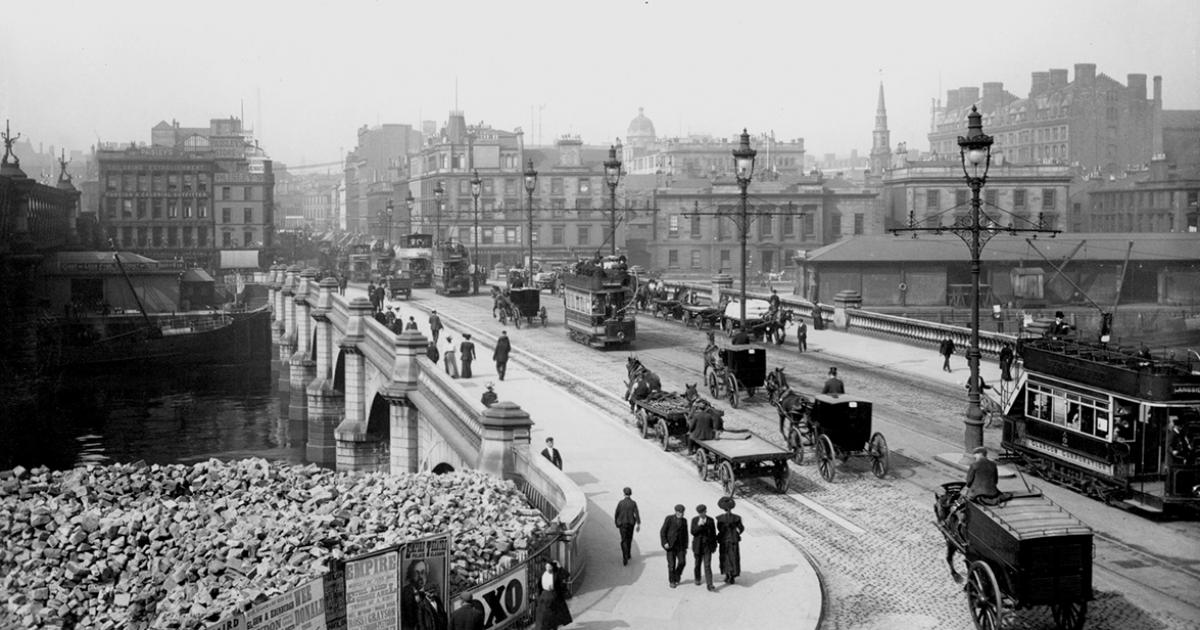
Corner of Broomielaw and Jamaica Street, 1914 (Image: Glasgow City Archives)
Over the next 100 years, the quay was extended bit by bit and the river was made more navigable by clearing sandbanks and deepening the bed to allow larger ships to reach the Broomielaw.
These works were paid for by the Town Council, the Trades House and the Merchants House, as they greatly increased access to various trade markets.
As well as reports and correspondence within the Trades and Merchants House records, historic maps and plans within the Town Clerk’s Department records (D-TC13) also highlight the changes to the area over the years.
Foundries, ropeworks and glassworks were built along this section of the river, including the imposing Oswald bottleworks in 1730. Located at the corner where Broomielaw meets Jamaica Street, the works included a large conical building which must have dominated the skyline in the area.
The importance of the site is also reflected by the choice to build the city’s second ever bridge there in 1772, at the junction between Broomielaw and Clyde Street.
Named the New Bridge at first, it has also been referred to as the Broomielaw Bridge, Jamaica Bridge and is now called the Glasgow Bridge. It was updated by Thomas Telford in 1833 before being replaced by its current version in 1899.
By the early 1800s, the river traffic at Broomielaw had become so busy that further work was required.
An 1807 report by the engineer John Rennie described vessels lying three or four rows deep from the wall, which greatly delayed the unloading of cargo and caused much damage, particularly during floods.
The proposed solution was to create a wet dock to accommodate more boats, though it was eventually decided to build this at the same spot but on the opposite south bank of the river. The dock became known as Kingston Dock.
The river traffic was supercharged by the invention of steam navigation. Henry Bell’s paddle steamer, the Comet, launched in 1812 and was the first successful passenger steamboat service in Europe.
Paddlesteamers, 1905 (Image: Glasgow City Archives)
Leaving the Broomielaw on Tuesdays, Thursdays and Saturdays at noon, passengers could now travel to Helensburgh and Greenock much faster and more comfortably compared to sailing or road travel. Thus began the age of going on trips “doon the watter”.
The Broomielaw would also be where many migrants would first step foot in Glasgow. From 1813 onwards, thousands of Irish migrants travelled over on the ferry known as the Derry Boat, which provided a direct link between Derry and Glasgow.
Clyde Navigation Trust building (Image: Glasgow City Archives)
The area’s standing as a key transport hub was further developed with the opening of Glasgow Central Station in 1879, connecting road, water and rail together.
A hoist was installed to help transfer cargo and baggage between the railway platforms above and the quay below.
Although the Clyde Navigation Trust building at the corner with Robertson Street serves as a reminder of the street’s significant part in the history of the river and its connection to the city, Broomielaw has changed much over the years.
Thanks to its inclusion in several popular songs and poems, however, its chapter as a bustling shorefront hub has lived on in many Glaswegian minds.