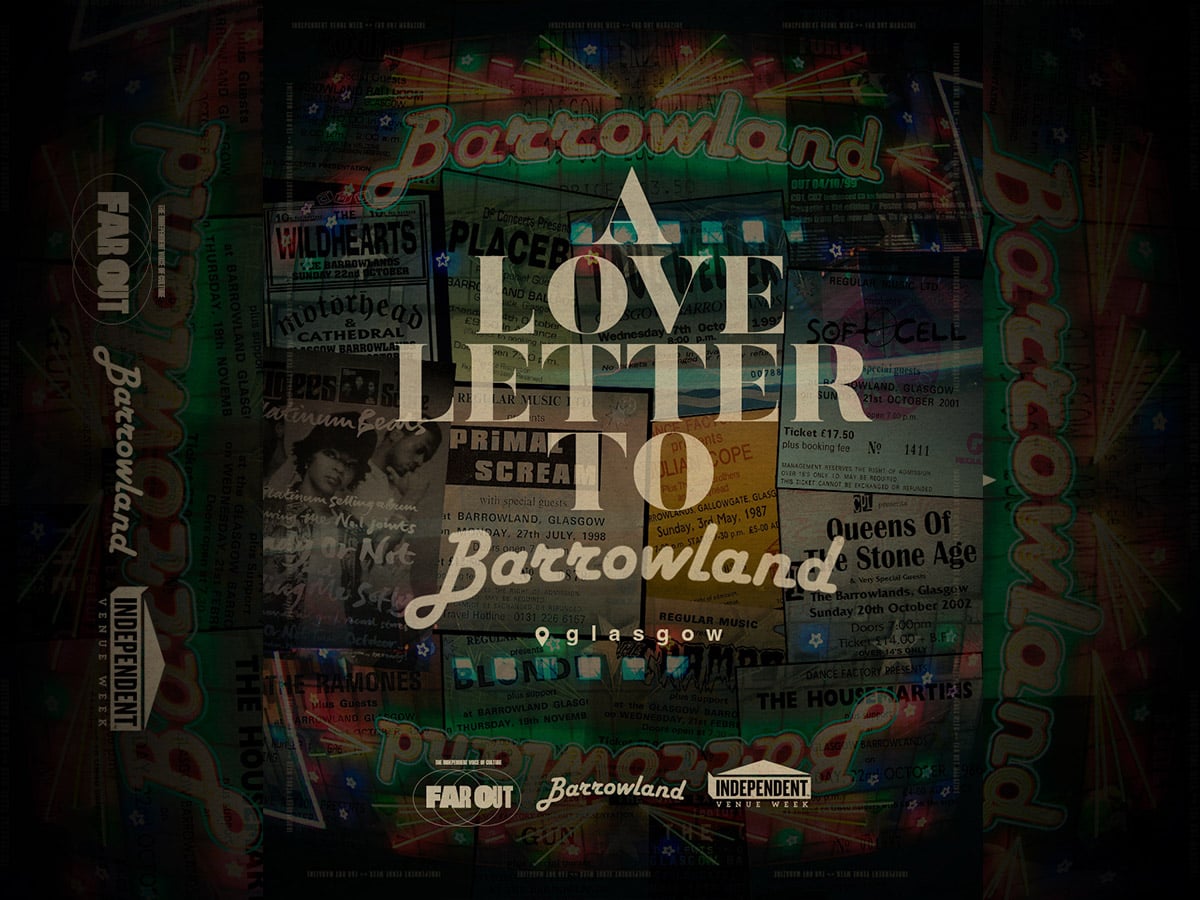

(Credits: Far Out / Glasgow Barrowlands)
Fri 30 January 2026 9:38, UK
The Calton district of Glasgow is a funny place to define.
Strictly, there are no borders to it – it’s just somewhere vaguely east of the city centre, and north of the river. There’s no walls, no inhibition, no sense of absolute permanence. In many ways, there’s no better place to have the Barrowland Ballroom.
Going by its better-known local moniker of The Barras, you have to understand that this is far more than a venue, but a cultural institution. It’s perhaps the only place on Earth with a market next door that sells Instagrammable homeware next to pirated DVDs, with a pub on the corner emblazoned in Glasgow’s green and white, being just a stone’s throw from Celtic Park, that sits happily next to a mothball vintage clothing store.
In essence, The Barras is a beehive between history, gentrification, politics, and people – and at the heart of it all sits that glowing neon sign. It’s a mecca that represents something far greater than music for the thousands upon thousands who flock from every corner of the world to stand under its behemoth wrath.
But the clue is in the name: the Barrowland Ballroom was not always steeped in musical history in quite the same way that it is now. Originally built in 1934 by founder Maggie McIver, who subsequently gained the reputation as the ‘Barras queen’, the original version of the building was burned down in a 1958 fire and had to be rebuilt from the ground up, to eventually reopen in 1960.
That origin story, although with its tragic episodes, proves more than anything what The Barras really means to a city like Glasgow, where culture reigns at its beating heart. In all honesty, it doesn’t really matter about the physical bricks and mortar – it’s the spirit of the venue as well as the people that inhabit it which is the real key thing.
 A love letter to the Barrowland Ballroom. (Credits: Far Out / Glasgow Barrowlands)
However, from its reopening in the early 1960s, The Barras wasn’t destined to become a music venue landmark for another 20 years yet. In that time period, it became the haven of every Glaswegian’s favourite weekend activity: the dancing. Complete with a sprung dancefloor that – miraculously, to be fair – still stands today, the place harboured an atmosphere of not just a dancehall, but jumping towards the stratosphere.
The analogy is fitting, given the outer landmark of the neon sign and the inner draw of the star-dusted ceiling. In the context of a gig, there’s nothing to beat the flash of the lights and the lure of the stage, as you look up and feel like you’re seeing a sky full of comets, new orbits, and horizons. Is there really any better metaphor for the emotion that live music creates?
Ask anyone in Glasgow what their relationship with The Barras is, and they’ll invariably reply with some raucous tale of a mosh pit, a drunken night, or a seminal experience of feeling fully affirmed that the place and all it stands for is the epicentre of life.
My own perception of The Barrowland is much the same. For a long time in my mind, it essentially represented a pinnacle in music where, if you were able to play there, you could make it anywhere, because no other venue is as special but equally as inimitable.
That sense has only further solidified for me in the past year, seeing two shows at opposite ends of the spectrum, but both bottled the magic. Self Esteem brought a sense of theatre to the venue, never seen before – considering this is a place with a 1,900 maximum capacity, that ability to not just command the stage but make it clear that ambitions weren’t limited by mere size seems like the spirit of The Barras in a nutshell.
 Lauren Hunter on her relationship with the Barrowlands.
Seeing The Last Dinner Party there in November was also a gig I will never forget, yet for very different reasons, because the show itself was going off without a hitch, but with a nervous, palpable, twitchy energy rippling through the crowd, and then suddenly, a roar went up, while at Hampden Stadium on the other side of the city, Kenny McLean had scored from the halfway line, and Scotland had qualified for the World Cup.
It didn’t matter that this was a completely different event, in a completely different area, potentially with a completely different demographic, because with the atmosphere that erupted, you would have thought that The Last Dinner Party themselves had scored the goal, right there in the middle of the stage.
Even after the gig ended, people stayed to dance, for no other reason than the sheer joy and celebration of being there at that moment, and as the famous dancefloor bounced beneath the dizzying stars, I couldn’t shake the feeling that this is the place where our grandparents met, our parents revelled, and we, as the new generation, were making history.
Nothing epitomises the significance of The Barrowlands better to me. It’s the place that people flock to, not just for the events on the line-up, but for the total spectrality of being there and enjoying life. The quote on the side of the building, taken from Douglas Stuart’s Shuggie Bain, says it best: “You’ll not remember the city, you were too wee, but there’s dancing. All kinds of dancing.”
 A selction of tickets and posters from the Barrowlands. (Credits: Glasgow Barrowlands)
Related Topics