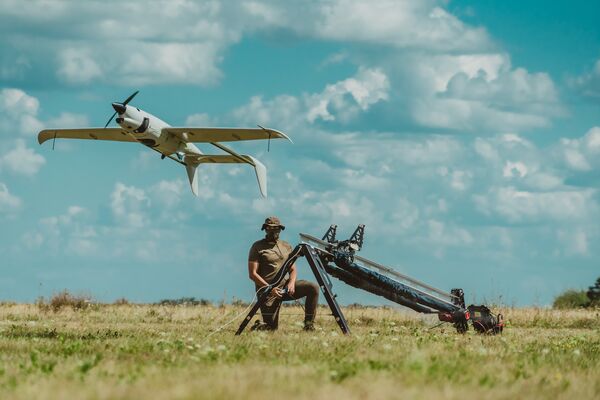

Ukraine has now introduced a hydrogen-fuelled version of its Raybird UAS (pictured), which made its combat debut in December 2025. (Skyeton)
The hydrogen-fuelled Raybird unmanned aircraft system (UAS) has made its combat debut in Ukraine, manufacturer Skyeton announced in mid-January.
The domestically built hybrid Raybird UAS was deployed on full-scale combat duties with an undisclosed unit of the Ukrainian Defense Forces in December 2025.
“The Raybird UAS is used for long-range reconnaissance missions. By utilising hydrogen-electric propulsion, the platform offers enhanced operational efficiency and environmental benefits for both defence and civilian applications,” the Ukrainian manufacturer said.
Having already amassed more than 350,000 conventionally fuelled combat hours since entering service with Ukraine in 2019, the hydrogen cell has been introduced for a number of reasons. As explained by Skyeton, these comprise a negligible thermal signature, an increased service ceiling, and a much quieter audio signature. In terms of the logistics of introducing another fuel type to the front lines, the company said any additional burden had been minimised with the operating unit either receiving pre-filled tanks to swap in and out of the air vehicle like cartridges, or else receiving a compact mobile unit that produces hydrogen on-site as needed.
“The mass-produced Raybird, which runs on an internal combustion engine (ICE), allows for a flight endurance of over 28 hours. As of January 2026, the hybrid version of the drone can remain airborne for approximately 12 hours,” Skyeton said.
For more, please see:
Ukraine, UK create joint venture to pitch Raybird UAS for British military requirements
Go beyond the headlines — with direct links to interconnected entities
Get full access to validated equipment, military capabilities, and market insights.