Let’s hope that SNP politicians have the current Scottish Social Attitudes Survey memorised off by heart. The latest report, published by the Scottish Centre for Social Research, revealed an astonishing collapse in public trust in the NHS.
Only 22% of Scots are satisfied with the health service: the lowest level since the survey began in 1999. Trust is at rock bottom.
It isn’t just the level of personal care that we receive as citizens – with patients lying in hospital corridors, the lottery of getting to see your GP, and agonising waiting lists – driving public concerns.
Today, we’re bombarded with repeated NHS scandals throughout Britain: serial killer nurses, sociopathic surgeons, money-grubbing bureaucrats.
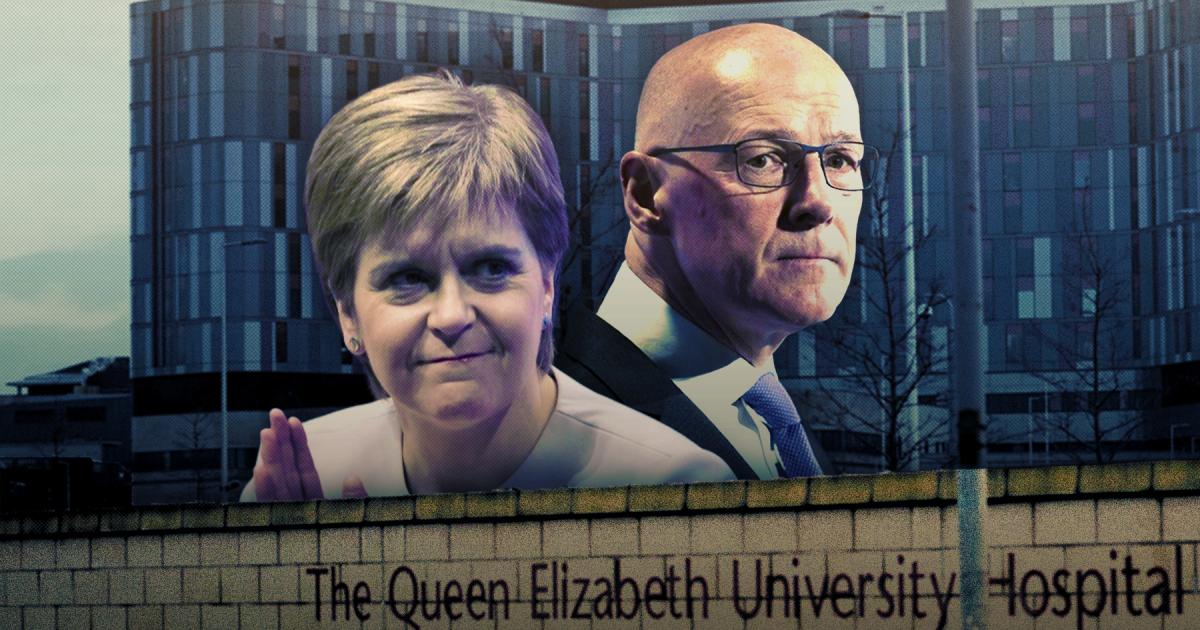
The antics of the Scottish government and the NHS itself around the scandal besetting Glasgow’s Queen Elizabeth University Hospital (QEUH) is super-charging public concerns, draining what little trust remains, and fostering a sense that the people who run our hospitals are dishonest and dangerous.
As we know, police are investigating the deaths of three children and three adults at the hospital. There has been a public inquiry into safety concerns at the billion-pound QEUH.
Last week, in closing submissions to the Scottish Hospitals Inquiry, NHS Greater Glasgow and Clyde (NHSGGC) admitted for the first time that it was “more likely than not” that contaminated water caused serious infections in vulnerable patients.
This has been agonising and distressing enough for the families who lost loved ones. However, events over the last week relating to the question of whether or not political pressure was applied to speed up the opening of the hospital have increased their pain, and further corroded public trust in Scotland’s NHS.
First, NHSGGC said that “pressure was applied to open the hospital on time and on budget”, and that it was now clear the hospital “opened too early” and “was not ready”.
First Minister, John Swinney – Finance Secretary at the time of the opening – was asked if the political pressure referred to had been applied by ministers. He said: “The direct answer to that question is no.”
Nicola Sturgeon – First Minister at the time the hospital opened – released a statement saying any suggestion she “applied pressure for the hospital to open before it was ready or that I had any knowledge of safety concerns at the time are completely untrue”.
Read more from Neil:
The hospital opened to much fanfare in 2015, an election year. Sturgeon attended the ceremony with the late Queen.
After denials by Sturgeon and Swinney, NHSGGC issued a ‘note of clarification’ saying that the “pressures to open on time and on budget” came from “within NHSGGC, with the chief executive at the time confirming that he would have sought updates on that basis”.
However, a new internal official report has emerged which says there was indeed “political pressure” to open the hospital before it was ready. The government had this report for seven years.
The document was brought to light by Scottish Labour leader Anas Sarwar. One section reads: “Political pressure was also being felt and no consideration was given to delaying the opening of the hospital despite the issues being faced with completion and operation.”
Other sections describe “dysfunctional” management and a maintenance budget “about half” of what staff believed was required. The report also said that the hospital was “far from optimum” in terms of operational readiness when patients began to arrive.
Someone is lying here. Either the NHS in Glasgow, or John Swinney, or Nicola Sturgeon.
The public – and most importantly the families of those who died – want and deserve answers.
Events such as these lie at the very root of the growing mood within this country that democracy just isn’t working for ordinary people. Herein lies the cause of much of our ills today, from polarisation to the growth of extremism.
We have inquiry after inquiry on all manner of subjects – from the needless deaths of children to failures in policing – yet nothing is done, and nothing changes. Nobody is called to account. Justice is never served.
Politicians and bureaucrats go through the motions, mouthing platitudes, promising action, talking of lessons learned. Yet the same mistakes keep being made. Ordinary people on the ground see no improvement.
Indeed, the overwhelming message is that our concerns do not matter. We feel lied to and ignored, and we feel powerless and forgotten.
When it comes to the Glasgow hospital scandal, voters see clearly what has happened. Politicians and NHS officials have failed. People have died. And now lies are being told about whether or not political pressure was applied which may have made matters worse.
The people are on the side of the families who say that their loved ones were “killed and poisoned”.
There is a simple way to clear this up. Swinney, Sturgeon, any other relevant ministers, and the current and former executive team of NHSGGC should be summoned to the Scottish Parliament’s health committee and compelled to give evidence about who applied political pressure. Lying under oath is a criminal offence. Perjurers face up to five years in prison.
This state of affairs cannot be allowed to continue. Someone is lying about a matter of grave concern to the Scottish public, and by doing so causing serious damage to both our democracy and trust in our NHS.
We need to find out who is responsible and have them dealt with accordingly, be that through the justice system, dismissal or removal from office.
Neil Mackay is the Herald’s Writer-at-Large. He’s a multi-award winning investigative journalist, author of both fiction and non-fiction, and a filmmaker and broadcaster. He specialises in intelligence, security, extremism, crime, social affairs, cultural commentary, and foreign and domestic politics