
A nest of dinosaur eggs dating back around 150 million years has been discovered on a beach cliff in Torres Vedras, Portugal. The site, located on Santa Cruz Beach, contains at least ten eggs from the Late Jurassic period, and initial signs suggest that many of the embryos may have successfully hatched.
The discovery was made by Carlos Natário, a researcher affiliated with the Centre for Research in Palaeobiology and Palaeoecology (Ci2Paleo), while inspecting known fossil sites along the coast. An Instagram post points out that the region has long been recognized as a paleontological hotspot, and this latest find helps confirm its scientific importance.
Fossil Uncovered During Routine Survey
While conducting monitoring work on the cliffs of Santa Cruz Beach, Natário identified a small nest embedded in sediment. It contained the remains of ten dinosaur eggs, clustered tightly together. Their shape and shell texture led researchers to classify them as dinosaurian, and early indicators suggest they may belong to a carnivorous species.
The nest is estimated to date back to the Late Jurassic, a period known for its high diversity of dinosaur species. According to a statement from the Natural History Society of Torres Vedras, experts based their initial hypothesis on the eggs’ external structure and porosity. The fossil’s location on an exposed cliff face has helped preserve its condition remarkably well.
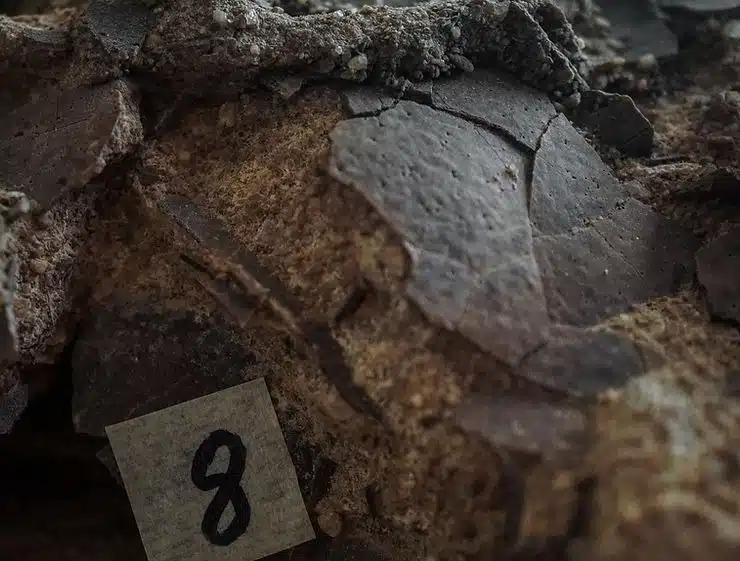 Close-up of fossilized eggshells, preserved three-dimensionally in the sediment, with the fragments under study identified. Credit: SNH
Evidence Points To Successful Hatching
Early analysis suggests that the majority of the hatchlings likely emerged from their eggs. Bruno Camilo, director of Ci2Paleo and doctoral researcher at the Instituto Superior Técnico, explained that:
“almost all the dinosaur hatchlings hatched, as there is a noticeable migration of the shells from the hatching side back into the eggs, with little lateral dispersion of the shells.”
Camilo also highlighted that the eggs’ outer surfaces are still intact. This level of preservation may allow further study of the microstructure, which can offer more information about the species involved. Though sediment currently covers the interior, there is a possibility that some embryonic remains are preserved inside the block.
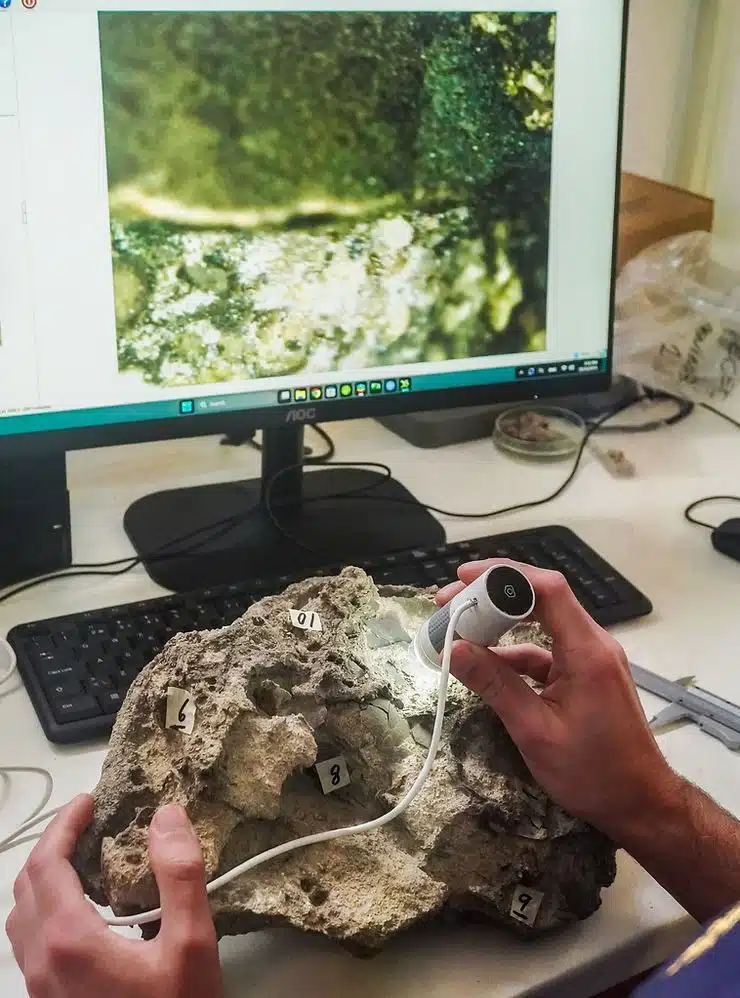 Preliminary lab analysis of a Late Jurassic dinosaur egg block. Credit: SNH
CT Scans Reveal the Invisible
To avoid damaging the fossil, the team plans to use CT scanning to examine the contents of the eggs. In Camilo’s view, new technologies now “allow us to see the imperceptible without resorting to potentially destructive techniques.” as reported by The Macao News. This approach is expected to help determine whether any embryonic structures survived.
While the scans will take time to process, they may reveal previously hidden anatomical details. If embryonic material is present, it would make this find even more valuable to the study of dinosaur reproduction and development. Portugal remains one of the few places in the world where entire nests of dinosaur eggs continue to be discovered.
The nest discovered at Santa Cruz is another milestone in Portugal’s growing paleontological record. Ci2Paleo researchers will continue their on-site analysis.