
From the ongoing game of musical chairs that is French politics right now to the move to replace American tech with French products, via France’s family-friendly reputation, Inside France is our weekly look at the latest news and talking points from France.
Inside France is editor Emma Pearson’s weekly look at some of the news, talking points and gossip in France that you might not have heard about. It’s published each Saturday and members can receive it directly to their inbox, by going to their newsletter preferences or adding their email to the sign-up box in this article.
Pick me
It’s all about alliances in French politics at the moment – nominally for the local elections which take place in March, but in reality everyone has an eye on the spring 2027 presidential election.
In this febrile atmosphere parties are announcing alliances, breaking alliances and negotiating for more alliances with all the seriousness of kids picking teams in sports class.
Journalists often use the term ‘wide open’ to try and make elections seem more exciting than they are – but this really is a fair description for 2027; polling suggests that the far-right candidate (who will either be Marine Le Pen or Jordan Bardella depending on whether she wins her appeal against her embezzlement conviction) will almost certainly make it to the second round.
Other than that – it’s anyone’s guess. Not only that, but neither the centre or the left have settled on their candidates or even decided how they will pick candidates (with the exception of the possibly doomed primary of the ‘united left’).
I was interested to note that the centrist candidate in the Paris mayoral elections listed his party in tiny type at the bottom of his election flyer, but much more prominently stated that he was ‘backed by Gabriel Attal and Edouard Philippe’ – the two most likely candidates for the centre in the 2027 elections.
French presidential politics has always been strongly personality based, but now it seems that we’re moving away from parties altogether.
No kids
A controversy that has been raging this week in France is the decision to ban children from certain types of first class train carriages. The actual proposal was really quite limited – only a few trains a week in a business class carriage – but the reaction was such that SNCF has now backtracked on the idea.
The strength of the reaction seems to confirm France’s reputation as a family friendly country – there are few spaces where children are explicitly not welcomed but this is a two-way street; children in spaces such as restaurants, art galleries and indeed trains are expected to behave.
I’ve heard French parenting criticised as being overly harsh or even ‘Victorian’, but I find that it’s more about French parents putting an increased emphasis on their children being considerate of others and aware of their surroundings (and when to use their ‘indoor’ voices).
In short, as this Paris-based journalist and mum puts it: “Treating children like small but valuable and responsible members of society helps them evolve into polite and respectful adults – how can they learn what society expects of them if they are excluded from public spaces as kids?”
Talking France
We discuss the child-free controversy on the latest episode of Talking France, as well as the upcoming local elections, and some of the best things to do in spring in France – listen here or on the link below.
Tech
Of course you can access Talking France on the usual platforms, including the French streaming platform Deezer.
In fact, if you are trying to cut American tech out of your life, we have a list of French alternatives.
The French government also announced this week that it intends to move off the American-owned platforms Zoom and Teams, in favour of French alternatives.
It is of course not unusual for governments to promote home-grown companies, but the reasoning for this decision was not only to support French companies, but explicitly to move away from US companies.
The public functions minister said that the aim was to “move away from dependence on American digital tools”.
It’s a very serious topic with entirely worthy aspirations, but I couldn’t help but laugh at this response.
Cowards! Bring back MINITEL en.wikipedia.org/wiki/Minitel
— Matthew Whitfield (@matthewwhitfield.bsky.social) 26 January 2026 at 17:18
For those who are unaware (or too young), Minitel was the proto-internet that was developed by the French government back in the 1980s and was installed in homes and businesses across the country long before Google was even a gleam in the eye of Sergey Brin.
READ ALSO: Minitel – the French online system that preceded the internet
A walk in the rain
One of my favourite things about Paris is what a great city it is for walking, and one of the things I find most hilarious about the modern world is that the eminently sensible and actually quite boring urban planning theory known as the ’15 minute city’ has become a conspiracy theory among the mouth-frothing loons of this planet.
Into that arena this week stepped the UK’s Daily Telegraph, describing the 15-minute city – which is the idea that city-dwellers should have the basics of life such as food shops, schools and leisure facilities within a 15-minute walk or cycle – as ‘Stalinist’.
Anyway, I walked to the florist at the weekend so am now apparently a disciple of Stalin . . .
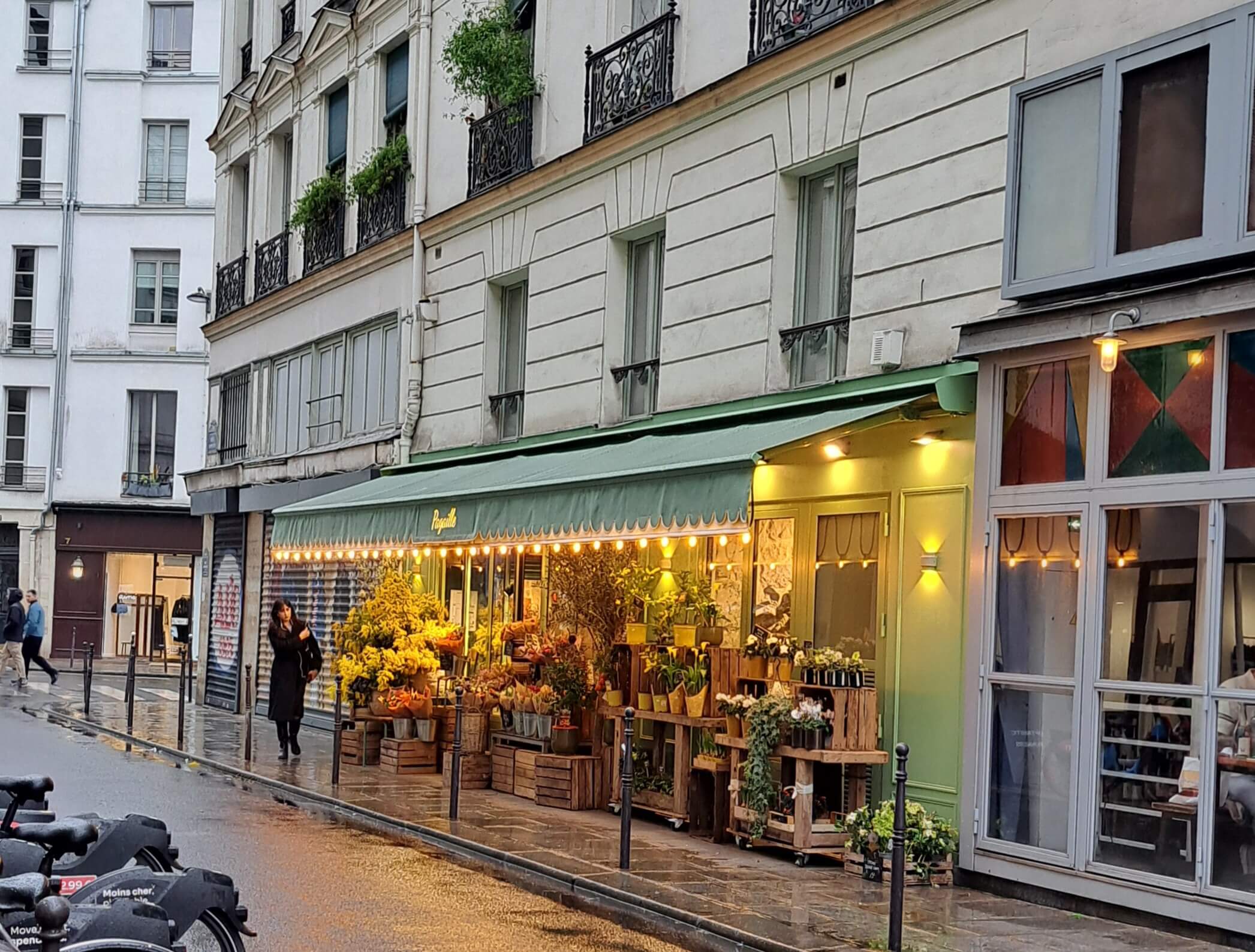
A Paris florist on a rainy afternoon. Photo: Emma Pearson
Inside France is editor Emma Pearson’s weekly look at some of the news, talking points and gossip in France that you might not have heard about. It’s published each Saturday and members can receive it directly to their inbox, by going to their newsletter preferences or adding their email to the sign-up box in this article.