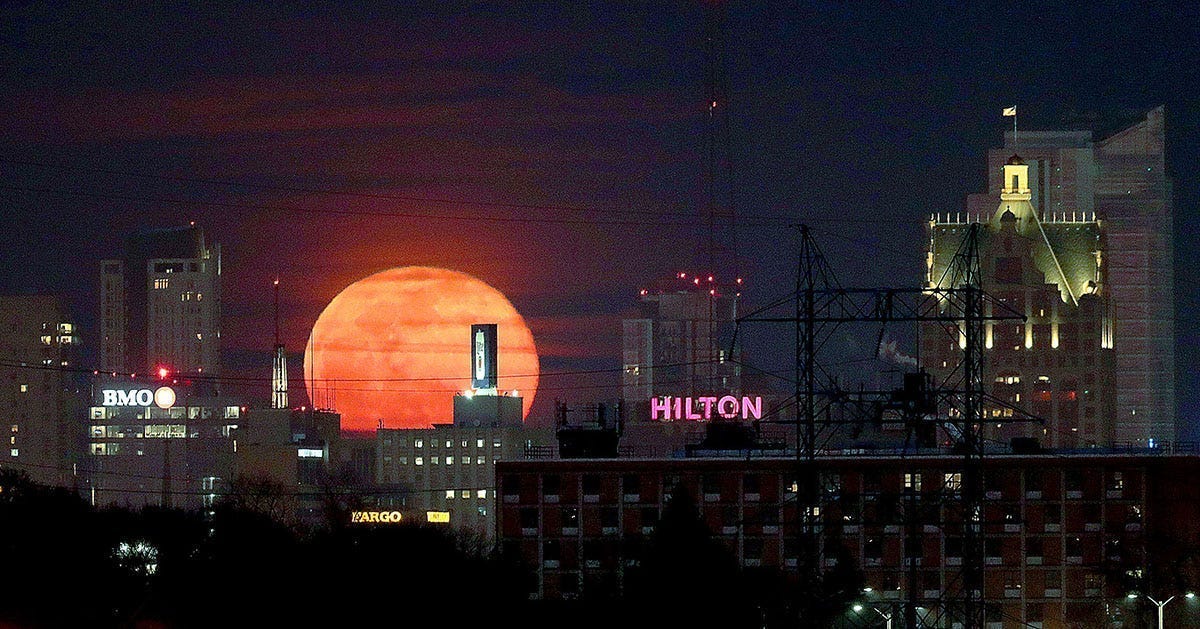
February begins with snow on the ground in some parts of the world and a Snow Moon illuminating the night sky.
On Sunday, Feb. 1, February’s full moon, also known as the Snow Moon, will reach its peak at 5:09 p.m. ET, according to the Old Farmer’s Almanac.
The sun may be close to setting during the moon’s peak in some parts of the country, while in others it’ll still be afternoon, but the moon will still appear full at night and for a few days afterward.
This next full moon will occur on March 3 and is known as the Worm Moon. It will be a total lunar eclipse, also known as a blood moon, visible across North America.
See list of 2026 lunar events: A blue moon, lunar eclipses and super moons. What 2026 has in store.
Wolf Supermoon photos are howling good shots of 2026’s first full moon
1 of 8
The moon rises on the eve of a Wolf Moon supermoon as passengers look out from a pod on the London Eye wheel in London, Britain, Jan. 2, 2026.
When is the February full moon?
The full moon peaks on Sunday, Feb. 1, at 5:09 p.m. ET, according to the Farmer’s Almanac.
When is the best time to see the full moon?
The moon may not be visible at its peak in some parts of the country, but backyard astronomers will still be able to see it in its full glory, weather permitting.
The moon will still appear full at night and for a few days afterward. It may even appear full the night before it peaks, depending on where you are.
Maps of sky coverage
As of Friday, Jan. 30, the National Oceanic and Atmospheric Administration (NOAA) predicts that over half of the U.S. will have clear skies at 7 p.m. ET on Sunday, Feb. 1. However, cloud coverage could change at around 1 a.m. ET.
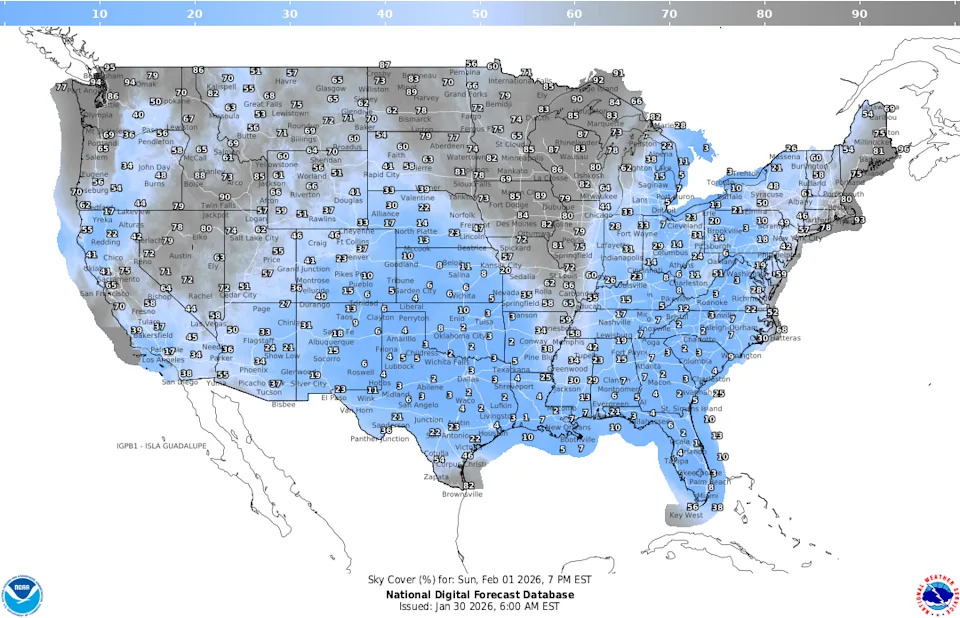
As of Friday, Jan, 30, the most of the South will see very little cloud coverage at 7 p.m. ET on Sunday. Feb. 1.
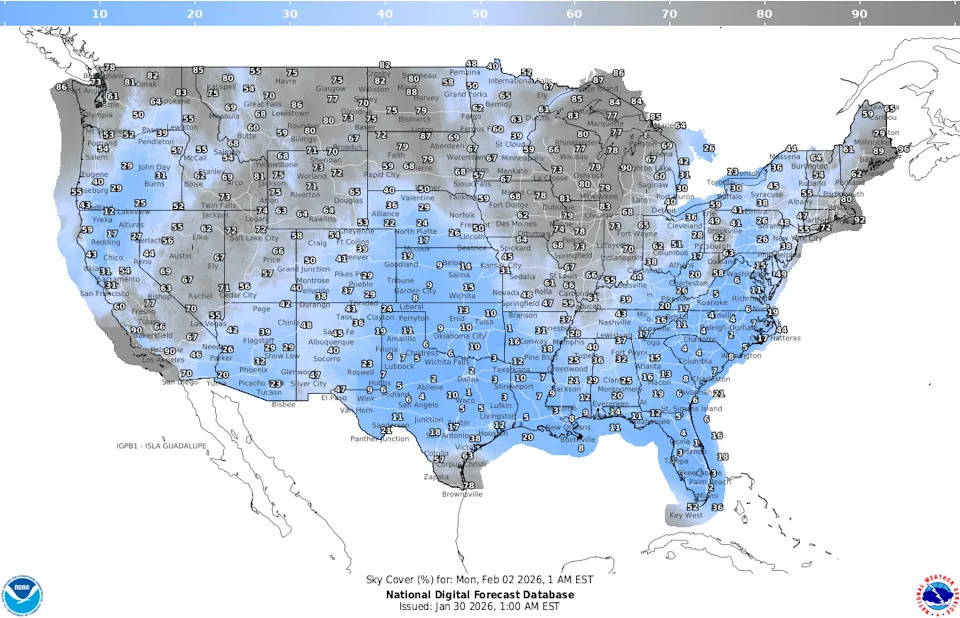
As of Jan. 30, Washington state is expected to have cloud coverage through the night on Sunday, Feb. 1 and in the early morning of Monday, Feb. 2 at 1 a.m. ET (10 p.m. local time), according to NOAA’s predictions.
Why is it called the Snow Moon?
February’s moon is known as the Snow Moon because it occurs around the time of peak snowfall, according to the Old Farmer’s Almanac. February is typically the snowiest month in North America.
However, many Native Americans have named the moon or associated it with animals. Other names for the moon include:
-
Bald Eagle Moon or Eagle Moon
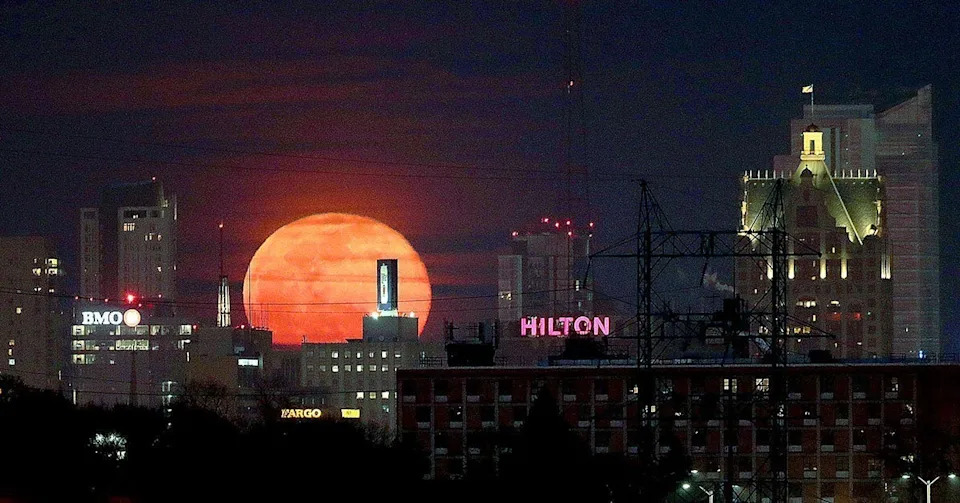
A full moon rises over Milwaukee on Feb. 27, 2021.
List of 2026 full moons
The moon will be full on the following dates, according to the Farmer’s Almanac:
-
Snow Moon– Peaks Feb. 1, at 5:09 p.m. ET
-
Worm Moon (total lunar eclipse)- Peaks March 3, at 6:38 a.m. ET
-
Pink Moon– Peaks April 1, at 10:12 p.m. ET
-
Flower Moon– Peaks May 1, at 1:23 p.m. ET
-
Blue Moon– Peaks May 31, at 4:45 a.m. ET. The blue moon occurs when two full moons occur in the same month. The last blue moon occurred on Aug. 19, 2024, according to Space.com.
-
Strawberry Moon– Peaks June 29, at 7:57 p.m. ET
-
Buck Moon– Peaks July 29, at 10:36 a.m. ET
-
Sturgeon Moon (partial lunar eclipse)- Peaks Aug. 28, at 12:18 a.m. ET
-
Harvest Moon– Peaks Sept. 26, at 12:49 p.m. ET
-
Hunter’s Moon– Peaks Oct. 26, at 12:12 a.m. ET
-
Beaver Moon (super moon)- Peaks Nov. 24, at 9:53 a.m. ET
-
Cold Moon (super moon)- Peaks Dec. 23, at 8:28 p.m.
Julia is a Trending reporter for USA TODAY and covers scientific studies and trending news. Connect with her on LinkedIn, X, Instagram, and TikTok: @juliamariegz, or email her at jgomez@gannett.com.
This article originally appeared on USA TODAY: When is February’s full moon? What to know about the Snow Moon.