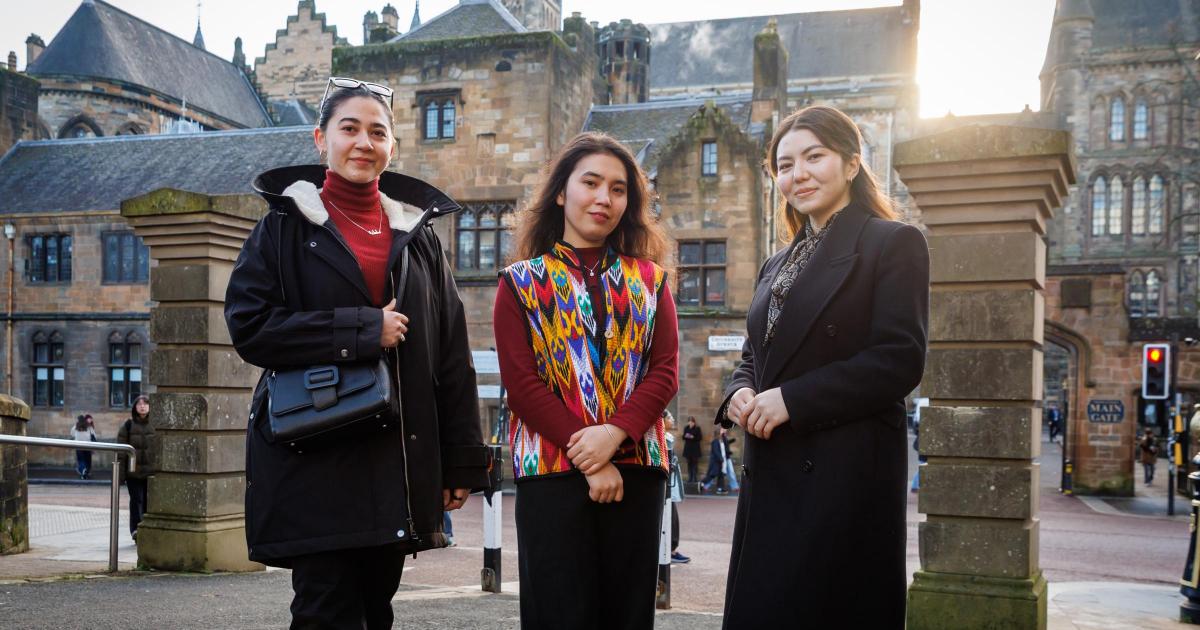
Rakhmanova is from the west of the country, more than a thousand kilometres from the capital, and close to what was once the Aral Sea but is now the toxic Aralkum Desert. Meylieva grew up in the south, near the border with neighbouring Afghanistan, in an area that, like the west, is beautiful but sparsely populated.
Ismoilova, on the other hand, is a child of Jizzakh, an industrial, manufacturing city which is still more than a thousand years old, and has a rapidly increasing population that today is similar to that of Aberdeen.
They had never met before, but have been brought together because of their academic work in education, and the government programme that has given them the chance to study in Scotland. They are just three of a number of young Uzbeks who represent the ‘Hope of the Nation’.
What was once the Aral Sea is now the Aralkum Desert. (Image: Getty)
None of the women come from wealthy families, meaning that their time here has only been possible because of a scholarship run by the El-Yurt Umidi Foundation.
“This scholarship programme covers all our tuition fees, living expenses, flight tickets,” Meylieva explains. “It pays for everything.” As a result, those being supported do not have to worry about paying bills or covering costs during their time abroad, and can instead focus entirely on their studies. The deal is, in some ways, fairly simple: the state will pay for you to study abroad, on the condition that you then bring your new knowledge, skills and experiences back home to help with Uzbekistan’s development.
But the bar for access is extremely high.
“Before even applying for the scholarship,” says Ismoilova, “you must have an acceptance letter from a university.” What’s more, only institutions considered to be elite in the relevant field are accepted, in order to maximise the impact of the programme and, ultimately, the benefits for Uzbekistan itself:
“You cannot choose any random university just because you want to go abroad.”
“You can’t be accepted for this scholarship very easily,” adds Meylieva. “It’s very competitive and you have to take several steps, like tests and interviews, before you are selected.”
Uzbekistan contains ancient cities and sites that have stood for thousands of years. (Image: Getty)
They explain that these interviews are especially daunting, because they can involve speaking to more than a dozen specialists and decision-makers, including government ministers, all of whom have to be convinced that your application for the programme, and the benefits that are available through studying your chosen course abroad, represent a worthwhile investment for Uzbekistan.
Choosing an area of study, even one that is recognised as being valuable, isn’t enough – applicants need to show that they have ideas for, and a commitment to, supporting their country’s development plans.
For Rakhmanova, for example, the goal is to return to her home region and support the development of education for women. Saltanat’s dissertation examined medical education for women in a Muslim-majority context.
READ MORE
Uzbekistan has an extremely young population – 60% of the 38m people living in the country are under 30 years old – and many regard this as the nation’s primary resource.
Education is, unsurprisingly, regarded as a central priority, and seen as a critical factor in enabling the country to support, develop, retain, and benefit from its greatest natural resource: its people. For example, the country is currently ranked near the bottom of PISA international rankings, but the goal is to have become a top-30 country by 2030.
The scholarship programme that has brought Ismoilova, Meylieva and Rakhmanova to Scotland is part of a wider campaign aimed at transforming the former Soviet republic and providing opportunities for young people who might otherwise seek to move abroad.
Rakhmanova explains that this includes free university places for promising students, and specific funding to allow women to study Masters degrees for free.
“We could have used this opportunity if we wanted to study in our own country,” she adds, but they all felt that they could learn more, and do more, by coming to Glasgow, which they chose because of the university’s outstanding reputation, as well as its historic campus.
Saltanat Ismoilova, Marjona Meylieve and Zulkhumar Rakhmanova have completed Masters programmes at the University of Glasgow (Image: Colin Mearns)
Having now successfully graduated, the time has now come to think about going back to Uzbekistan, and while they are eager to see their families and put their learning into practice, they now feel permanently connected to Scotland’s largest city.
“Glaswegian people are really like our people,” says Maylieva. “When I have been to Edinburgh or London I felt like I missed home, but I was thinking about Glasgow.”
For Ismoilova, experiencing the warmth and friendliness of Glaswegians has been a particularly special experience:
“Every single person we see here is so polite and so friendly and they accept you as a friend as if they already knew you before they met you. This is what I love about Glasgow people.
“This is a real society. The city itself is like a family
Rakhmanova agrees: “We will come back. We have made promises to each other. Maybe we won’t come to see England, but we will definitely come to Scotland, and to Glasgow!
“We were welcomed here as in our country. We’ve never been treated as foreigners or outsiders. We say that Glasgow is our second home.
“At first when we came we saw everywhere that ‘People Make Glasgow’ and we couldn’t understand what it meant.
“Now we understand that People Make Glasgow.”