Gado/Getty Images
Jewish delis are a sacred place where people gather to indulge in their favorite Jewish delicacies. No matter which one you walk into, you know what you’ll find on the menu. There’s an automatic comfort when you open the deli door to familiar smells of simmering matzo ball soup, brisket, and fries fresh out of the blistering oil. Let’s not forget about the older diva who manages the line and seats people, with her hair full of Aquanet and a voice like she smokes Virginia Slims immediately after her coffee.
It’s a whole vibe, and growing up as a New York transplant raised in South Florida (the New York of the South), Jewish deli culture is deeply woven into my DNA. My grandfather owned the Stage Deli in NYC at one point, and my dad worked there slicing meat. As a child, I went to our favorite Jewish deli weekly. It’s a ritualistic experience which begins with a bowl of half sour pickles, and ends with a giant black and white cookie. My go-to order rarely wavered: Grilled cheese on challah with French fries, and a bowl of matzo ball soup. Jewish delis are scattered almost everywhere if you know where to look. Despite any differences, they’re all built on pride, tradition, and comfort food steeped in Jewish culture. If you’ve never been to one, please allow me to share some of the unspoken rules of ordering and eating at a Jewish deli.
Ordering any soup other than matzo ball
Alleko/Getty Images
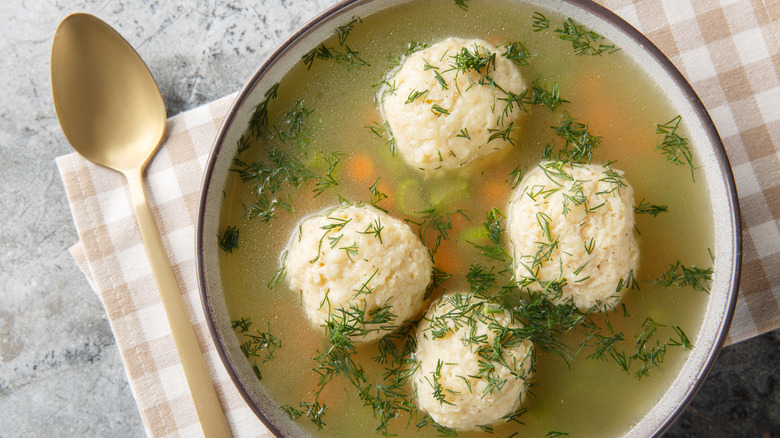
Matzo ball soup is a pillar of Jewish food. It’s served at most Jewish holiday tables, and the minute your Jewish mom detects the faintest of sniffles, she’s already pulling out of the driveway to grab a quart of Jewish penicillin to go. Each matzo ball is made by hand, with love, and it’s by far the most famous of the Jewish soups. It’s like the Kim Kardashian of soups, while the others on the menu are Khloe, Kourtney, Kendall, and Kylie. I say this with the utmost respect. The only correct choice is matzo ball, every time. If you deviate from this path, you’re not having a true Jewish deli experience.
In addition to the beloved matzo ball, the soup can include carrots, onions, celery, bits of chicken, noodles, or any variation of the lot. The texture of the matzo balls can range from light and fluffy to super dense, and everyone has their preference. The matzo balls — also referred to as dumplings — are made from matzo meal, egg, water, and, of course, the schmaltz (chicken fat that has been rendered). Whether they sink or swim in the chicken broth is up to the person making them. The soup is rooted in Ashkenazi Jewish culture and is a true staple of every important meal, in addition to being the belle of the ball at Jewish delis. The savory broth is extraordinarily comforting, satisfying, and should not be skipped.
Asking for your sandwich on white bread
Smith Collection/gado/Getty Images
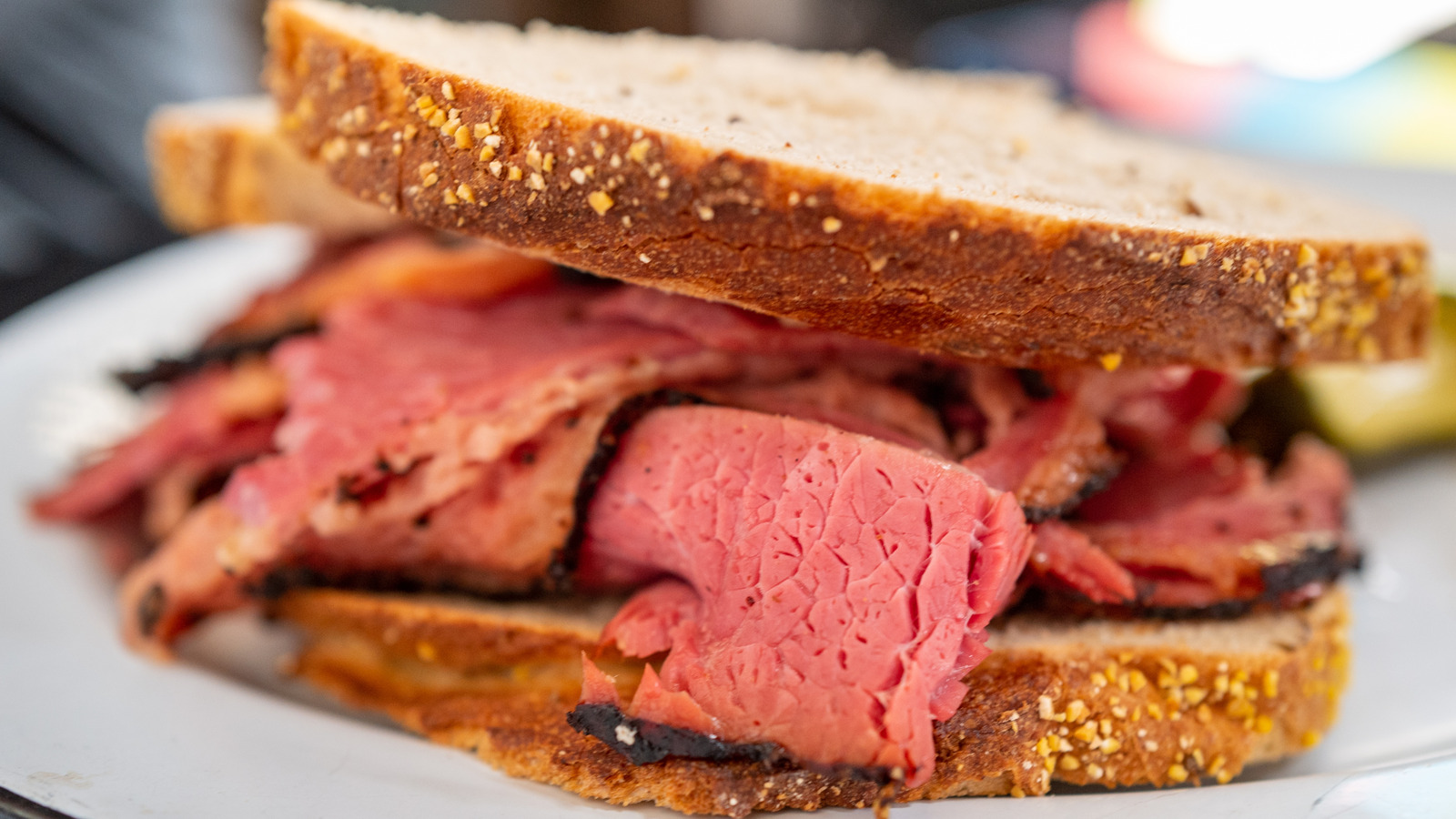
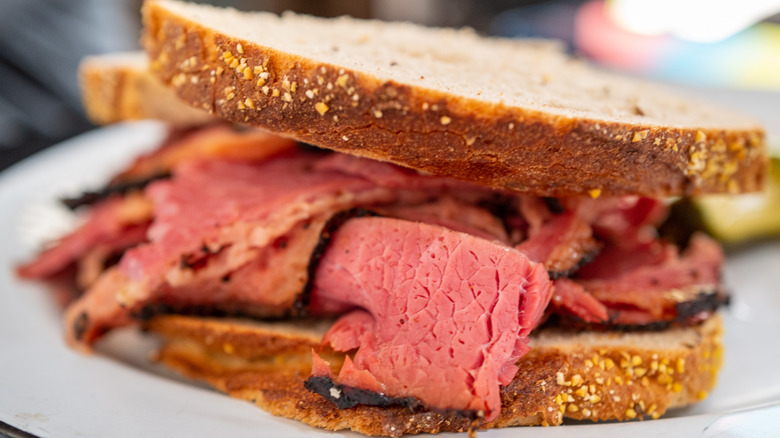
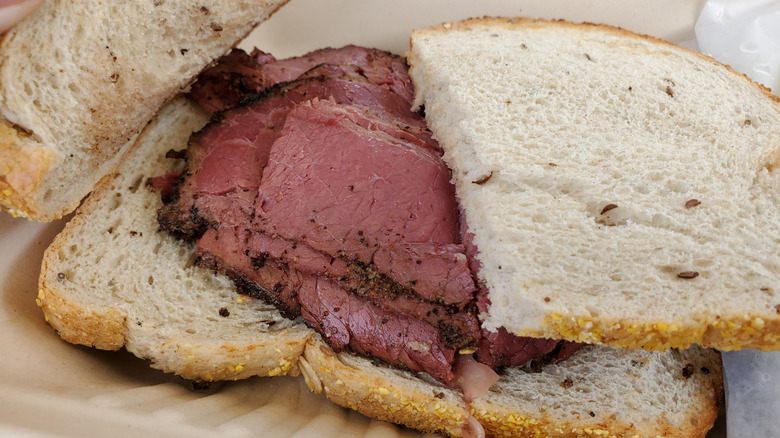
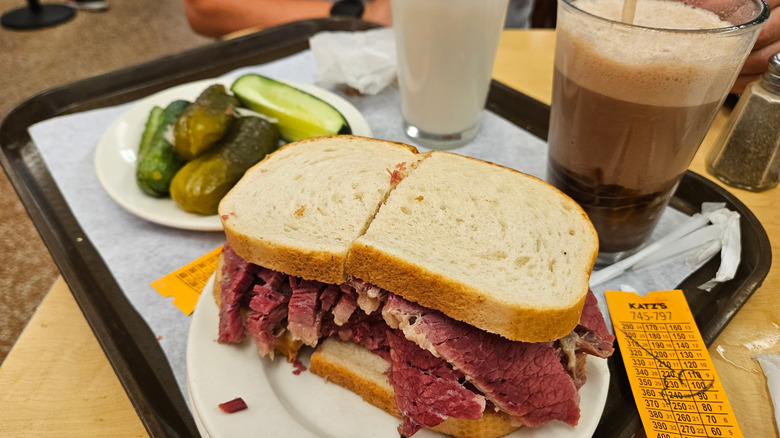
Ordering your sandwich on white bread at a Jewish deli is a travesty. From fresh-sliced turkey to expertly-crafted pastrami, the meats at a Jewish deli belong on one type of bread and one only: Rye bread or no bread. It’s an unwritten law of ordering a sandwich at a Jewish deli, part tradition and part science. Using any other carb vehicle is frowned upon. What about challah? It’s unequivocally delicious, but the minute it’s piled with a huge portion (we’ll get to that later) of fatty meat, it succumbs to the weight and immediately absorbs any sauces for one big sloppy mess. A quality Jewish rye is soft, while still being able to keep its structure together. It’s literally the perfect bread for a Jewish deli sandwich, and the only one that can handle the job.
Before you deliver a TED Talk on how much you dislike the flavor of rye bread, hear me out. I used to be like you. Give me anything other than those licorice-tasting caraway seeds buried in a bread with an almost sourish taste. However, something magical happens when you have a deli sandwich on rye. It just works. You know the whole “when in Rome” schtick? Well, when you’re in a Jewish deli, you eat the sandwich on rye. Trust the process, and the word of this converted believer. Save the white bread for your PB&J.
Skipping the Knishes
Hipokrat/Getty Images
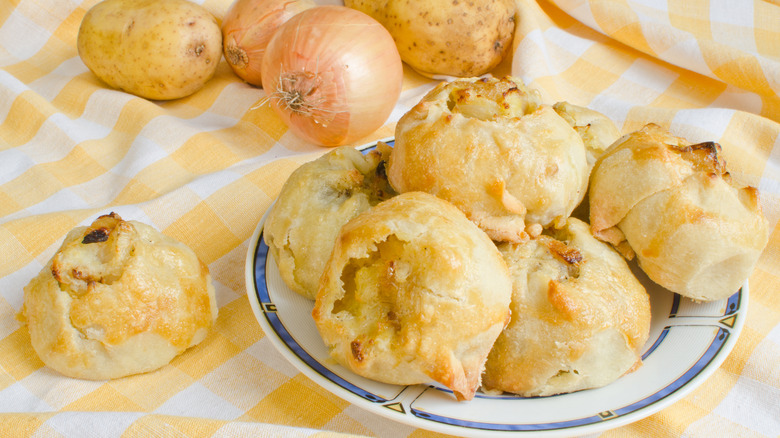
My love affair with knishes dates back to my brother and me buying them from New York City streetcarts whenever we would visit family. I prefer the round ones, and my brother is more into the square ones. That in itself is a debate among knish fanatics. While potato knishes are the most common, there are others worth a try, and I encourage you to spread your knish knowledge. Knishes are another delicacy associated with Jewish culture, with a long history within Eastern European food. I’ve had knishes so massive that they’re a meal in themselves, and there’s nothing wrong with that.
You could order fries with your meal, but why would you do that when you have access to a gorgeous, flaky pastry filled with a pillowy, savory potato filling that never disappoints? Think of delicious mashed potatoes, nestled into a pastry crust and baked to perfection. Knishes are great at room temperature and even better warmed up. Now, let’s talk about condiments. There’s one accoutrement worthy of pairing with a knish, and it’s mustard. Spicy or yellow mustard doesn’t matter, but that’s how it goes down in a Jewish deli.
Trying to customize a sandwich
Alex Segre/Shutterstock
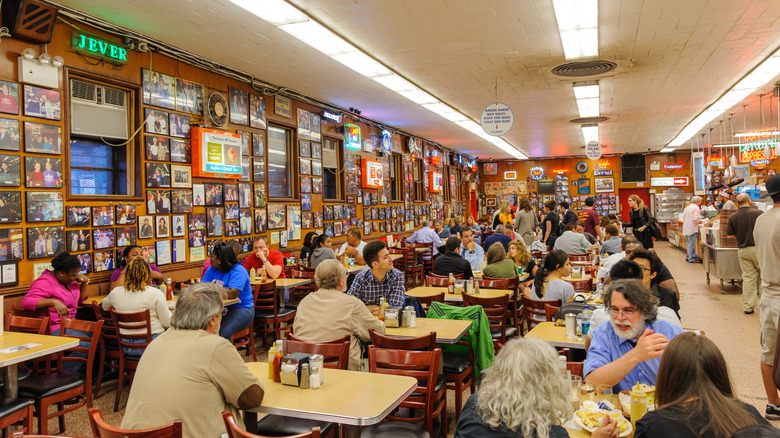
When ordering anything that serves as a hallmark of a certain restaurant or culture, it’s best practice to take it as it comes. Jewish delis know exactly how to build the sandwich of your dreams, so let them. Don’t be like Meg Ryan in “When Harry Met Sally” when you order your sandwich. Customizing sandwiches is something you do at Subway, not a Jewish deli that has perfected the process. It’s almost disrespectful to time-honored classics like pastrami or corned beef on rye.
The bottom line is that Jewish deli sandwiches are iconic because of how they’re prepared and served. Every single layer and component has been thoughtfully planned to give you the revered sandwiches Jewish delis are known for. You don’t need avocado or any other toppings you might order on a typical sandwich, because a Jewish deli sandwich is anything but typical. This is not the time to be picky or make changes. There’s a reason why your sandwich isn’t overflowing with toppings and sauces: It would compromise the flavors and integrity that the deli gods created. If you want to have an authentic Jewish deli sandwich experience, just go with it, and you’ll understand why you shouldn’t make adjustments.
Disrespecting the pickles
Alizada Studios/Shutterstock
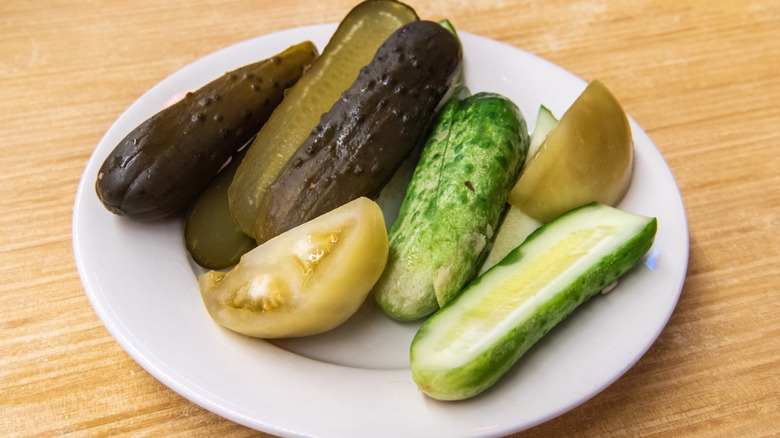
Even if your Jewish deli doesn’t toss a bowl of snacking pickles on the table before your tush hits the chair, they’ll show up on most any plate you order. They should never be treated as superfluous, because pickles are a cornerstone of any legit Jewish deli meal. You haven’t fully experienced a Jewish deli until you’ve taken down a half sour pickle. It’s better than any pickle you could ever pull out of a jar, and it’s not to be disregarded like an afterthought.
That pickle on your plate is a time-honored tradition in the world of Jewish delicatessens, and it’s been prepared for this exact moment. Specifically, it’s fresh garlic added to the brining liquid that makes a proper Jewish deli pickle. Don’t forget the signature snap and crunch. As a longtime Jewish deli visitor, I treat the pickle like a reward after my meal, and as something to give my taste buds a little reset before dessert. It’s the perfect intermediary, and as soon as you recognize the importance, the sooner you’ll see why the pickle is a crucial part of Jewish deli history.
Underestimating the size of a sandwich
rj lerich/Shutterstock
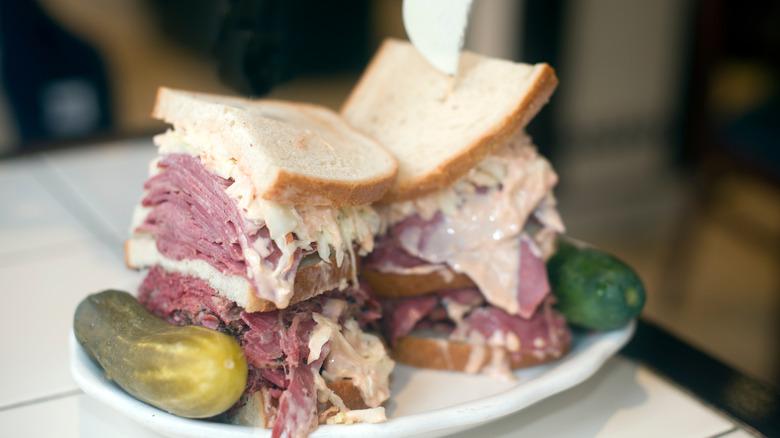
The portions at a Jewish deli are exceptionally generous, because god forbid you’re still hungry after a meal in a Jewish establishment. That’s every Jewish mother’s worst nightmare, and they won’t have it. However, nothing is more impressive than the size of a Jewish deli sandwich. They’re colossal, and deeply ingrained in Jewish history and culture. The sheer height of the sandwiches is unbelievable, and you might think you’ll need to dislodge your jaw just to get a bite. Between the meat piled to the sky and the classic rye bread, it’s a sandwich that could nourish a small army.
The unofficial birthplace of the towering pastrami sandwich is the Lower East Side of Manhattan, and that’s where its popularity really blossomed. I can’t tell you how many times I’ve witnessed my parents negotiate whether they were going to split a corned beef or brisket sandwich, or get both and go halvesies. The last couple of decades have brought the Jewish deli a surge in popularity, delivering its fare to entirely new generations who get to experience the overstuffed delights that are lasting symbols of Jewish deli culture. Arrive hungry.
Requesting mayo instead of mustard
Karinsasaki/Getty Images
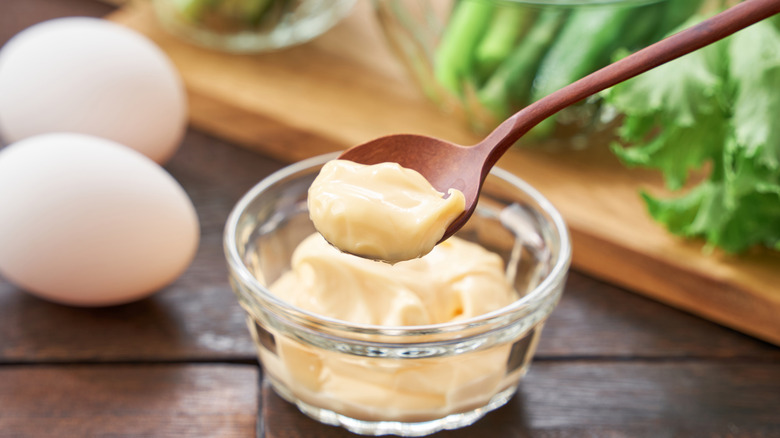
Jewish delis do not mess with mayo. It’s mustard or nothing, and that’s just the way it goes. People have been turned down for having the audacity to ask for mayo on their pastrami or other sandwich meats. You can have the mayo in your egg salad, but never on meat. The gravitation toward mustard goes so far back for Jewish people that it has biblical roots. Most Jewish delis use spicy brown mustard — the kind that’s super grainy and can feel like you inhaled a little bit of wasabi when you bite off a significant amount.
The mustard’s strong flavor pairs perfectly with pastrami, corned beef, and the other usual suspects to really let them shine. Some patrons prefer regular yellow mustard, and that’s acceptable too. The “no mayo” rule is based on the historical significance of a kosher-style environment. When Jewish Delis first surfaced, they were all set up to be kosher, meaning that meat and dairy couldn’t be mixed. Condiments like butter, cheese, and mayo all qualify as dairy, and therefore are a no-no. That’s how mustard — both spicy and yellow — came to be the chosen one.
Asking for cheese on your sandwich
Handmadepictures/Getty Images
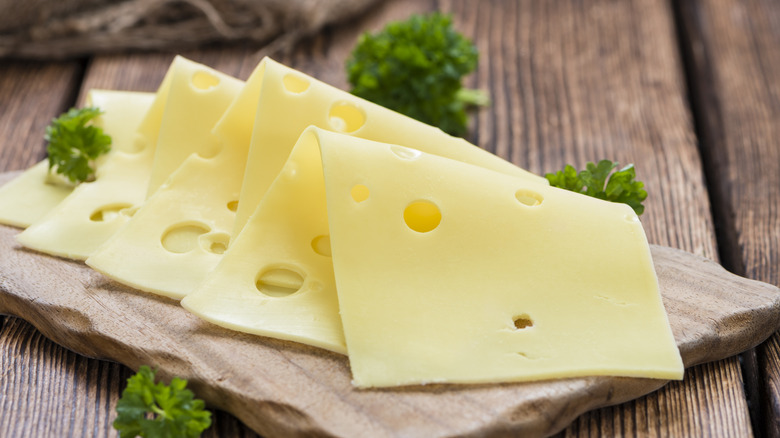
Even if you don’t keep a kosher home, you’re kosher any time you enter a Jewish deli. Just as mayo isn’t used to dress any sandwiches with meat due to kosher dietary restrictions, the same is true for cheese. If you prefer a turkey sandwich with cheese, you’re better off taking it to go and adding cheese at home. As a Jew who never kept kosher, but spent time in Jewish deli culture, that’s always been my move. This doesn’t mean that Jews who abide by kosher laws can’t have cheese or other dairy. They just can’t mix it with meat, which is why there are separate establishments that are dairy-focused.
There are, however, Jewish delis that don’t abide by Kosher dietary restrictions. You can identify them if they have a Reuben on the menu, as it’s topped with Swiss cheese. That’s where the term “kosher style” comes in. Calling a deli “kosher style” infers that the rules are a bit more lax. You still wouldn’t blatantly mix dairy and meat, but some items may not be certified kosher. The label is open to some interpretation, but it’s clear that something like a cheeseburger is still off limits.
Expecting a bacon, egg & cheese

Lauripatterson/Getty Images
The bacon, egg, and cheese sandwich is legendary. Some love it on a bagel, and others swear that a roll is the way to go. If you’ve spent any time in New York and have ever ordered one, you know it’s imperative that you ask for a BEC SPK. That’s bacon, egg, and cheese with salt, pepper, and ketchup. Just don’t expect to order one at a Jewish deli. Bacon in a Jewish deli would never fly, considering it’s the epitome of unkosher. If there were a poster child for non-kosher fare, it would be a strip of bacon.
Here’s how the kosher rules shake out regarding what meats are acceptable and which ones are not allowed: It’s all about the hooves. If the animal has cloven hooves (two toes), it’s a go. If they don’t, it’s a no. Pigs fall into the latter category, which is why pork products are not considered kosher and therefore not often on traditional Jewish Deli menus. That’s what diners are for. Go there to get your crispy side of bacon, and save the Jewish deli for your giant corned beef sandwich. All that said, I’ve made fully loaded latkes (potato pancakes) at home using bacon, and I would do it again.
Not getting a Black and White for dessert
Lisa Top/Shutterstock
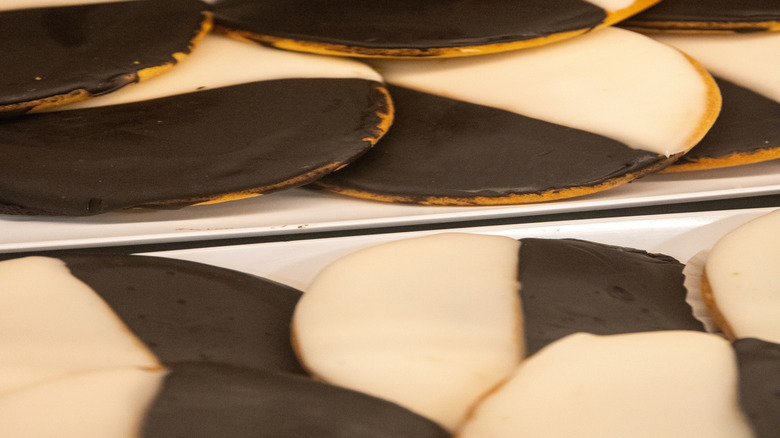
Jewish deli dessert cases are enough to make you drool. Rows upon rows of cookies and other confections lure you in before you even get to your table. I remember vividly plotting which one I wanted after my meal, and the answer was always a giant black and white cookie. It’s the GOAT of Jewish-adjacent bakery items, and it’s the storybook ending to a proper Jewish deli meal. Every black and white connoisseur has their own strategy for enjoying one, and they’re usually enveloped by nostalgia as soon as they sink their teeth into the sugary icing.
Some eat one side at a time. Others break it in half and place one side on top of the other. I personally like to take a bite from each side to maintain equal chocolate and vanilla real estate throughout the duration. There’s no wrong way to enjoy black and white cookies, though. The only wrong move is not ordering one. I recently learned that some culinary geniuses make ice cream sandwiches with the cookies, and now I need to try one. This might ruffle some feathers, but don’t waste my time with the mini black and whites. I want the whole glorious thing, and not a tamed-down version.
Ordering anything other than a Dr. Brown’s soda
Smith Collection/gado/Getty Images
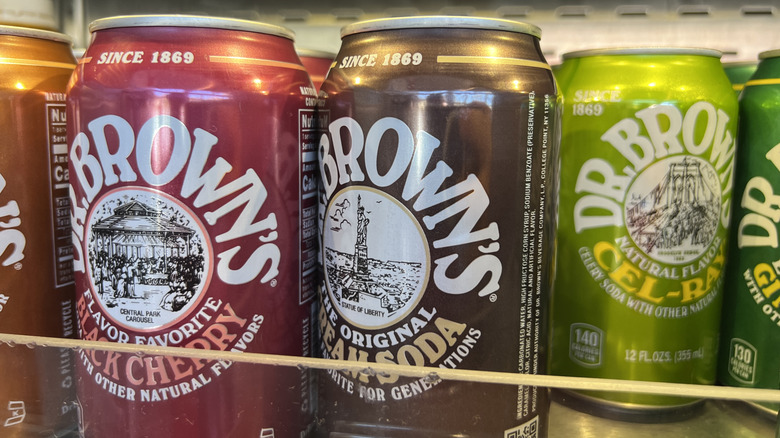
While you may be tempted to order a Diet Coke or an iced tea to wash down your pastrami on rye with mustard … don’t. That type of sandwich deserves the company of a Dr. Brown’s Soda. I don’t like telling people what they can and can’t do, but unspoken rules are rules. In my opinion — after being raised in a home where Dr. Brown’s reigned supreme — you should go for the Diet Cream Soda or Diet Black Cherry. I was indoctrinated by my Jewish New Yorker parents at a young age, and knew the second I spotted a Dr. B’s in a friend’s refrigerator, they were Jewish.
The lore behind Dr. Brown’s and its ties to Judaism are wild. The story goes that Dr. Brown created a drink to help children suffering from malnutrition. He mixed celery seeds, seltzer, and sugar to get some veggies into their bodies. So basically, Dr. Brown was every mother trying to hide nutrition in unexpected places. I’ve never felt more seen after learning this fact, since I am guilty of mixing copious amounts of chocolate syrup into my kids’ antibiotics so they will drink it willingly. Same, Dr. Brown. Same. There are five flavors to choose from, and any of them are standard for correct ordering protocol at a Jewish deli.
This is not the time to count calories
Chris J Ratcliffe/Getty Images
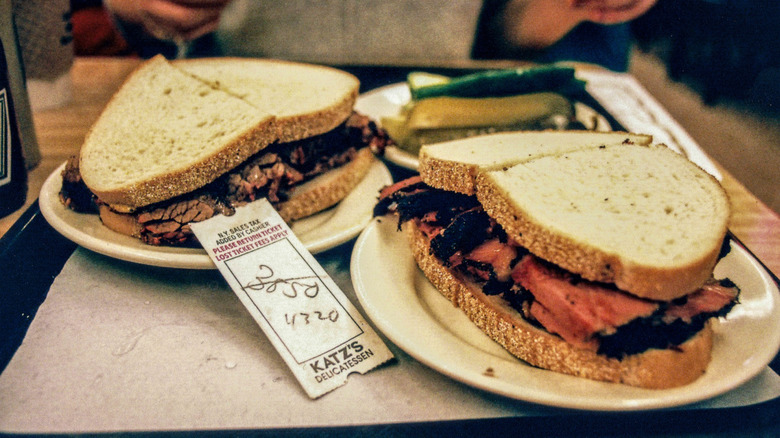
We’ve talked about the glorious, hand-carved meats, the matzo ball soup with plenty of schmaltz, and the beloved black and white cookies. If it’s not obvious by now, a Jewish deli is not the place to concern yourself with cutting calories. It’s a place to live your life and experience the delicious, hearty, not-at-all low-fat cuisine that has been part of Jewish culture from the earliest days. While you can find something lighter on many Jewish deli menus, there’s a time and a place. In an institution where you’re surrounded by so many delights, ordering a cantaloupe with cottage cheese is downright blasphemous.
This is not the place to start your diet, or count Weight Watchers points. A Jewish Deli is a beacon of comfort food, backed by decades of tradition and lots of fatty ingredients. It’s not a place to skimp and deny yourself. If you want to immerse yourself in the culture and walk away from your Jewish Deli experience a winner, eat all the things, and do not hold back. Revel in it — soak it in like the matzo ball soaks up the savory chicken broth, and save your diet for another day. Sincerely, a proud Jewish gal who loves food and only wants the best for you.
Methodology
nevada.claire/Shutterstock
I pulled information from a variety of resources to determine the biggest misses when eating at a traditional Jewish deli, including Reddit, reviews, and Jewish-specific sites. As a Jewish woman who spent her life dining at least weekly in our neighborhood Jewish deli, I was also able to pull from my own personal experiences.