
Large schemes at lowest level in decade, but completion of Loft Lines later this year could be a game changer by unlocking long-awaited growth in city centre living
There have been an average of nine new major projects starting each year since the Belfast Regional Crane Survey began in 2016.
And the annual report from business advisory firm Deloitte said the completion of a new build-to-let development, Loft Lines in Titanic Quarter, later this year will be a crucial test case for the city’s residential market.
Deloitte said that since 2016, the survey had recorded 87 major projects completed or underway in the city centre across all categories, representing a period of significant growth and development for Belfast.
Completions have included landmark projects such as Grand Central Station, Ulster University’s York Street Campus, the Grand Central Hotel, and The Ewart office development.

Belfast Grand Central Station (Photo: Getty)
The firm said the construction of research and development facilities and student accommodation were the key drivers of development activity in Belfast in 2025.
But it said that the Loft Lines residential project could prove pivotal in unlocking the long-awaited growth of city centre living.
The project, made up of 778 apartments across three blocks, was a joint venture between Lacuna Developments and Watkin Jones.
While the £175m scheme of build-to-rent, social and affordable homes will help alleviate Belfast’s housing shortage, critics have hit out at how it has altered the city’s skyline by blocking Titanic Belfast from many vantage points.
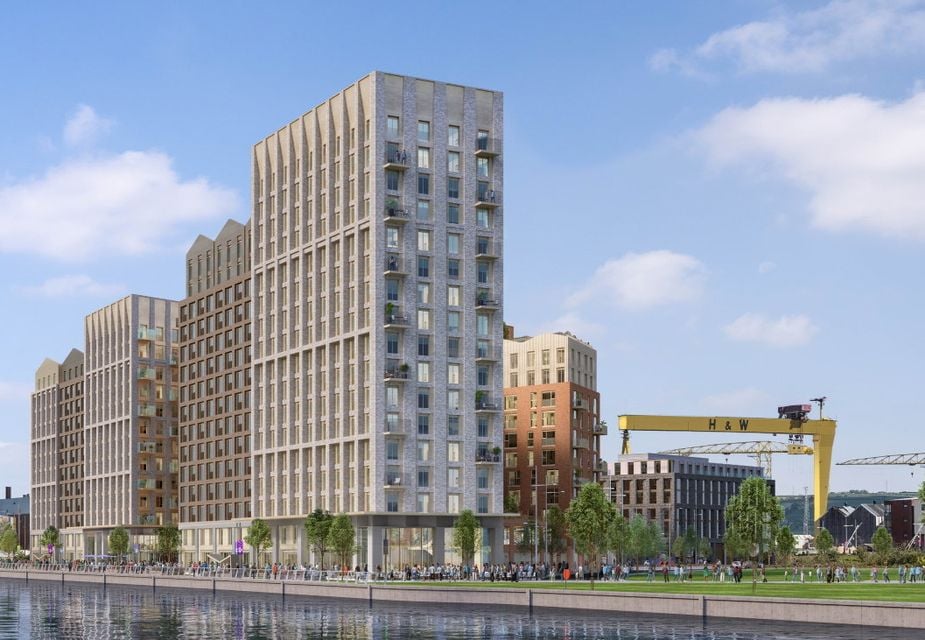
A CGI image of Loft Lines
Deloitte’s crane survey monitors construction activity in Belfast city centre across offices, residential, hotels, retail, education and student housing, and is seen as a bellwether of developer sentiment and future plans.
Marie Doyle, office senior partner at Deloitte in Belfast, said: “There has been significant progress since Deloitte launched the Belfast Crane Survey back in 2016, with major developments such as Grand Central Station acting as a driver of the economy and positively impacting how we live and work in the city. It is clear from this year’s survey that the education sector remains crucial to Belfast’s continued development.

Colin Mounstephen, director at Deloitte
News Catch Up – Friday 30 January
“Alongside the student populations, city stakeholders remain focused on creating a vibrant, lively and sustainable city centre, which means growing the permanent city centre residential population.
“There are many reasons why targets for city centre living have not yet been achieved, but the signs are more positive that this next major step in the evolution of Belfast is within reach.”

Marie Doyle, Deloitte (Picture by Luke Jervis)
The crane survey showed that in total 15 major schemes were under construction or completed in Belfast in 2025, slightly down on the total of 17 recorded in 2024.
There were five new projects that broke ground during the year, the same as 2024 but down from seven in 2023. The survey represents the lowest level of active developments and joint fewest number of new starts since the survey was first published.
Deloitte noted that in the past decade over 2.5 million sq ft of office space and 1.5 million sq ft of education and R&D space has been delivered or is under development, while 7,500 purpose built student accommodation units and 2,200 hotel rooms have been completed or started since 2016.
Three of the five new 2025 starts were in education. Of these, two are R&D developments – the Institute of Research Excellence for Advanced Clinical Healthcare and Momentum One Zero.
One new hotel project started during the year – the redevelopment of the empty Dorchester House – and one office scheme started on-site. One Bankmore Square, on the site of the former Movie House on Dublin Road, adds 75,000 sq. ft of Grade A office space and is the first new office building to start construction since 2020.
While 1,224 student bedspaces remained under construction and are due for delivery in 2026, there were no new student accommodation starts during 2025.
Belfast City Council’s Local Development Plan identifies a need for 8,000 new residential units within the city centre by 2035.
The Crane Survey recorded no new residential starts during 2025 but includes two live residential schemes, Loft Lines in Titanic Quarter and the Radius Housing development near the Gasworks, together comprising almost 900 homes. Deloitte said the figure was “significant” as the crane survey has recorded only 500 new homes in the city centre since 2016.
The Belfast Crane Survey is part of Deloitte’s Regional Crane Survey series, which monitors construction activity within four UK cities. Across all surveys – Belfast, Birmingham, Leeds and Manchester – 53 new construction starts were recorded in 2025 compared to 47 in 2024.

Colin Mounstephen, director at Deloitte
Colin Mounstephen, director at Deloitte in Belfast, said: “When Deloitte launched the first crane survey in Belfast a decade ago, the city was experiencing a significant expansion in hotel development, marked by major projects such as the Grand Central Hotel and the AC Hotel by Marriott. The focus then shifted to new office spaces, with over half a million square feet completed in 2022 alone before the pandemic slowed momentum.
“The annual crane surveys have also tracked a surge in purpose-built student accommodation which continued beyond the pandemic but is now slowing, as well as significant education and R&D developments by Ulster University and Queen’s University Belfast.
“The one sector that is slow and puts Belfast at odds with other cities is residential, which will be the focus for delivery over the next ten years. All eyes remain on the success of the Loft Lines development as a test case for new city centre living that could trigger new momentum and investment in residential.”