
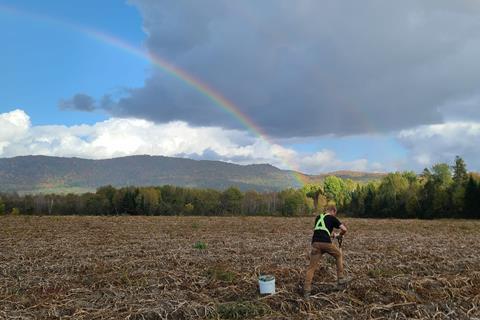
McCain Foods has announced plans to launch a Farm of the Future in North Yorkshire.
In partnership with the University of Leeds, this is McCain’s third commercial-scale research and innovation site to trial regenerative agriculture practices.
McCain said it marked a major milestone in the company’s efforts to advance future-focused farming methods.
The 202-hectare site joins established farms in Canada and South Africa, and completes its global commitment to establish three Farms of the Future – which are designed to accelerate the adoption of regenerative practices in real-world farming conditions – by 2025.
The UK farm will be the most advanced of its kind, adopting practices such as controlled farming, year-round soil cover and biodiversity building.
Potato production will begin in 2026.
“Farming is at the heart of Britain’s food system, and farmers face growing challenges that demand new solutions,” said James Young, VP of agriculture at McCain GB&I. “We’re proud to launch our third and final Farm of the Future here in the UK, combining global knowledge with local action and a research partnership with the University of Leeds.
“This farm will show that regenerative farming works in practice and aims to provide a blueprint for others, helping secure the future of farming for generations to come.”
It will also be the first Farm of the Future to pilot a circular nutrient system, developed in partnership with the University of Leeds National Pig Centre, using pig manure to enrich soils, reduce waste and demonstrate how mixed farming systems aim to improve soil health and biodiversity while helping to lower greenhouse gas emissions.
It will work with the university to develop a scientific and teaching partnership, providing opportunities for independent data validation across key metrics including soil health, biodiversity and greenhouse gas emissions.
Read more:
“Our partnership with McCain at their Farm of the Future in the UK is a clear example of our joint ambition to promote farming practices which minimise environmental impact,” said Professor Nick Plant, vice chancellor for research and innovation at the University of Leeds. “Establishing this 20-year agreement will enable us to further develop research expertise in soil health and land productivity that can benefit farming approaches worldwide.”
Additional areas of focus will include autonomous vehicles and alternative fuels for farm equipment.
Like the Canadian and South African Farms of the Future, these results will be published annually in dedicated reports, and insights from the UK farm will feed directly into McCain’s global network of 4,400 farmers, supporting wider adoption of regenerative agricultural practices worldwide.
It comes as McCain unveiled its 2025 Global Sustainability Report, which revealed progress the business had made towards its global sustainability commitments and outlined its updated Science Based Targets initiative targets to align with the latest climate science.
As part of its progress, nearly 70% of its global acreage has been onboarded to McCain’s Regenerative Agriculture Framework, with 30 Innovation Farms for regenerative agriculture established globally.
It has also reduced its Scope 1 and 2 emissions by 28% since 2017 with 60% of total electricity use from renewable sources. It has also made improvements in packaging, meaning 98% of its packaging is now designed to be recyclable.
“As we look to 2030 and beyond, we recognise the years ahead will bring challenges and the journey will not be easy,” said Charlie Angelakos, vice president, external affairs and sustainability at McCain Foods. “We must build on our lessons learned as well as deep partnership and collaboration with our partners across the value chain to ensure we deliver sustainable progress and create a resilient business.”
$(document).ready(function() {
if (window.location.pathname == ‘/advertise’) {
$.getScript(“https://tag.clearbitscripts.com/v1/pk_6c1cac1dc287e45bfaab20867b193dcb/tags.js”);
console.log(“Clearbit Loaded”);
}
});