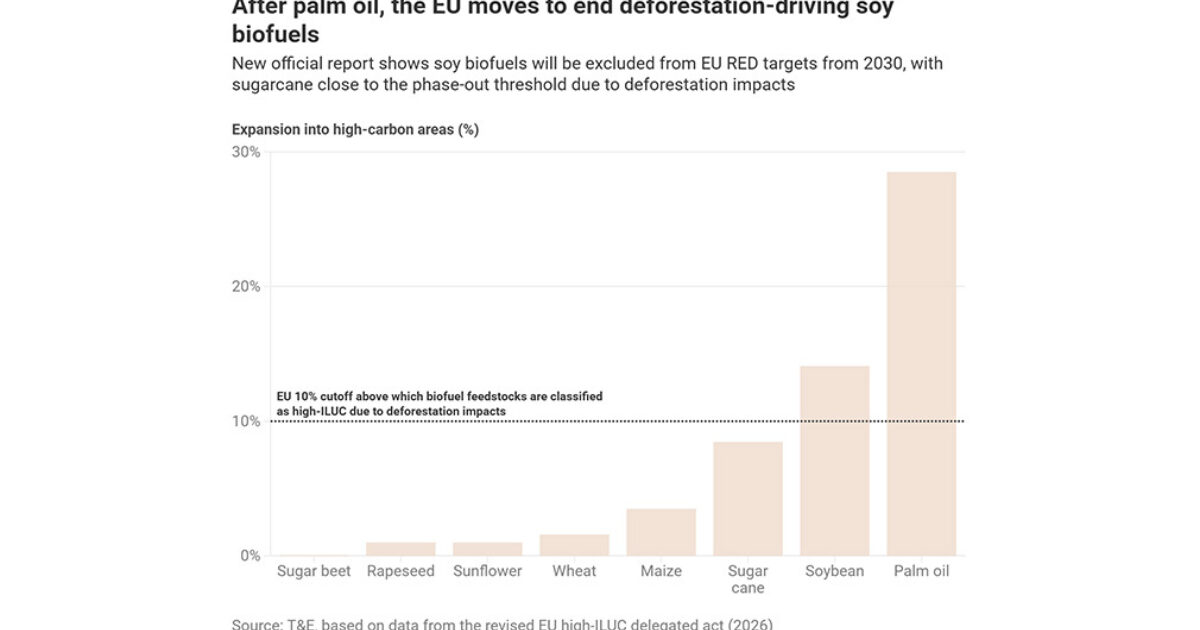
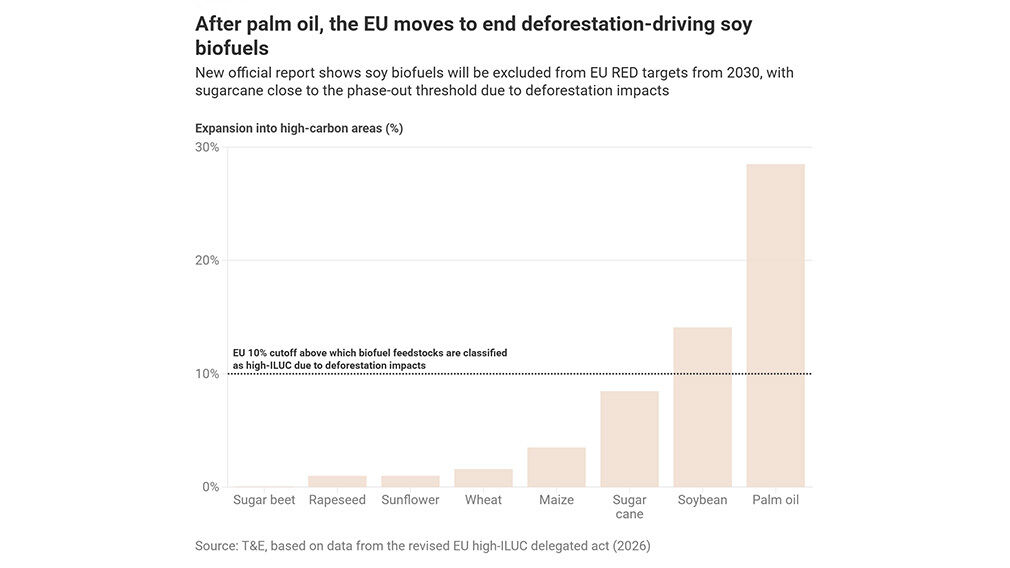
New report shows soya-derived biofuels should be excluded from EU renewable targets. Image source: T&E based on data from the revised EU high-ILUC delegated act (2026)
Soya-derived biofuels should no longer count towards European Union (EU) renewable targets according to European Commission (EC) research confirming they contribute significantly to deforestation, clean transport campaign group Transport & Environment (T&E) says.
The EC’s research showed that soya was over the 10% threshold above which biofuel feedstocks were classified as causing high-indirect land use change (ILUC) due to deforestation impacts, T&E wrote on 22 January.
“Biofuels have been widely promoted across the EU since the adoption of the Renewable Energy Directive (RED) in 2009. In 2019, the introduction of the high ILUC Delegated Act confirmed a phase-out of palm biofuels by 2030. Soya will now be subjected to the same fate,” T&E said.
“Phasing them [soya biofuels] out is the right way to go and ensures that American, Argentinian and Brazilian soy[a] does not end up in European tanks, especially now that the EU has signed the Mercosur trade deal,” said Cian Delaney, biofuels campaigner at T&E.
“But other feedstocks associated with high levels of land use change, like sugarcane, remain just below the threshold. This means they can continue to count towards EU renewable targets.”
Despite the latest EC research, T&E said growing EU demand for biofuels meant that the scramble for feedstocks would still intensify.
The EC had initially been expected to revise the high-ILUC Delegated Act in September 2023, T&E said.