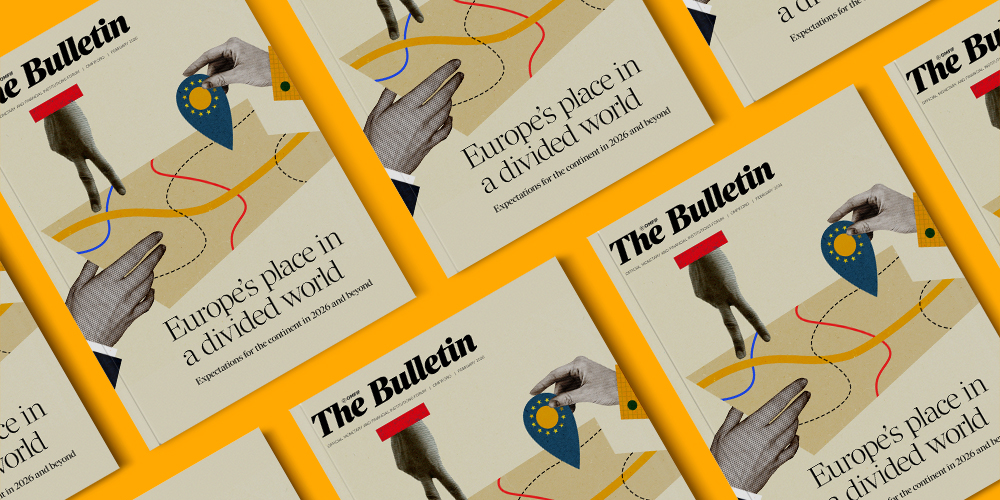
Making accurate predictions on the political and economic outlook for a region is difficult at the best of times. During a period of sustained geopolitical instability, where it seems anything could happen, it is almost impossible. Europe, caught between the consequences of volatile and vengeful policy-making on one side and brutal military conflict on the other, is facing a year that could make or break it as a power on the world stage.
For that reason, the February 2026 edition of the OMFIF Bulletin does not attempt to be a crystal ball into Europe’s future. Instead, it lays out the various problems facing the region – including demographic pressures, political fragmentation, defence needs and low growth – and focuses on what it will take for Europe to overcome these challenges. It draws on a vast network of experienced and expert views to offer up a vision of what Europe could become if it can get its act together.
An uphill climb
Contributors to the Bulletin do not shy away from the fact that Europe is facing an uphill climb on several issues. Heiko Peters from Moody’s Ratings observes that Europe is in the crosshairs of major geopolitical and geoeconomic shifts, while Stefano Bodrato from EY points out that cybersecurity concerns are only set to grow in a more digitalised world.
As such, it is essential that Europe is able to protect and build up its sovereignty. However, independent economist Silvia Dall’Angelo warns that this will only be possible through effective regional coordination. Member states cannot go it alone, as history has shown us.
Low growth has been a persistent problem in recent years. Federica Coelli of the European Bank for Reconstruction and Development shows how this is compounded by ageing populations and the economic burden of a shrinking labour market. But Europe is not without options. Edoardo Reviglio of LUISS Guido Carli encourages Europe to recognise that its industrial strength lies in the mid-sized specialised firms that are central to supply chains and operate across sectors.
Europe can also benefit from fresh approaches to growth. Iain Begg of the London School of Economics and Political Science calls for a rethink of the fiscal rules in favour of a system that is less complicated. OMFIF’s Andrea Correa draws on OMFIF-EY research that shows redirecting public money into strategic areas like technology would generate far more productive investments and boost gross domestic product growth. Meanwhile, Conor Perry, also from OMFIF, encourages legislators to consider the European Secured Note in attempts to alleviate the burdens on small and medium-sized enterprises in the region.
Not all doom and gloom
It is not all doom and gloom for Europe. Alvise Lennkh-Yunus of Scope Ratings points to a broadly resilient outlook for the region, providing it can contain geopolitical threats, and Kalin Anev Janse from the European Stability Mechanism shows how Europe can build on a better-than-expected 2025.
With geopolitical uncertainty abounding, the shine is starting to come off the dollar for investors. Massimiliano Castelli from UBS observes that the euro has an opportunity to expand its international role and increase its share of global reserves. Geoffrey Yu from BNY reflects that the currency has started the year on a strong footing, but that the macro picture will be volatile, while Christophe Braun from Capital Group focuses on Europe’s ‘multiplier moment’ and the opportunities for growth it brings.
Bracing for change
The next few years will be a time of political change in Europe as major players are set to come to the end of their terms. The results of elections in 2026 and 2027 will have critical implications for the direction of travel in the region as populist parties look to build on their rising popularity of the last few years. OMFIF’s Yara Aziz comments that the political stage is becoming a more fraught place for female policy-makers, and that the work done on improving gender equality over the last decade is at risk of backsliding.
Whoever takes on the helm of the European Central Bank once Christine Lagarde steps down will need to navigate difficult waters. OMFIF’s John Orchard examines the frontrunners for the position and highlights the pitfalls of trying to make accurate predictions, particularly at a time of such unpredictability across the globe. This is something OMFIF Chairman David Marsh knows all too well. Drawing on the views and insider knowledge he dissected in Can Europe Survive?, he acknowledges the problems facing Europe, but maintains that ‘The Europeans have survived worse depredations than Trump’s return.’
As this edition of the Bulletin makes clear, Europe’s strength lies in its numbers – but forming a united front against the challenges facing the continent is easier said than done.
Sarah Moloney is Editorial Director at OMFIF.
Download the OMFIF Bulletin, February 2026 edition.
Interested in this topic? Subscribe to OMFIF’s newsletter for more.