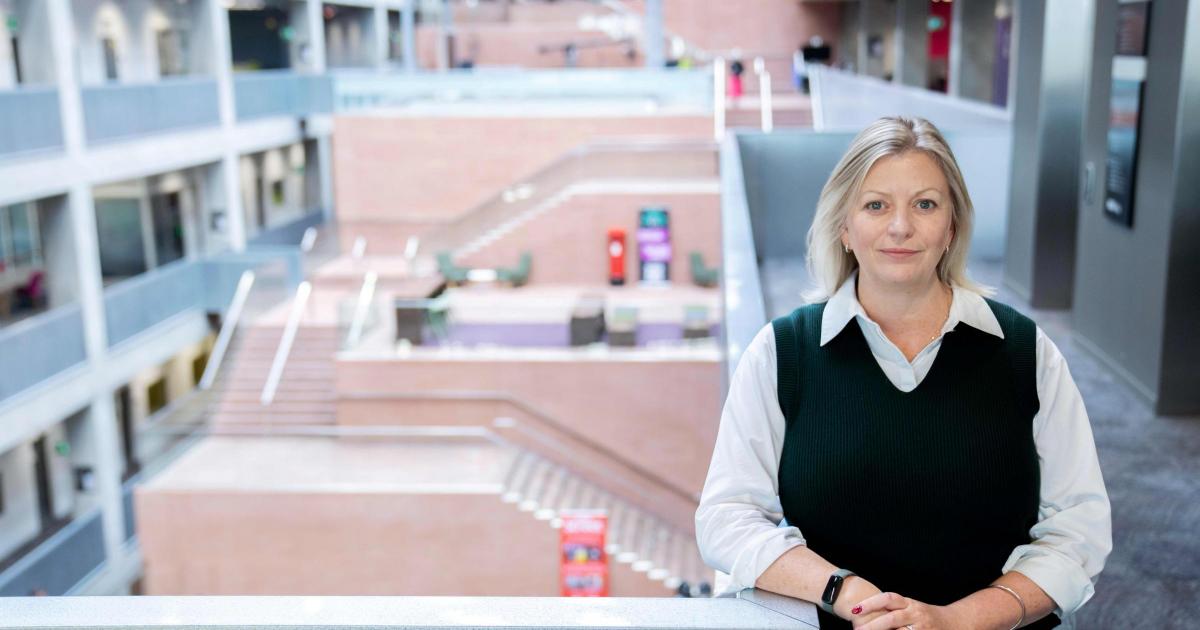
She was responding to concerns raised by academics and MSPs about a perceived lack of trust over the BBC’s output in Scotland.
Read more:
Giving evidence to Holyrood’s culture committee, Ms Valentine that said BBC Scotland’s output was “absolutely led from Scotland” by her and head of news Howard Simpson, who was appointed last May.
Ms Valentine admitted she was concerned about “declining” trust in mainstream media organisations around the world.
BBC Scotland is based at Pacific Quay in Glasgow. (Image: PA)
However Ms Valentine insisted the BBC’s news coverage was still “the most trusted in the world” and suggested there was risk of “overplay” of the issue of trust.
Research carried out by the BBC itself last year found that 42 per cent of viewers and listeners in Scotland were concerned about the broadcaster’s political independence.
Hayley Valentine spoke recently at the Scottish Parliament’s culturecommittee. (Image: free)
Less than half of those surveyed in Scotland as part of the biggest “listening exercise” in the BBC’s history believe its programmes properly reflect the whole of the UK.
The culture committee has taken evidence from academics and industry leaders on the Scottish broadcasting industry in recent weeks.
In her evidence to the committee, Catherine Harper, professor of media sociology at Glasgow University, said: “A decline in trust has been experienced right around the world by traditional media, by which I mean TV, radio and newspapers.
“Our research shows that one of the ways in which that manifests itself in British and Scottish audiences is through a perception that public service news broadcasters—the BBC and the others—are far too close to government and politicians and that their independence is no longer there.
“That has a particular character in the Scottish context because there was a historical disaffection with the coverage of the independence referendum. There are still strong feelings.
“The independence referendum period showed BBC Scotland’s inability to be autonomous in its coverage of its own affairs, because there was a clear perception among audiences that a lot of the control came from the BBC network and BBC London.
“That was perhaps unfair, but there was certainly a perception that London was calling the shots and—almost—that the state line was being followed in respect of the coverage of that debate.
“The more that BBC Scotland and its journalism can be independent from London and from politicians in both Westminster and Holyrood, the better. That is a really important aspect of rebuilding trust in journalism.”
Speaking at the culture committee SNP MSP Keith Brown raised concerns about the level of political “interference” with the BBC.
He added: “Tim Davie (BBC director general) fairly recently told us that he had four or five visits every week, with people from each of the two main parties beating a path to his door to complain about something or other.
“Scotland does not really feature in that. There is sometimes a feeling that the BBC is impervious to demands from Scotland for more balanced reporting.”
Conservative MSP Stephen Kerr put it to Ms Valentine that there was a “more pronounced or distinct trust deficit” in Scotland because of the political environment, citing suggestions that BBC Scotland was being “constrained in editorial terms by controls from London”.
Ms Valentine said she was not aware of any evidence that BBC Scotland was “controlled or constrained” by London.
She added: “I do not recognise the idea that we are stymied by London.
“We run our own newsroom and I do not receive instructions from anyone on how to run it.
“As you know, we report without fear or favour. We cover exceptionally difficult stories and we take big editorial risks. We run a lot of live output. We are the only nation that has a regular debate programme.
“We hold those things dear. I cannot talk positively enough about our ‘Disclosure’ brand and the work that we do there. It is not just about impactful television or journalism; it makes proper change in this country. The evidence is in what we do.”
Ms Valentine insisted the BBC was “highly trusted” in comparison to other media organisations “in this country and abroad.
She added: “Our news is the most trusted in the world. I am proud of things such as the World Service, which I used to work on. We can overplay the issue of trust.
“Another thing to say is that people consume us in huge numbers. In Scotland, 83% of the country consumes BBC content every week.
“That number goes up to 90-odd % every month. When people are asked which broadcaster they trust the most, we get almost 50% of the total, and the next best gets something like 6%.
“I am not going to pretend that we do not live in a polarised society where trust in mainstream media as a whole is on the decline. We have to work hard on that. I am pretty optimistic.
“I said this last year and, as we go into an election, I will say again that the trust scores for Scotland, in particular, went up between the two most recent General Elections. According to Ofcom, the way in which the country views us is pretty stable in terms of reliability and trust scores. We are not on a massive decline, it is in the margins.”
“That is not to deny the culture that we live in. I live with a fairly hostile media all the time in Scotland.”
Speaking at the culture committee, Paul McManus, negotiations officer at the Bectu union, warned that the Scottish broadcasting industry was facing a number of “significant challenges,” including the impact of the renewal of the BBC’s current charter at the end of next year.
He added: “It is extremely important that this Government and other bodies stand up to support the BBC to defend its impartiality in the wake of all the disinformation that is flying about.
“It is crucial for the culture and democracy of Scotland that we have a strong, independent, impartial BBC that is free from political interference and that the services that it provides are universal to all.
“Without that – if people do not have universal access to high-quality broadcasting – we start to undermine the culture and the democracy of the country.”