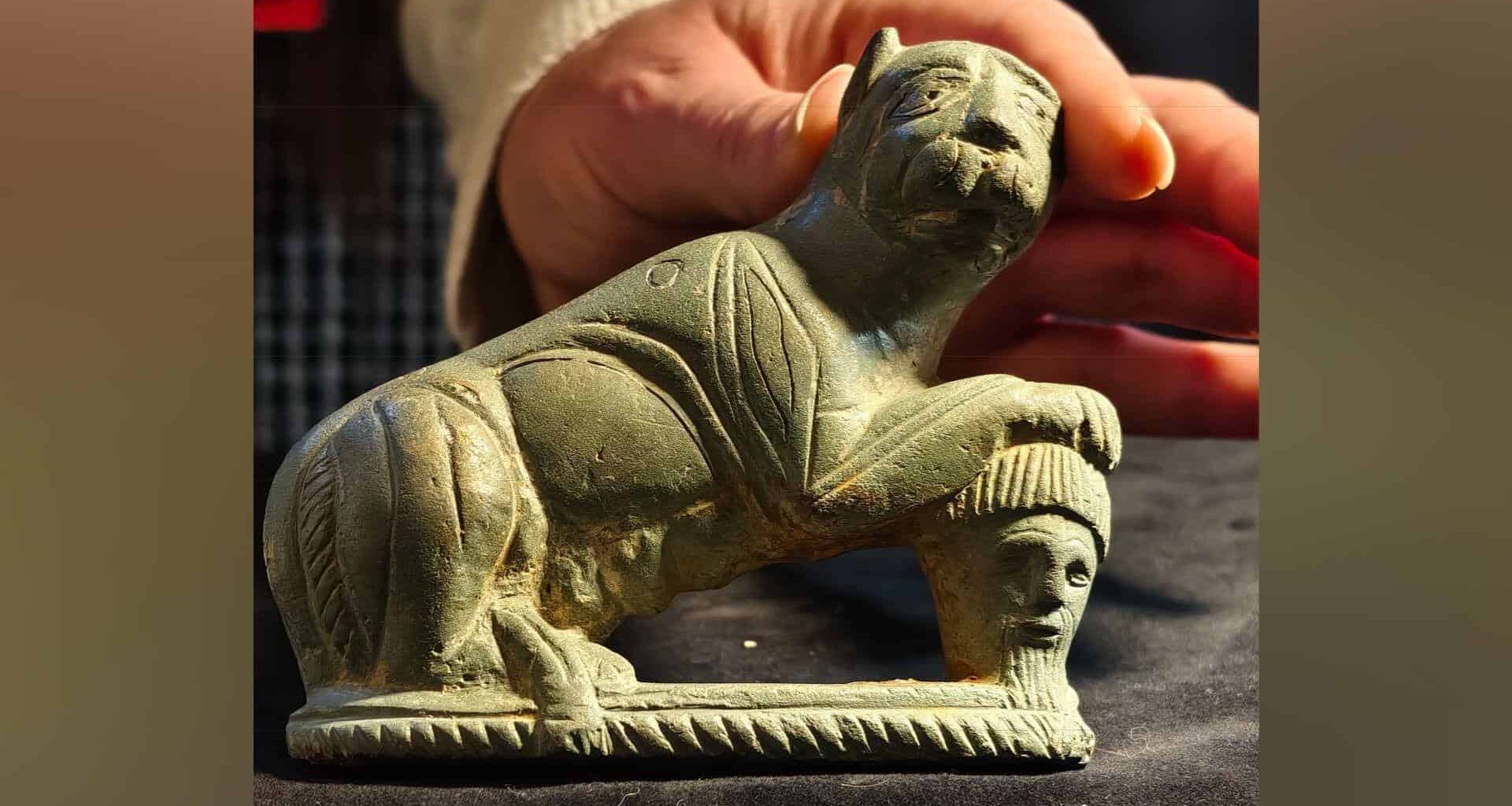
 The statue is now oxidized, but would have glowed quite brightly. Image credits: British Museum.
When the Romans conquered a region, they didn’t just want your land — they wanted your soul. To that end, they used more than their fierce legions; they used law, culture, and a particularly violent form of branding.
In this case, the branding was pretty violent: a gleaming copper panther pinning down the severed head of a defeated local.
This four-inch figurine, recently unearthed by a metal detectorist not far from London, is one of the most provocative “treasures” added to the British Museum’s records this year.
The Roman “BMW”
The decoration was uncovered in 2024 by a metal detectorist scanning the dirt near Harlow, not far from London. It’s a high-status ornament that would have been used as a carriage fitting, and one of 79,616 finds reported that year.
“The fitting will quickly become one of Essex’s most iconic archaeological objects,” said Lori Rogerson, the county’s finds liaison officer, for the BBC.
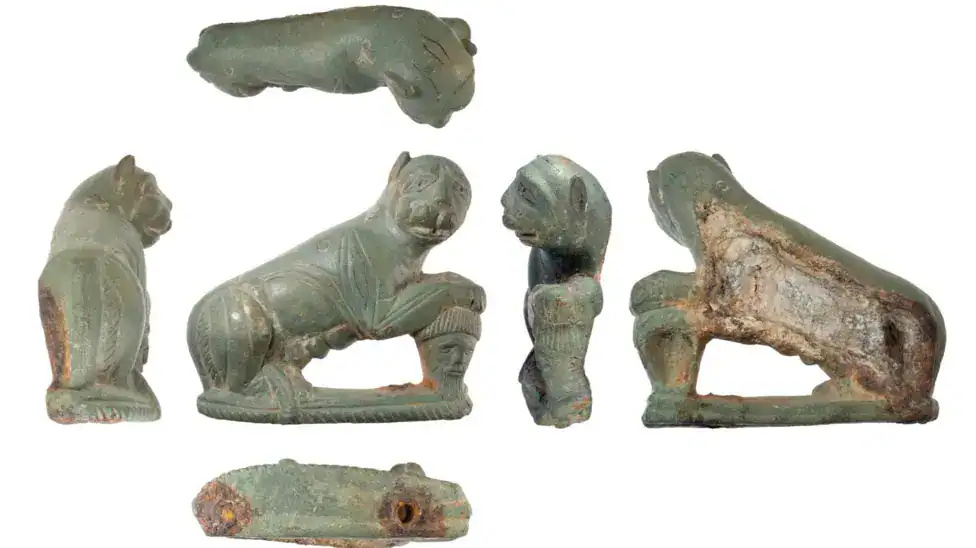 The statue is one of the most impressive examples of psychological warfare deployed in Britain, researchers say. Image credits: British Museum.
It’s green and oxidized now, but in its heyday, it would have glowed with a bright yellow-orange luster, catching the sun as it rattled down Britain’s famous straight roads. It almost certainly belonged to a wealthy farmer or merchant. It’s the Roman equivalent of having an expensive BMW or a Mercedes.
“You could see it gleaming and you’d know whose carriage it was coming towards you,” says Dr. John Pearce, an archaeologist at King’s College London, also for the BBC.
But the real magic (and the psychological warfare). Archaeologists have noted that this panther is a “Romano-British” hybrid. It uses traditional Roman subject matter like the panther and the defeated foe. However, it renders them with the swirling, geometric flair of the local Iron Age Britons. The message was clear: we own this place.
×
Thank you! One more thing…
Please check your inbox and confirm your subscription.
Art and Agony
The panther is a symbol of Bacchus (Dionysus), the god of wine and “the good life,” representing Roman power and civilization. The severed head is a direct reference to a “barbarian” enemy. By placing the panther’s paw on the head, the artist was depicting Rome’s literal and metaphorical crushing of the British tribes.
The owner wanted to signal that he’s living the good life, while also showing that Romans crushed the locals. It was a brutal and arrogant display. “There’s nothing quite like it in Romano-Britain,” Pearce adds.
This specific find likely wouldn’t have been saved for the public if the British government hadn’t updated the Treasure Act. Previously, objects had to be made of precious metals (gold or silver) or be part of a hoard to be legally declared “treasure.” Under the 2023 amendment, other “significant” finds like this panther can now also fall under the government’s protection.
This means that instead of the figurine disappearing into a private collector’s drawer in New York or Tokyo, it was diverted to the British Museum. The find will be officially valued by an independent board. It will be valued, and the reward (often thousands of pounds) is typically split 50/50 between the person who found it and the owner of the land. It’s a system that encourages people to do the right thing and report their finds rather than selling them on the black market.
As for how the panther ended up in the ground in the first place, that’s anyone’s guess. The simplest answer would be that it simply fell off on the bumpy Roman roads. But as the piece will enter a museum’s collection, archaeologists can study it in more detail.