One of the EU’s largest contractors has been suspended again by the European Commission, marking another setback for a controversial consultancy that has received hundreds of millions of euros in development aid contracts.
IBF International Consulting – a Brussels-based consultancy with a chequered past – was banned by the Commission in early December from participating in EU public procurement tenders for two years, according to a letter seenby Follow the Money and IrpiMedia.
The firm mainly implements EU projects in developing countries – from promoting gender equality in South Africa to preparing officials in Albania for the bloc’s bureaucracy.
The Commission’s letter did not specify why IBF was suspended, but it referred to “grave professional misconduct” in relation to a major EU contract for foreign policy services.

Frédéric André
© IBF
On the day the ban took effect, 9 December, IBF’s CEO Frédéric André told roughly 100 staff in an internal email that it was related to two EU tenders for projects in Moldova.
Several aid contractors that have collaborated with IBF are now considering cutting ties with the consultancy, three people with knowledge of the matter told FTM.
It means yet more turmoil for a firm that was suspended by the Commission in 2020 for using leaked information to manipulate the EU’s procurement process and win contracts.
The consultancy is also currently under criminal investigations by Albanian authorities and by the European Public Prosecutor’s Office (EPPO), over suspected offences including corruption, forgery and money laundering.
In response to FTM’s emailled questions, IBF confirmed that it is challenging its exclusion before the EU General Court.
The Commission’s decision raises “concerns about legal certainty and the proportional use of sanctions in EU tenders,” IBF’s management said in an emailed statement.
The exclusion has affected the company’s reputation and its staff, it added.
A spokesperson for the Commission declined to comment on the reason for IBF’s suspension, telling FTM that the deliberations and proceedings of the panel on the Early Detection and Exclusion System (EDES) were confidential.
Our journalism is only possible thanks to the trust of our paying members. Not a member yet? Sign up now
However, the spokesperson did say that the EDES was set up “to reinforce the protection of the Union’s financial interests against unreliable persons and entities”.
The use of consultancies by the Commission has faced scrutiny in recent years, with critics questioning value for money, waste and the risk of conflicts of interest, among other issues.
A 2022 report by the European Court of Auditors found that the Commission did not manage such risks sufficiently, and said that its “reporting on the use of consultants was weak”.
Ripple effect
The suspension isn’t just a blow to IBF – it’s a problem for the wider development aid sector.
In December, panic began spreading among consultancies working in consortiums with IBF to provide services to the EU’s foreign policy departments, as part of a massive so-called framework contract worth up to €660 million overall.
The firms received a letter from the Commission informing them that IBF had been excluded “from participating in award procedures for [EU] public procurement for a duration of two years”, starting on 9 December 2025.
The exclusion applies only to IBF International Consulting SA, which is based in Belgium. However, the consultancy has created several new corporate entities in recent years.
Former IBF insiders told FTM that these entities ultimately operate as a single company, which is led by André and has the same people running the HR and finance departments.
IBF’s management said it rejected that description.
“IBF companies don’t form one big company and there is no joint management,” it told FTM.
The Commission’s letter said it was considering whether to terminate the parts of the framework contract in which IBF participated – which account for the majority of the work.
Follow these files
Unfollow these files

It also said consortiums that include IBF would be barred from bidding for new projects while the case was assessed.
As a result, development aid consultancies are considering removing all IBF entities – not just IBF International Consulting SA – from their consortiums as part of the framework contract, three people in the sector told FTM.
In his email to staff on 9 December, André said the Commission’s suspension of IBF traces back to 2018, when the firm hired the same expert for two different tenders in Moldova.
He said IBF was “on the right side” as sufficient time had elapsed between the contracts.
“We will surely file a complaint to the Ombudsman for maladministration and see if we open a case to the Court of Justice,” André wrote in the email.
IBF’s management confirmed to FTM that it has since launched court proceedings.
Fall from grace
Although IBF has been operating for nearly half a century, it was founded in 1977, the consultancy has only come under the spotlight and courted controversy in recent years.
IBF grew in stature and size from the early 2000s, winning contracts from a range of institutions.
At its peak in 2018, the consultancy employed around 200 staff and contractors – mostly based in Belgium – according to a former employee.
It specialises in providing expert support to nations in the Balkans – many of which are preparing for EU membership – and Northern Africa, helping such countries improve their governance, infrastructure or social services through advice or training.
The European Commission has long been its main client. Between 2014 and 2024, IBF entities received more than €358 million worth of contracts from the Commission.
-

Bureau Brussels
Insights from our EU specialists and news from the Brussels bubble.
Yet things started to go wrong for the consultancy in 2020.
In January that year, the Commission initially banned IBF from participating in new projects for a period of 18 months.
The firm was blacklisted for acquiring leaked information through a conflict of interest, giving it an unfair advantage in public tenders.
However, IBF vowed to address the misconduct – including by curtailing the influence of its CEO on the tendering process.
The ban only ended up lasting three months, with the firm winning new EU contracts in April 2020.
Despite that reprieve, IBF has since faced pressure on multiple fronts.
Since 2020, IBF has been under criminal investigation in Albania – where CEO André began his career at the EU delegation in the 1990s – for alleged violation of procurement rules and money laundering.
It’s also being probed by the EPPO and Belgian authorities over suspected corruption, forgery, money laundering, deceit and criminal organisation, according to an official document seen by FTM.
“It seems like IBF wants people to leave. Workers are being fired”
In 2024, Belgian police interviewed IBF staff and asked them about cash payments that were allegedly made on top of their salaries, said one of the employees who was questioned.
The probe is well advanced, and involves at least one Commission official as a suspect, according to an individual familiar with the case.
IBF’s management told FTM that Albanian officials “only asked IBF International Consulting for a few clarifications back in 2023 that were linked to a situation dating from 2016”.
In relation to the Belgian probe, IBF said police had interviewed some of its staff.
“We believe that the provided documentation shall be sufficient for the Police to close the case,” the consultancy’s management wrote.
In another incident, the EU delegation in Algeria informed IBF in November 2024 that it wanted to recover the full €8 million it had provided for an energy transition project that the firm had implemented.
IBF’s CEO André told staff in an email in July 2025 that the consultancy had pushed back against the complaint, and that the recovery request had been withdrawn.
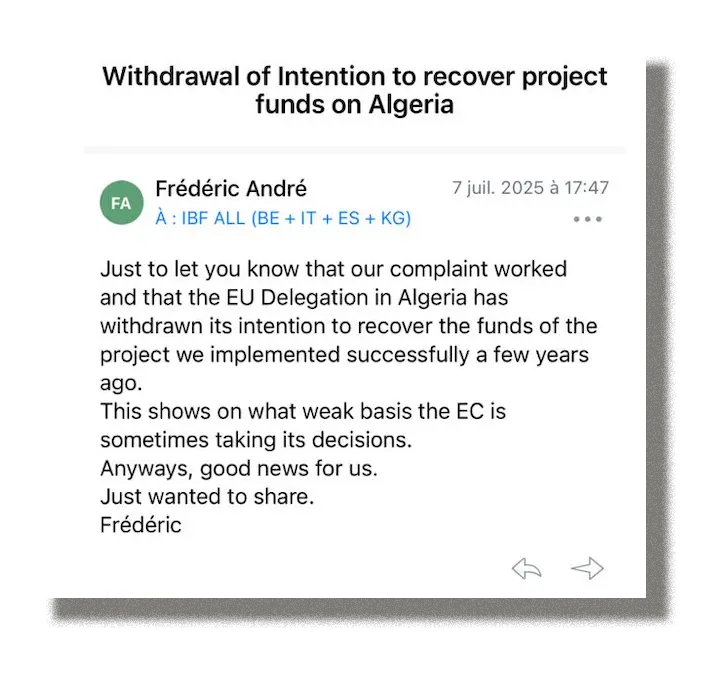
Yet the European Commission offered a different account when asked about this by FTM.
“The Commission has not decided to withdraw the recovery but to reassess the amount,” a spokesperson said.
When asked to comment, IBF’s management said it is also contesting the new amount and is awaiting a response from the Commission.
The latest suspension comes at a time when morale is low at IBF and there are concerns about the firm’s trajectory, two people who previously worked there told FTM and IrpiMedia.
“It seems like IBF wants people to leave. Workers are being fired,” a former employee said on condition of anonymity.
“People are really unhappy.”