
A decade after works began, the expansion of the Midlands Metro is changing the urban landscape in Birmingham and beyond.

“That’s a new building, so is that red one, and that’s a new building on the corner. That’s a new facade to that building over there.”
Riding on the Birmingham Westside Extension between New Street Station and Edgbaston Village, Midland Metro Alliance project director Maria Ion is pointing out how much this part of the city has changed since construction of the tram line began in 2017.
She’s also demonstrating how many other construction sites her team had to interface with during the project.
Constructing a new tram line while a city of over 1.1M people carries on its daily activities is no mean feat. The Covid lockdown did see a lull in the city’s activity that eased the construction of the Birmingham Westside Extension; but there has been no such reprieve for the first phase of the Birmingham Eastside Extension, with construction beginning in 2021 and still underway.
There have been all sorts of hurdles for Ion and her team to clear over the course of both extensions, from unmapped utilities to statue relocation, or from major demolition to the exhumation of 472 bodies from an old burial ground.
Meanwhile, her colleague Tom Maplethorpe, project director for Phase 1 of the Wednesbury to Brierley Hill Extension and Alliance director since October 2024, has had different issues to address.
“We don’t have interfaces with traffic and highways. We have interfaces with a life expired asset,” says Maplethorpe.
This is because much of the Wednesbury to Brierley Hill Extension will run on a section of the former South Staffordshire line which carried freight until 1993.
Updating a Victorian railway line to today’s standards has involved replacing three canal bridges, infilling five disused underbridges, replacing two bridge decks and reconstructing another two bridges. Drainage has been replaced and upgraded, over 1.5km of retaining walls constructed, and mines and shafts infilled. There have also been badger setts and invasive species to deal with.
Though such technical and logistics issues are significant, it is managing the myriad stakeholders and their aspirations that has been the real challenge, according to Colas Rail Urban and Industries managing director Iain Anderson. “When you get to putting the track in the ground, it’s all pretty straightforward. The skill is in getting to that point,” he says.
A history of trams
Trams, first horse-drawn and steam-driven and then electrically powered, ran in Birmingham from 1872 until 1953. After a long hiatus, Line 1 of today’s West Midlands Metro began operating between Wolverhampton and Birmingham Snow Street Station in 1999, with the line extended to Birmingham New Street – the tram stop is called Grand Central – between 2015 and 2016.
In 2016, further expansion of the network began with the signing of the Midlands Metro Alliance (MMA). As well as improving connectivity in the city itself, the new lines will provide regular and reliable public transport for communities between Wednesbury and Merry Hill and – eventually – between Birmingham and Solihull. Running every six minutes, the trams should cut car journeys in the region, improving air quality and reducing congestion. Some sections of the lines will be catenary free – a first for the UK.
There are nine partners in the MMA: client West Midlands Combined Authority (WMCA); designers Egis, Pell Frischmann and Tony Gee; and constructors Colas Rail, Colas, Bouygues UK, Barhale and Auctus Management Group, which supplies labour.
Initially set up to run for 10 years, and recently extended for another 12 months to 2027, the agreement sees MMA deliver all WMCA’s metro expansion projects let within that timeframe. Two legs are already complete and running; Birmingham Westside Extension opened in time for the Commonwealth Games in 2022, and the two-stop Wolverhampton City Centre extension opened in 2023.
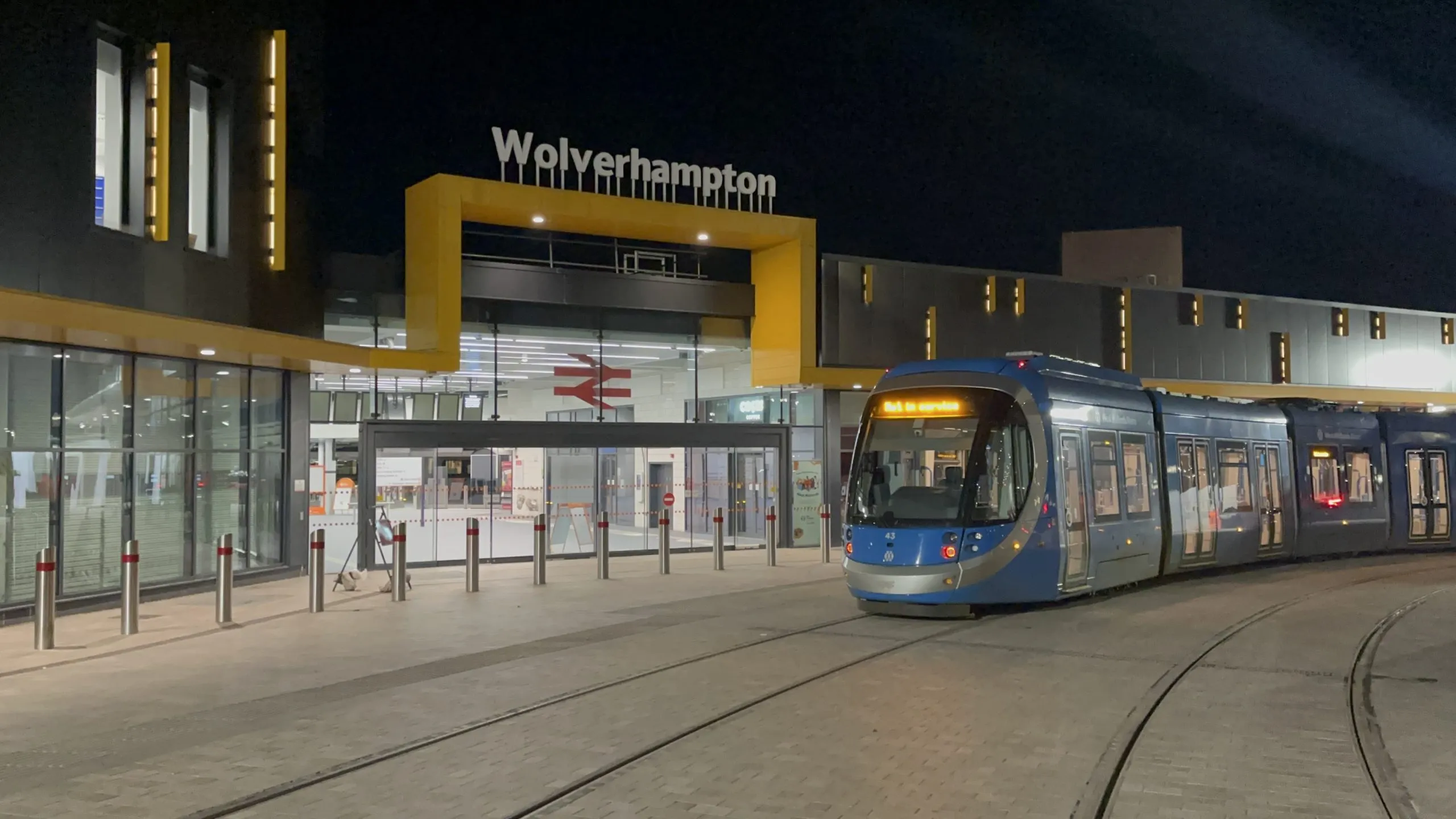
The two-stop Wolverhampton City Centre extension opened in 2023.
Construction of the first phase of the Birmingham Eastside extension, which started in 2021, has been complicated and delayed by its interchange with HS2’s Curzon Street Station. Walking down the route of the new tram line, the green hoardings of the HS2 site mark the barrier to progress.
As a result, MMA started building at each end, moving inwards. The section between Meridan Street and High Street Deritend is built. Meanwhile, a temporary tram stop has been installed before the HS2 hoardings outside the Clayton Hotel, where there is a bus interchange.

Construction of the first phase of the Birmingham Eastside extension has been delayed by its interchange with HS2’s Curzon Street Station. As a result, MMA started building at each end, moving inwards, and a temporary tram stop has been installed before the HS2 hoardings outside the Clayton Hotel, where there is a bus interchange.
Progress has also been slower than initially imagined on the Wednesbury to Brierley Hill Extension, with funding constraints leading to the delivery of the 11km line in two phases. The first phase to Dudley Town Centre is due to open in Summer this year.

Progress has been slower than initially imagined on the Wednesbury to Brierley Hill Extension, with funding constraints leading to the delivery of the 11km line in two phases
Government funding for the 4.5km second phase as far as Merry Hill Shopping Centre came through in 2025, with that section scheduled to open by the end of 2028.
MMA has also renewed some of the Line 1 track during a shutdown for a power upgrade. And at Wednesbury, it is extending the depot to make space for the new trams that will service the Wednesbury to Brierley Hill line.
The total reported cost of the extensions so far, including land, design, new trams and construction, is currently reported at around £1.35bn. Construction costs account for between 40 and 50% of that, says Maplethorpe. “As a contractor we did just under £100M last year of our works,” says Anderson.
Pushing parts of the project back obviously leads to increased costs due to materials and labour costs inflation. And there have been scope changes along the way, as some “reasonable requirements” of local authorities, their highways departments, utility companies and other stakeholders have been negotiated.
The reported cost of the Wolverhampton Town Extension was £50M while the Westside Extension was £149M. The cost of both phases of the Wednesbury to Brierley Hill Extension is around £650M, while the Birmingham Eastside Extension as far as High Street Deritend is £240M, according to MMA.
MMA is waiting to find out whether the next section of the Birmingham Eastside Extension, from High Street Deritend to the new Powerhouse Stadium in the planned Sports Quarter, will be let before the alliance agreement expires.
“We are currently carrying out optioneering design work for the Sports Quarter extension towards the new stadium,” says Ion. “They want to bring new transport to the new stadium, which they hope will be ready for 2030.”
More than tracks
The UK is often pilloried for the cost of its light rail when compared to other countries. However, what the West Midland Metro extension illustrates is that we are not comparing like for like.
First there are utilities to be located, moved, protected and sometimes enhanced if the owners can negotiate that. There have been many unexpected utility discoveries, particularly on the line to Edgbaston. “In France or Romania, the government does the utilities first,” comments Ion, who was brought in from Colas’ Central and Eastern European operations to work on the Midlands Metro programme.
Second, there is the fact that MMA’s scope extends far beyond the track itself. In the city and town centres, the whole width of the street is being repaved and new street furniture, lighting and other infrastructure installed. Aluminium furniture has been replaced with bronze in Birmingham’s historic Victoria Square area and road layouts have been remodelled to better channel buses and cars. At Edgbaston, a whole memorial garden for local schoolgirl Christina Edkins, including 16 trees, has been relocated.
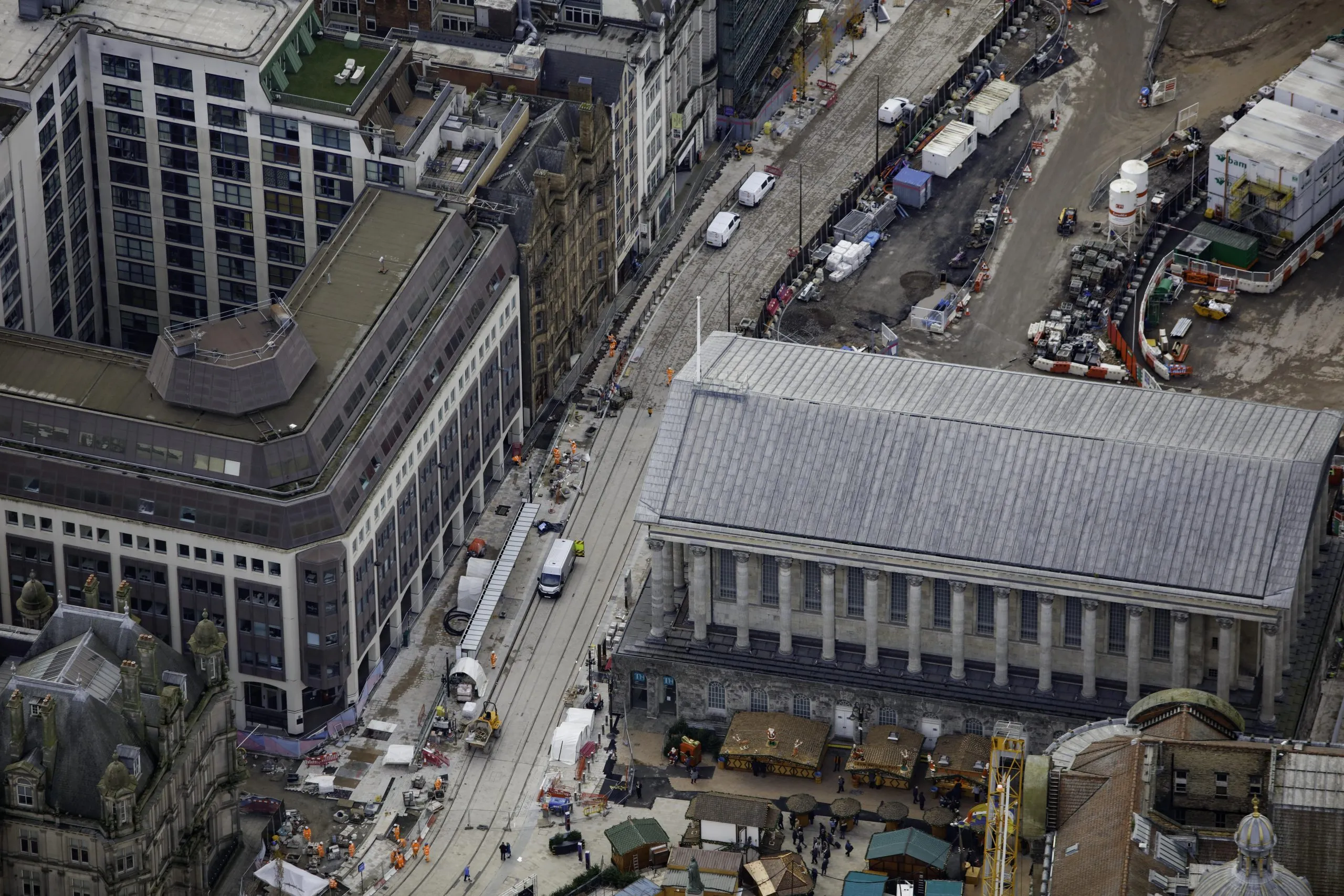
Victoria Square
To make way for the Eastside extension, MMA had to demolish a huge building which was lying across the path of the tram. And at the Moor Street junction, bodies from an ancient graveyard were expected but huge lumps of concrete from a
demolished flyover were not.
The Wednesbury to Brierley Hill line involves significant structural work, both ancient and modern. The most impressive of the new structures is a concrete viaduct for a delta junction which will split the line from Wolverhampton to Wednesbury and to Birmingham, constructed by specialist contractor MPB.
“This is actually four structures in one,” says Tim Betts, MMA senior projects manager. “There is the Eastern approach, a concrete box for a possible future extension towards Walsall, the western link bridge over the access road and the approach viaduct.”
Of the works to existing structures, MMA’s restoration of the Parkhead Viaduct in Dudley is the most impressive. The viaduct was designed and constructed by Isambard Kingdon Brunel, initially as an eight-truss timber structure and later encased in brick and strengthened. Works here included brick repairs, new tie rods and the construction of a U-shaped reinforced concrete trough to carry the tracks across the deck.
Balancing act
Learning to walk the tightrope between creating infrastructure that delivers the best economic, social and political outcomes, while holding onto the purse strings has not been easy, says Anderson.
“In the first couple of years I think all the partners in the Alliance spent too much time saying yes,” says Anderson. “Sometimes you need to push back and understand the mutual position – that’s my biggest learning.
“All the partners need to be strong and competent. It’s only in the second half of the alliance that the client has strengthened their team, bringing more expertise in, which is important because they have a key role in
stakeholder management.”
MMA has developed processes designed to manage scope changes while still accommodating reasonable requests. Now there is a separate and finite pot of money that can be drawn upon for increases in scope, which helps manage expectations. This prevents the potential impasse where the local council, for example, won’t approve plans without their requirements being met, but the budget isn’t there.
Getting the details right is important because it impacts on the success of the scheme, evidence of which is already apparent. Aside from the raft of new buildings around Centenary Square, Anderson highlights the changes along Broad Street towards the terminal at Edgbaston. And on the section of line to High Street Deritend, huge swathes of land have been cleared by demolition ready for new buildings to rise.

Centenary square
Dudley residents should benefit hugely once that line starts running, says Maplethorpe. “For Dudley town centre, the nearest train station is Dudley Port which is two miles away. They have some of the lowest car ownership and the least connected public transport there. The tram will mean they can travel for work and leisure.”
In terms of modal shift, statistics to date are more difficult to read. In 2024, 8.3M journeys were made on the West Midlands Metro, an increase of over 50% compared to 2023. However, all this growth cannot be attributed to the extensions since 8M journeys were made in 2019, pre-Covid19 and pre-extensions.
MMA is proud of the skills legacy it has created with the metro expansion, an achievement that was nationally recognised when its head of engagement and skills Rose Rees received an MBE in 2024 for services to diversity and inclusion.
MMA’s engagement and training statistics are impressive, with Rees pushing beyond easy wins, working to get ex-offenders into employment, designing workshops for Special Educational Needs and Disability schools and setting up a bespoke programme to bring people with no qualifications into the light rail sector.
“We targeted specific areas in Dudley, Wolverhampton and Birmingham where we knew there were high levels of unemployment and young people at risk of getting involved in gangs and things they should not be doing,” says Rees.
Some of those who have been through the programme have gone on to do apprenticeships, others got roles as traffic marshals or labourers, and others found employment in other sectors after their course. Some 42 apprentices have worked on the MMA projects, with six of the original cohort of trainees who joined without qualifications now supervisors for Colas Rail.
With the Sports Quarter extension and the 17km extension out to East Solihull yet to come, those who have gained skills on the metro projects to date have a strong chance of having work into the future. Given its track record over the past 10 years, perhaps MMA can feel the same.
Like what you’ve read? To receive New Civil Engineer’s daily and weekly newsletters click here.