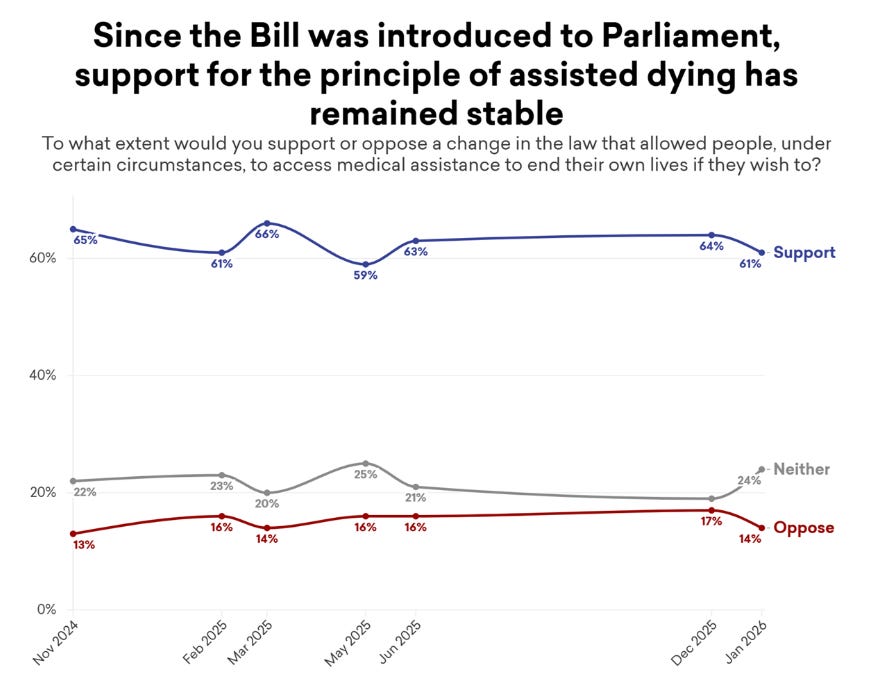
Welcome to the 202nd edition of The Week in Polls (TWIP), and this week, I take a look at the opinion polling about legalising assisted dying.
This is followed by a summary of the latest national voting intentions polls, seat projections from MRPs, and the most recent party leader ratings.
Subscribers who pay for the full edition can also read ten insights from the latest polling and analysis, including:
-
The fragility of support in the polls for banning children from social media;
-
Which party leaders the public think are least likely to tell the truth; and
-
Why it is difficult to see how Vernon Bogdanor’s claims about public trust in the ‘establishment’ stand up to examination of the data.
If you are not yet a paid subscriber, you can read all ten by starting a free trial now:
For more polling news as it comes in during the week, you can also follow The Week in Polls on Bluesky.
One other preliminary: how did the polls do in the Gorton and Denton by-election? As I commented last week, “It is common for there to be large shifts in opinion at the close of a by-election … So even if the polling is right, the outcome may be rather different. We’ll never know for sure if polling got it right.” But aside from pollsters breathing a sigh of relief that both the polls published shortly before polling day put the Greens in first place, it is notable that they were both nearly bang on about the Reform vote share (29% and 28% in the polls versus a result of 28.7%). While ‘errors’ on the Green and Labour vote shares might have been real errors or might have been caused by late tactical voting shifts, being so close on the Reform vote share suggests the polls did a good job.
And with that, on with the show.
Whether assisted dying should be legalised in the UK, and if so on what terms, is primarily a policy question, not a polling question. Opinion polls do though have a useful twofold role.
One is to tell us about the nature of public concerns, so that if the policy decision is to go ahead with legalisation, that can be done on terms that are best designed to secure public confidence in the system.
The other is to help set the context for any controversially unusual procedural decisions that might be required to get legislation through Parliament. With the House of Lords unlikely to have sufficient time in this parliamentary session to complete its consideration of Kim Leadbeater’s bill, and hence talk – for example – of possible use of the Parliament Acts, knowing whether the public want the proposals to become law is relevant.
Since I last covered the topic, public opinion may have changed and many new people have started reading The Week in Polls, so let’s take a look at what the latest polling can tell us.
YouGov in January found the public supporting by 76%-14% the idea that “in principle … assisted dying should be legal in some form”. That’s near identical to May last year (when it was 75%-14%).
Views narrow somewhat when given a wider range of options: 58% support it “both in principle and practice” and a further 7% “oppose it in principle, but in practice I am willing to support it for those who want”, adding up to a total of 65% supporting it in practice. Against that, 20% pick “I support it in principle, but in practice I am opposed as I don’t think it is possible to create adequate law” and a further 8% “oppose it in principle and in practice” for a total of 28% opposing it in practice. Again, the numbers are barely changed from May 2025.
It is a similar picture with More in Common:
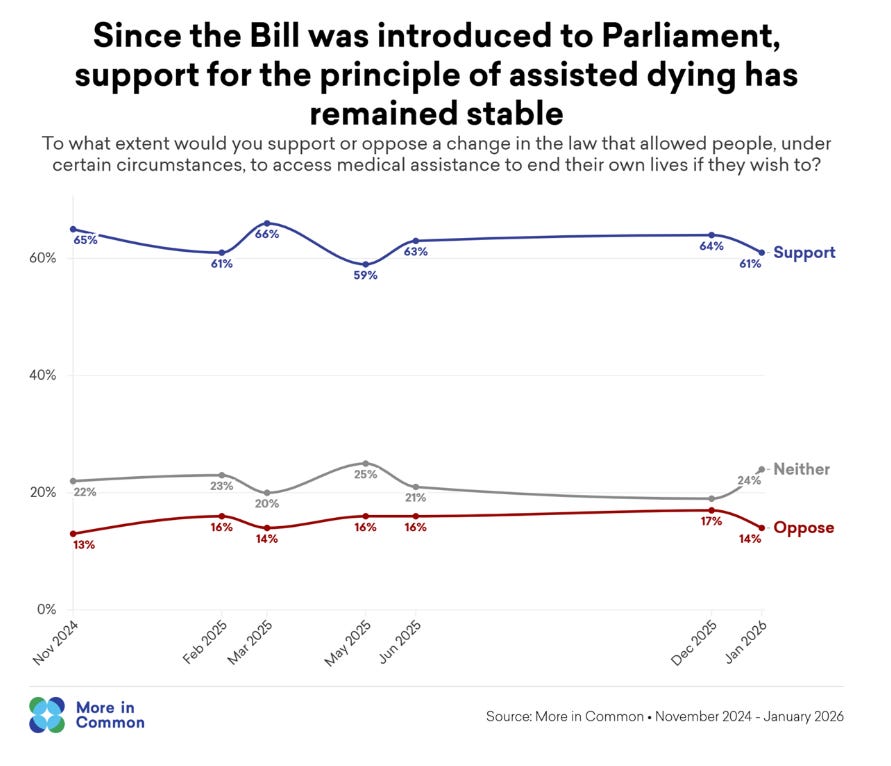
Likewise with the slightly older Ipsos data which last October had 66%-16% support for assisted dying for the terminally ill and again a flat trend over time. Ipsos also asked about the non-terminally ill, finding 57%-22% support if someone is “physically suffering” but only 35%-39% if they are “mentally or emotionally suffering”. (Savanta has also polled more permissive scenarios for potentially legalising assisted dying.)
Although YouGov’s polling in different forms has consistently shown a large majority in favour of legalisation, it has also found majorities for some concerns. In particular:
-
By 56%-27% people think it likely that “significant numbers of people would have assisted deaths primarily because they feel they cannot afford the care and support that would help them cope with terminal illness.”
-
By 55%-29% people think it likely that there would be “significant numbers of people having assisted deaths primarily because they feel that they have become a burden to others.”
There has also been polling from Focaldata about concerns regarding the legislation. Unfortunately, the insights in that polling were obscured in misleading presentation of it by campaigners against assisted dying and by it only testing one side of the issue. (The pollsters themselves have on their website a clear health warning about what the polling does and doesn’t say, and the problematic presentation came in a press release from others.) I wrote more about that polling in The Week in Polls #185.
On its current trajectory, the bill will fail at the committee stage in the House of Lords because that stage will not be completed in the time allocated. The most talked about procedural way around that is for the legislation to be restarted in the House of Commons in the next parliamentary session and for the Parliament Acts to be used to ensure it does not fail by running out of time in the Lords again.
By 52%-20% More in Common finds that people think it would be bad, rather than good, if the bill “were to fail because the House of Lords ran out of time to scrutinise it by the deadline”. Not surprisingly, supporters of assisted dying split 70%-13% on that while opponents split 27%-54%.
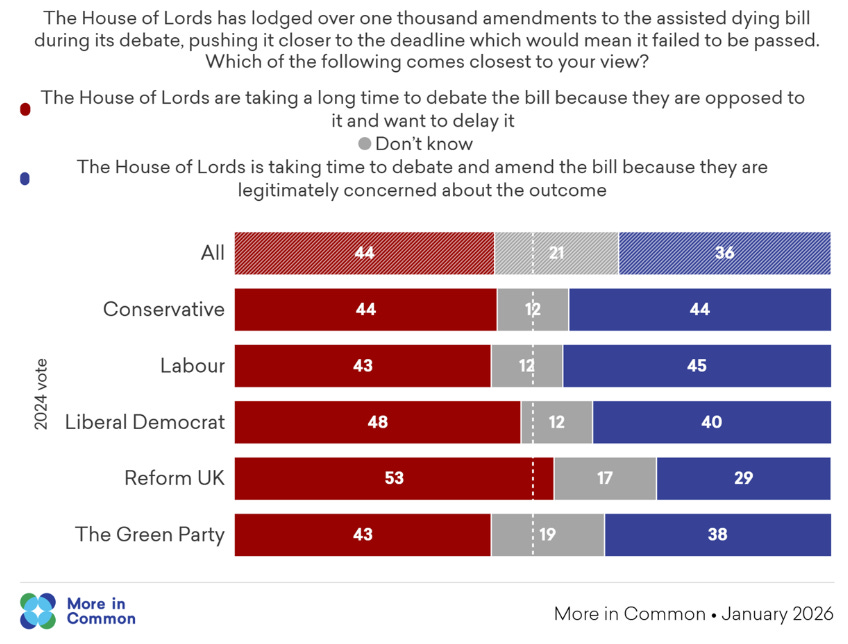
An important caveat to this, though, is that ‘ran out of time’ is an apparently clear and neutral description, but behind this is a highly contested question: is the scrutiny of the bill simply requiring more time than has been made available, or is the scrutiny of the bill being filibustered to eat up time unnecessarily?
So far, the media coverage of this question has been pretty superficial, simply reporting the contrasting claims of time wasting versus proper scrutiny. There is very little media coverage that gets into sufficient detail about how time is being used up to let someone draw an informed conclusion about which side is, in their view, right. Rather, all you have are the editorial choices of that media outlet and your own prior assumptions about which side you are more inclined to believe.
This means that public opinion on this may be rather soft and liable to shift if (even) more controversy, and so more coverage, kicks off. So far, again using More in Common data, it’s a fairly close public split over what’s going on:
If it does fail, then 83% according to More in Common want to see the bill reintroduced in the Commons.
The polling mentioned so far has all been for the UK or Great Britain and although the polls have Scottish cross-breaks in each case they are small sample sizes. However, due to devolution there is separate legislation going through the Scottish Parliament on the topic. Recently published data from the British Social Attitudes survey shows strong support for the concept in Scotland based on a solid sample size.
The situation in Wales is more complicated as it involves both the Senedd and the Westminster Parliament. A recent Welsh poll finds a similar picture of overall support to that across Britain.
But let’s end with some polling you shouldn’t pay attention to.
Banish from your consideration any trace of last year’s story in The Independent – also printed out on glossy paper and circulated anonymously to peers – claiming public support for peers voting down the assisted dying bill. Both myself and Peter Kellner thoroughly debunked that story. As Peter put it:
The trouble is that the headline is misleading, the poll not what it seems, and the larger truth about public opinion sadly absent.
In addition, 38 Degrees has emailed peers with a message which says that “we also polled 16,638 members of the public on the issue with the following results…” However both that unusually large number and the way the data is otherwise presented makes it look like this was simply a survey they sent to their own supporters rather than a proper opinion poll. Alas, they have not so far responded to my query about this. As far as looking for solid polling data goes, therefore, this is one to put aside, at least pending 38 Degrees being willing to say more.
Last Monday, the government made a ministerial statement to Parliament about the reversal of its plans to cancel various local elections due in May. We discussed the statement in the House of Lords two days later, and there’s an intriguing sign that the government may be willing to change the law to provide better safeguards if cancelling elections is ever on the agenda in future:
Will Labour now curb government’s power to cancel elections?
Welcome…
Read more
3 days ago · 1 like · Mark Pack
Borrowing an idea from Stuart Ritchie and others, if you spot a factual error in an edition of this newsletter, I will give you a free 12-month subscription to the paid-for version (or an extra 12 months on your existing one). Factual errors qualify rather than grammatical errors or disagreements over interpretation, with my decision being final. Messages about both of those are always very welcome, though.
Here are the latest voting intention polls from different pollsters, though note that it will take a couple of weeks to see if the Gorton and Denton by-election is having an impact on levels of party support.
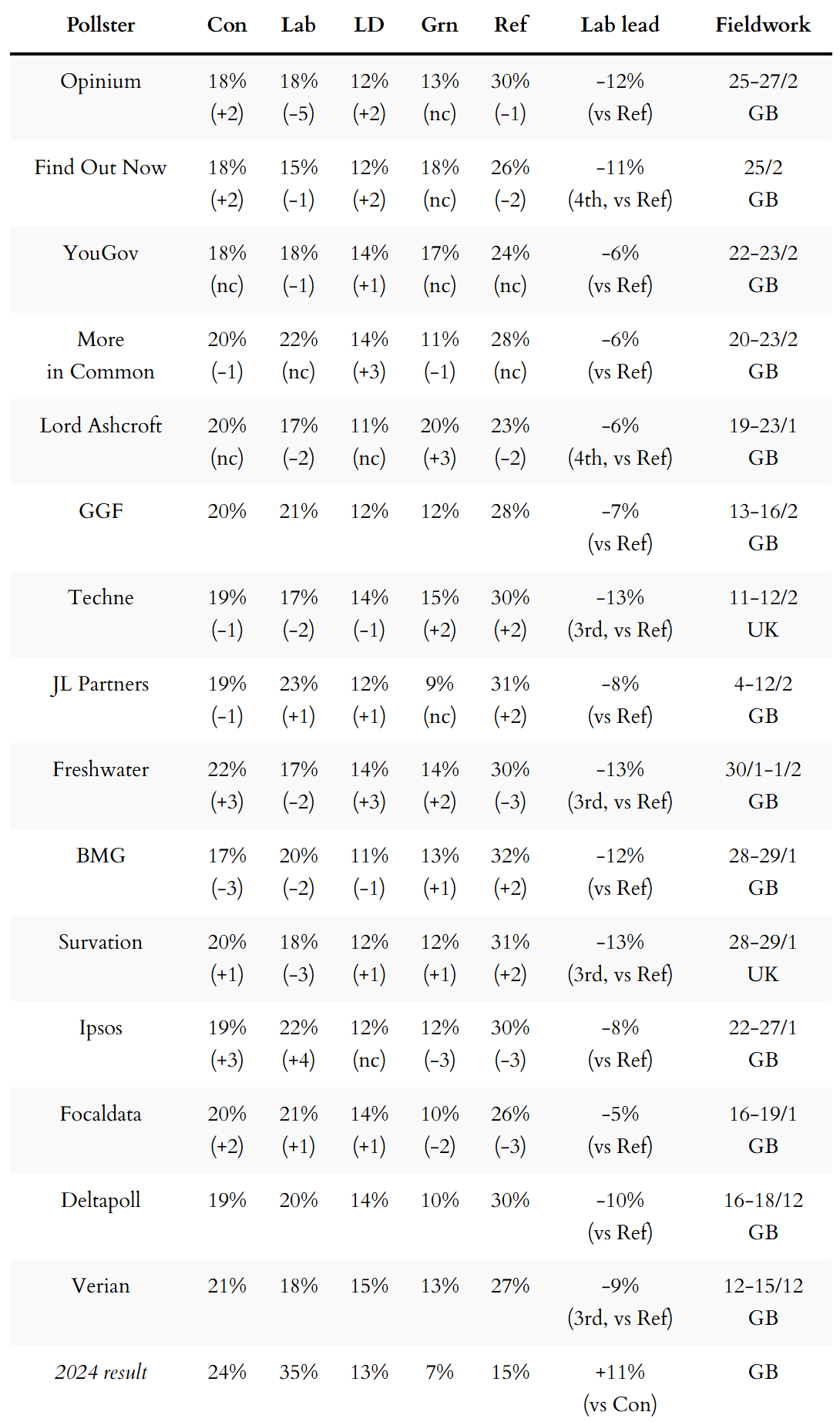
The table is also online here. It is updated regularly through the week with new polls.
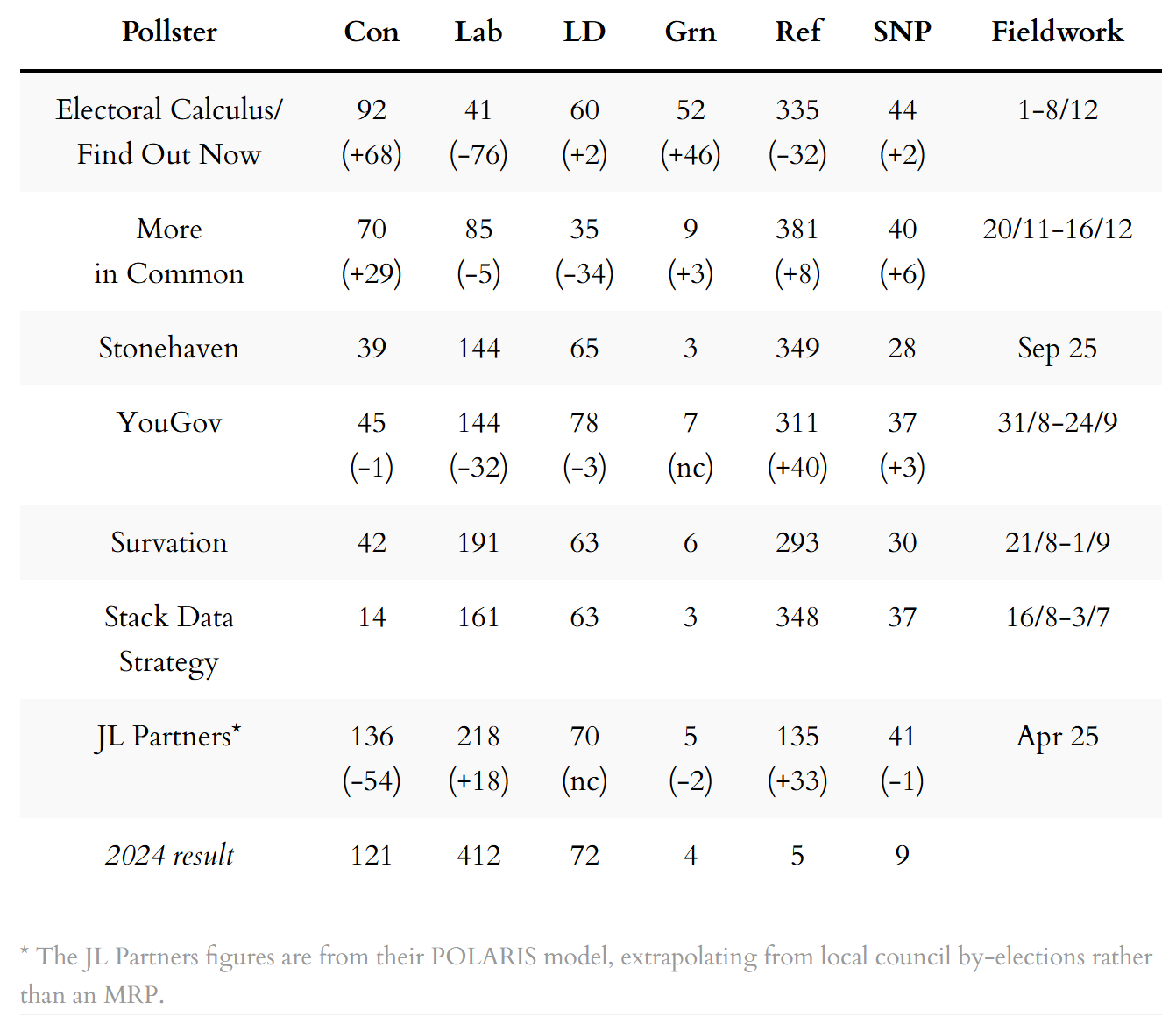
Next, the latest seat projections from MRPs and similar models, also sorted by fieldwork dates. As these are infrequent, note how old some of the ‘latest’ data is.
Finally, a summary of the latest leadership ratings, sorted by pollster name:
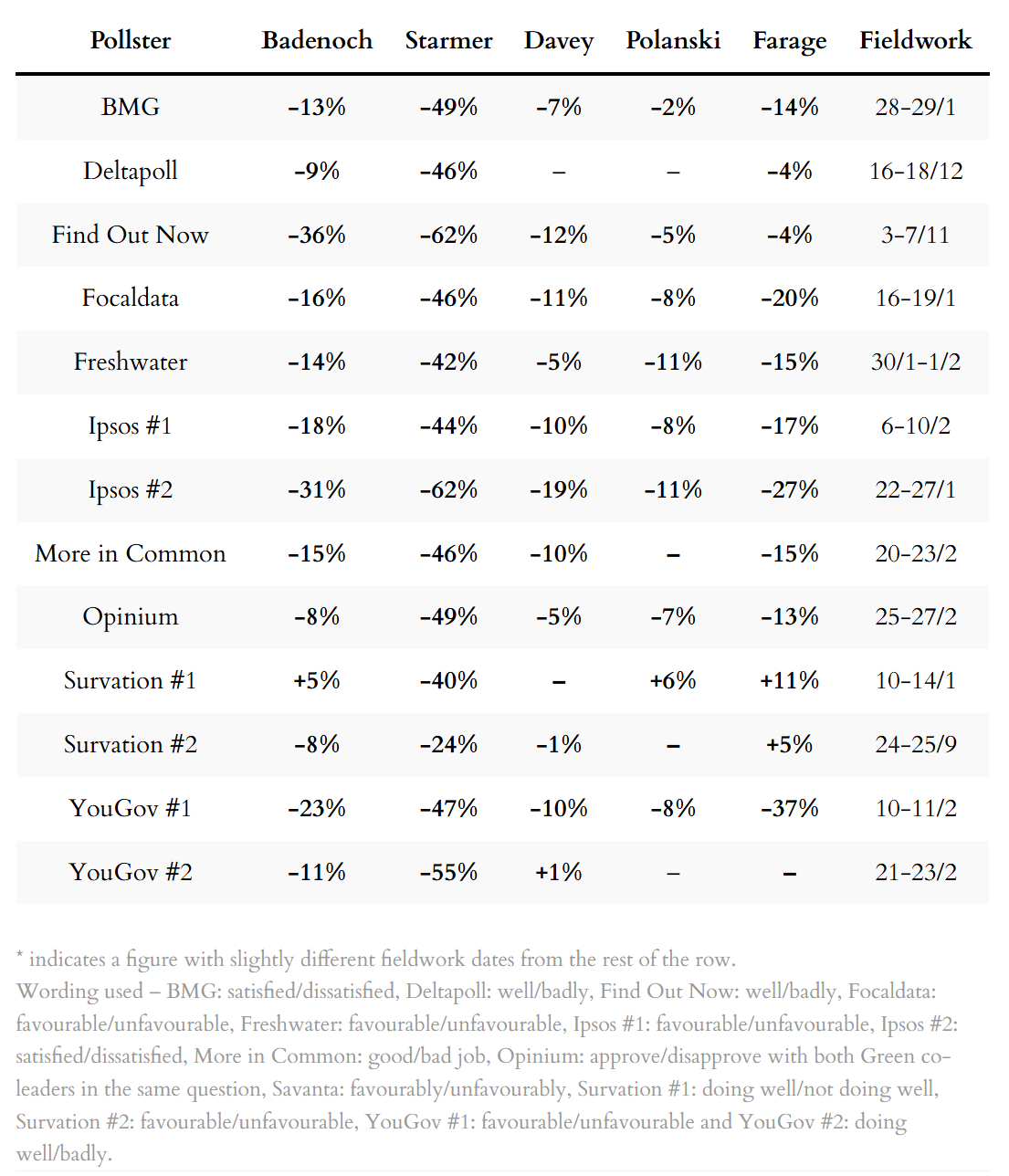
The table is also online here with additional details, and is updated regularly through the week as new data comes out.
For the historic figures for both voting intention and leader approval, including Parliamentary by-election polls, see PollBase.
 Gorton & Denton Parliamentary by-election: what three constituency polls tell us
 Three risks for Reform hiding in the data
My privacy policy and other legal information are available here. Links to purchase books or other items are usually affiliate links which pay a commission for each sale.
Quotes from social media messages are occasionally edited lightly for punctuation and clarity.
If you are subscribed to other email lists of mine, please note that unsubscribing from this one will not automatically remove you from the others. If you wish to be removed from all my lists, simply reply to this email to let me know.
The following 10 findings from the most recent polls and analysis are only for subscribers who pay for the full edition, but you can sign up for a free trial to read them straight away.
-
We can’t know for sure, and also don’t even have polling data on candidate approval scores. But informed speculation about what impact picking Matt Goodwin as their candidate had on Reform’s chances in the Gorton and Denton