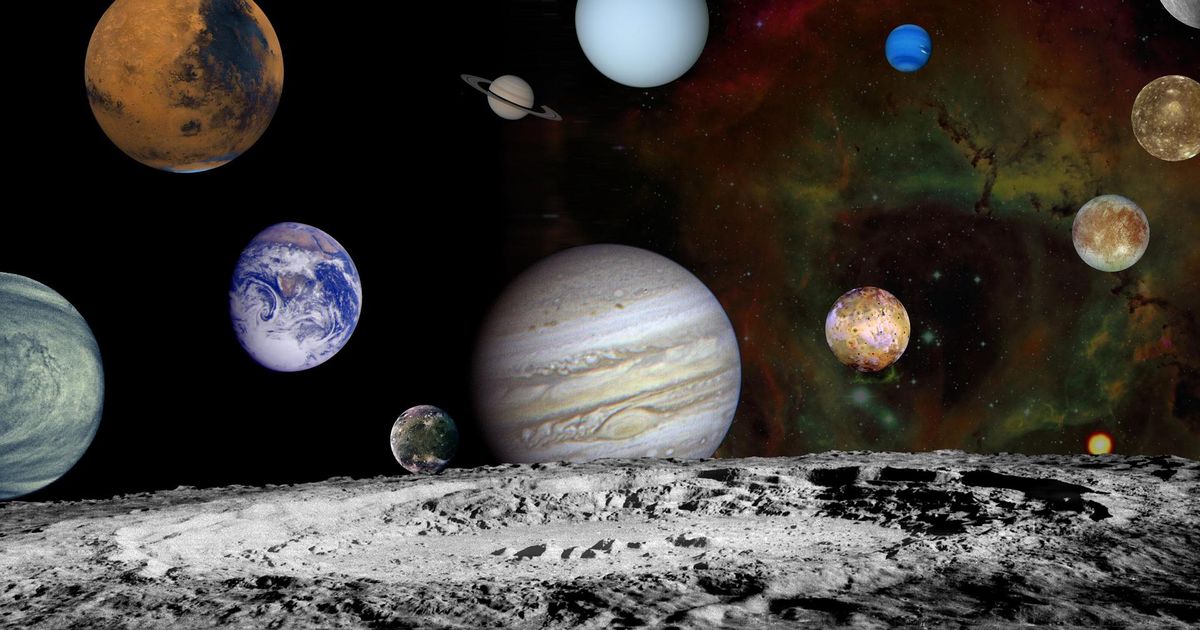
Scientists claim they have discovered a potential candidate for Planet Nine – and it’s not Pluto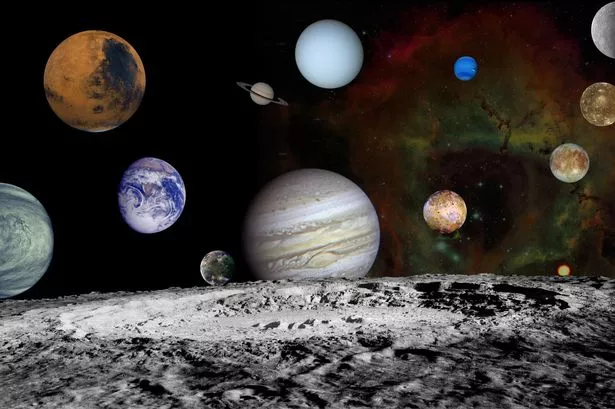 Scientists claim to have discovered ‘9th planet’ in our Solar System(Image: NASA/JPL/ASU)
Astronomers claim to have discovered a new ninth planet in our Solar System.
Planet Nine, also known as Planet X, is a hypothetical celestial object that would distantly orbit our Sun – but there is significant debate in the scientific community about whether it exists.
If Planet Nine does exist, it could help to explain some of the unique orbits of smaller objects in the Kuiper Belt – a region of icy debris – at the far reaches of our solar system, according to NASA.
Now, a team of international researchers say they have identified signals that could indicate a planet far beyond Neptune.
“I felt very excited,” Terry Long Phan, an astronomy graduate student at Taiwan’s National Tsing Hua University and the study’s lead author, told Science. “It’s motivated us a lot.”
The new preprint study states that infrared dots detected by space telescopes appear to be moving in a way that is consistent with a large and distant planet.
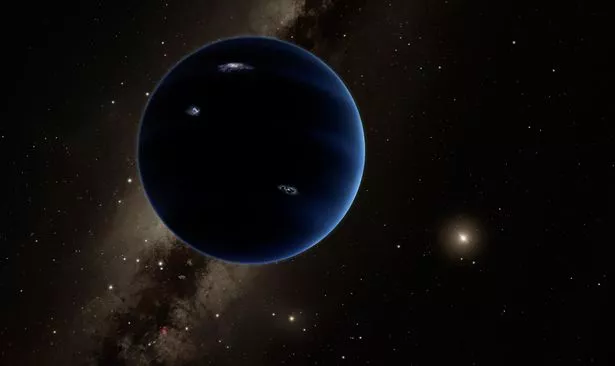 Artistic impression of Planet Nine in distant orbit of the Sun(Image: PA)
In space, infrared can be used to penetrate dusty regions of space to reveal hidden cosmic objects like young stars or planets.
The researchers used surveys of the sky from two infrared space telescopes that were launched in 1983 and 2006 and found 13 pairs of dots that could be explained by a moving planet that resembled Planet Nine.
However, the research has been met with some skepticism.
The Planet Nine theory was made by Caltech astronomers Konstantin Batygin and Mike Brown in 2016. Their research provided evidence for a planet about 1.5 times the size of Earth in the outer solar system, but did not actually find a candidate planet.
Responding to the latest study, Brown told Science that he isn’t convinced the infrared dots correspond to a ninth planet. He was not involved in the study, but said his calculations suggested the celestial body would be on a much greater tilt than the solar system’s plane and would orbit in a different direction from the known planets.
This difference “doesn’t mean it’s not there, but it means it’s not Planet Nine,” Brown told Science. “I don’t think this planet would have any of the effects on the solar system that we think we’re seeing.”
The solar system consists of the Sun, our home star, and everything that is bound to it by gravity: the planets Mercury, Venus, Earth, Mars, Jupiter, Saturn, Uranus, and Neptune, along with dwarf planets like Pluto, moons, and millions of asteroids.
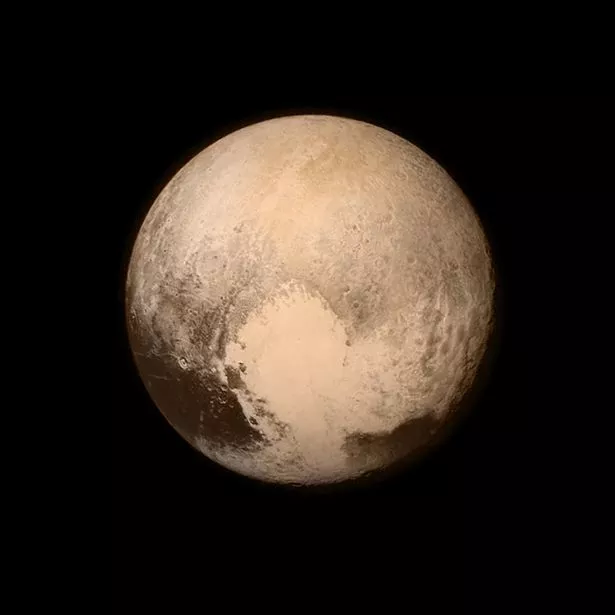 Pluto was once considered to be the ninth planet in the solar system(Image: PA)
Discovered in 1930, Pluto was long considered our Solar System’s ninth planet, but was unseated in 2006 after the discovery of similar worlds deeper in the Kuiper Belt. As a result, it was reclassified as a dwarf planet.
Instead, the hypothetical Planet Nine is said to orbit about 20 to 30 times farther from the sun than Neptune, taking between 10,000 and 20,000 Earth years to make one full orbit around our star, according to Brown and Batygin.
“Although we were initially quite skeptical that this planet could exist, as we continued to investigate its orbit and what it would mean for the outer solar system, we become increasingly convinced that it is out there,” Batygin, an assistant professor of planetary science, said in 2016. “For the first time in over 150 years, there is solid evidence that the solar system’s planetary census is incomplete.”
No observational evidence for Planet Nine has been found, but the latest study is not the first time a candidate has been put forward.
The study has been accepted for publication in the journal Publications of the Astronomical Society of Australia and has been published on the preprint server arXiv.