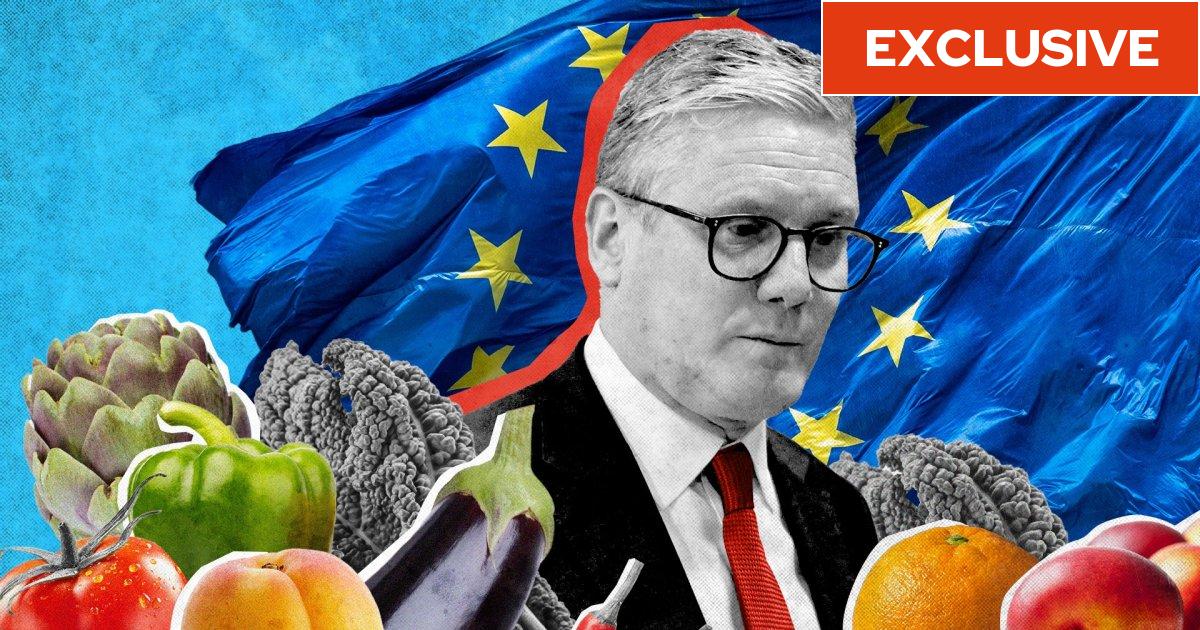
British shoppers face paying more for fruits like oranges, lemons and cucumbers under Sir Keir Starmer’s Brexit reset food deal despite a promise that it would bring down prices.
The Prime Minister has made a food and drink deal with the EU the economic centrepiece of his so-called Brexit reset, promising it would keep costs down at supermarket checkouts.
But while the planned deal, which will see the UK follow EU laws on food and drink, will make it easier to import food from Europe by reducing border checks and paperwork, the opposite will happen for some products imported to Britain from the rest of the world.
New FeatureIn ShortQuick Stories. Same trusted journalism.
The problem will be particularly acute for fruit and vegetables, which the UK Government has, post-Brexit, decided should face no checks if coming from the EU and no or minimal checks if imported from countries in the rest of the world. This was designed to ease trade and because the products are deemed relatively low risk to British biosecurity.
But under the reset deal, EU rules that the UK will have to follow will force the Government to impose dramatic increases in checks on particular types of fruit in particular that Britain imports in large numbers.
Checks could cost UK industry £400m
UK industry faces a £400m cost hit from the change, with the likes of citrus fruits like oranges, lemons, limes and grapefruits, cucumbers, mangoes and other stone fruits particularly badly hit, according to the Fresh Produce Consortium (FPC).
These products currently face zero or minimal (5 per cent) plant health inspections if imported from the rest of the world, under rules decided by the UK Government, but under the Brexit reset deal would face checks of varying frequency up to 100 per cent on products like cucumbers.
The extra costs include port fees, official inspection fees, potential inspection fees in the exporting country, as well as extra paperwork and administrative costs.
These will inevitably be passed on to supermarket customers unless the Government negotiates a carve-out from EU law for imports from the rest of the world, according to FPC chief executive Nigel Jenney.
He said “costs of that magnitude and cumulative costs can only go one way, the UK consumer sadly has to fund that”.
He claimed that because the Government has already unilaterally decided to impose no or minimal checks on fruit and veg imports, prices would rise rather than fall for many of these products.
The UK currently produces about a third of its own fruit and veg, while importing a third from the EU and a third from the rest of the world.
Jenney said: “It will just make it slower and more costly [to import fruit and veg].”
“Everything we’ve enjoyed for the last five years with trading with the rest of the world will be lost,” he added.
“Unless they are willing to adopt a carve-out clause, we will subject potentially up to 4m tonnes of fresh produce to border checks that we currently don’t consider necessary for a political outcome, not a science-based decision that will add huge costs and delays to our industry.”
UK may struggle to reach a deal to avoid checks
Former UK trade official David Henig said adopting EU inspection rules “for food and drink arriving from outside the bloc may put us in breach of trade deals negotiated in the last five years such as joining CPTPP, potentially requiring some renegotiation”.
Henig, UK director of the European Centre for International Political Economy, told The i Paper the Government was unlikely to be able to meet Jenney’s demand of negotiating a carve out.
“The UK cannot expect to negotiate an exemption to checks on third country products if we expect our own production to move seamlessly across the EU, and this might increase some prices.”
Balwinder Dhoot, director of growth and sustainability at the Food and Drink Federation (FDF), said the Brexit food deal would “streamline trade and unlock new opportunities for many food businesses”.
But he added that “aligning our food standards with the EU is a significant task and means that all food businesses operating in the UK will need to comply with EU food law, whether they trade with the EU or not”, calling for support to be given to businesses “including more information on the checks that rest of world imports will become subject to”.
A spokeswoman for the Department for Environment, Food and Rural Affairs said: “We have reset our relationship with the EU – our closest partner and biggest market – to support British businesses, back British jobs, and put more money in people’s pockets.
“We expect the deal to remove most routine checks on EU imports, while checks on most goods from the rest of the world will broadly align with the EU’s approach.
“These negotiations are ongoing and we will set out further details when they conclude later this year.”