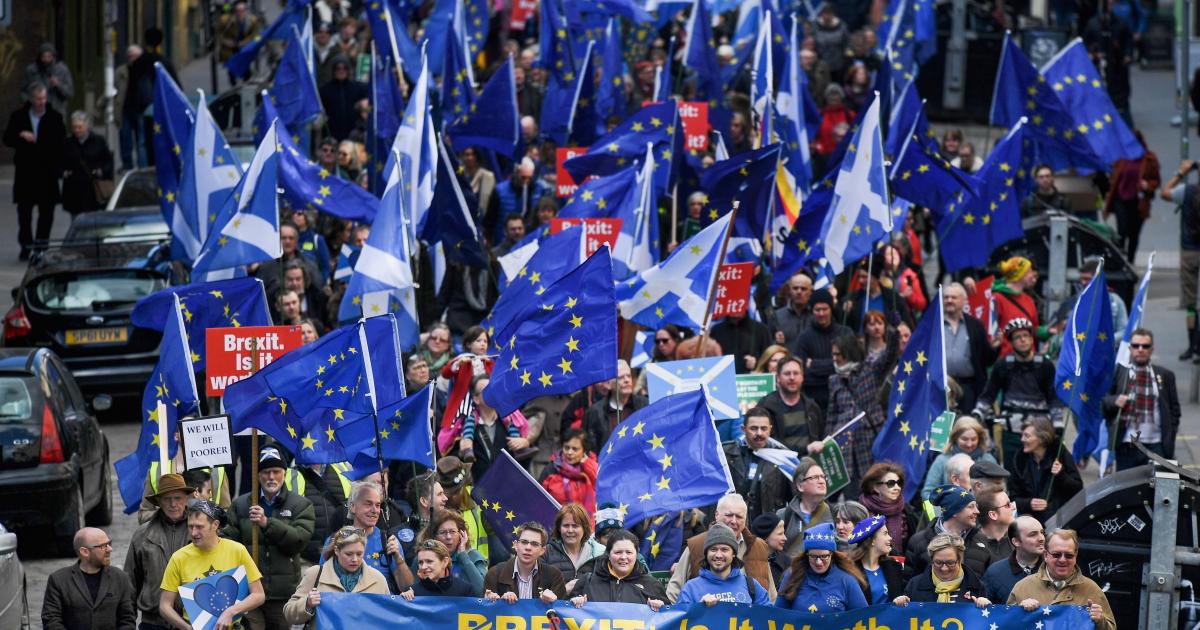
Brexit has been very much in the spotlight over the last couple of weeks, with Labour Mayor of London Sir Sadiq Khan and Chancellor Rachel Reeves highlighting the damage done.
However, while both were robust and direct in their comments, when it came to what should happen next there was quite the contrast.
Sir Sadiq, in an interview with Italian newspaper la Repubblica published on Thursday last week, made it crystal clear what he thought should happen and when.
Ms Reeves, who is obviously hemmed in by Labour’s red lines of not rejoining the European Union, single market or even the customs union, was notably but not surprisingly bereft of any plan to mitigate the Brexit damage in a major way in her Mais lecture last week.
And Jill Rutter, a senior fellow of the Institute for Government independent think-tank who has written extensively on Brexit, this week declared: “While both Prime Minister and Chancellor are speaking with new-found warmth towards the EU, it is debatable whether any progress has been made.”
Ms Reeves said in her Mais lecture at Bayes Business School in London on Tuesday last week: “Brexit created profound uncertainty, raised new barriers to trade, and leaves Britain facing an additional danger today: the risk that we find ourselves stranded between powerful trading blocs, as globalisation retreats.”
Later in the speech, she declared: “This Government is already making significant progress on our relationship with the European Union on agrifood, electricity, emissions trading, and Erasmus.
“But Brexit did deep damage. Recent independent studies indicate its GDP impacts could be as much as 8%.
“It has meant higher costs for businesses, and therefore…higher costs in our shops. It’s meant shrinking markets for UK exporters, and our strategic industries exposed, as protectionist barriers rise.”
It is good to hear the Chancellor highlight the huge damage from Brexit – underlined by that colossal “as much as 8%” of gross domestic product quantum for the impact.
The tiresome “Brexit is done and we must move on” mantra of the Leavers has always rung extraordinarily hollow.
And it most certainly continues to do so, with Labour clearly having shaken off some of its timidity when it has come to telling the likes of the red-wall voters who swept Boris Johnson to victory in December 2019 just what is what.
Ms Reeves did declare “no trade deal with any individual nation can outweigh the importance of our relationship to a bloc with which we share a land border, with which our supply chains are closely intertwined”, and talked constructively about regulatory alignment with the EU.
That said, Labour’s red lines remain utterly demoralising.
Sir Sadiq, for his part, made absolutely no bones about his opposition to these red lines.
Read more
He told la Repubblica: “I see on a daily basis the damage Brexit has done to not just London, but Londoners, the damage economically, socially and culturally. And I’m quite clear in terms of what needs to happen, which is, I do think we should join the European Union.”
He went on to advocate “a five-stage process, in relation to this”.
Sir Sadiq said: “Number one, we should reset relations with the EU, and that’s done. Tick. Number two, we should have closer alignment, and the Chancellor this week has talked about closer alignment, sector by sector, and only diverge in exceptional circumstances. So we basically have to take the next three steps that are incredibly important.
“Step three, we should rejoin the customs union this parliament. Any trade agreement is less good than the customs union. And then step four, we should rejoin the single market. We should try and do this during this parliament. And then we should, as a Labour Party, fight the next general election with a clear manifesto commitment: a vote for Labour means we would rejoin the European Union. I think it’s inevitable. Why do I say that? Because we’ve seen the damage it’s done, but also we’ve seen the promises made by the Brexiteers have been exposed. There is no additional £350 million every week going to the NHS, families are suffering, businesses are suffering, the country is suffering. This is quite extraordinary.”
The Mayor of London was then asked by la Repubblica if he thought the Labour Party should commit for the next election to rejoin the EU, without a second referendum.
And he was “quite clear” too in his response to this question.
Sir Sadiq said: “This parliament, we should rejoin the customs union and single market. I’m quite clear. On the ballot paper of the next general election is a vote for Labour, a vote to rejoin the European Union, and we should be unequivocal about the benefits of the European Union because we’ve now seen the alternative. We’ve now seen what happens when you’re outside the European Union: less investment in the UK, less exports to the European Union.
“But let me speak from experience. You know, since 2019, and it breaks my heart, I’ve seen Londoners who are EU nationals leaving London. We had in 2019 more than 840,000 EU Londoners working in London. That’s gone down to now 700,000, that means 140k Londoners have left London, and the two biggest sectors they’ve left concern construction and hospitality. And these are Romanians, Polish, Italian, French, Irish Londoners, who’ve left their friends. They’ve left their neighbours. As a consequence, we’ve suffered economically, in construction, hospitality, but also we’ve suffered socially and culturally as well.”
Sir Sadiq was also forthright when asked if he had personally discussed this topic with the Prime Minister, who we should remember was a vociferous and eloquent opponent of Brexit in late 2019 but is these days continuing to highlight Labour’s “red lines”.
The Mayor of London replied to la Repubblica as follows: “No, he’s busy being Prime Minister. I’m busy being Mayor. But the next time I speak to him, and he knows my views, he knows that I’m somebody who’s still heartbroken about leaving the European Union. You’re weaker without the UK. I think it’s in nobody’s interest for either side, you know, to play hardball for the sake of incremental benefits. Get us back inside the club, back inside the European Union, and let’s be stronger together.”
Given its dreadful impact and the UK’s economic malaise, it should be of no surprise to anyone that Brexit remains a huge issue.
Ms Rutter’s reflections on the current state of play, in an article published by the Institute for Government on Wednesday, were eye-catching.
She declared: “Shortly after Reeves spoke, the London mayor, Sadiq Khan, went much further and called for the UK to join the single market and a customs union this parliament – with Labour campaigning to rejoin, with no referendum, at the next general election. Reeves herself used a much higher figure than the OBR’s (Office for Budget Responsibility’s) for the costs of Brexit – 8% not 4% long-term cost, suggesting a much more fundamental problem than can simply be fixed by tweaking Boris Johnson’s ‘botched Brexit’.
“As Labour wakes up to the loss of support to the Greens – a potent threat in London elections – the Government may find itself pulled into ever greater reset ambition. Some in the EU would welcome this, while others would have less time for UK exceptionalism and are agitating for EU-first policies which risk worsening the UK’s position.”
Ms Rutter concluded: “The past year shows it is easier to up the rhetoric than to deliver results. The past week suggests that 2029 could be another Brexit election.”
It certainly did seem notable that Ms Reeves chose to highlight the damage from Brexit so directly.
The big question is whether the Labour Government will feel inclined to move from albeit now far more direct and realistic talk about Brexit’s effects to actually tackling the damage in a serious way, something which would mean obliterating its own red lines.