

Credit: Far Out / Kathleen Ballard / UCLA Library / Albert B. Grossman Management
“Janis Joplin is singing with Big Brother in the Panhandle and almost everybody is high,” Joan Didion wrote in 1967’s Slouching Towards Bethlehem, her observation of the dark side of San Francisco’s counterculture, “and it is a pretty nice Sunday afternoon between three and six o’clock, which the activists say are the three hours of the week when something is most likely to happen in the Haight-Ashbury…”
While Joplin was born and raised in Port Arthur, Texas, she would become synonymous with San Francisco from when she first moved there in 1964, hitchhiking her way from home with her friend, Chet Helms (soon to be known as the unofficial ‘father’ of the Summer of Love and the founder/manager of Big Brother and the Holding Company). It was during this summer, in 1967, that Didion would find herself wandering, desperately seeking an answer to the disarray that she saw underneath the culture’s guise of peace and love. Under her gaze, San Francisco was wholly exposed and dissected, and Joplin, as one of its stars, was one of Didion’s many subjects.
In the interim from her arrival in San Francisco and the so-called Summer of Love, Joplin had made her reputation in the city, both as a singer and a personality. She began recording blues standards with future Jefferson Airplane guitarist Jorma Kaukonen, but, at the same time, her substance abuse began to escalate. For the next two years, Joplin’s drinking increased, while she took an array of psychoactive drugs and amphetamines, and occasionally used heroin. In 1965, her friends eventually convinced her to return to Port Arthur, where she remained sober and recorded songs on her own, accompanied by her acoustic guitar. However, once Helms came knocking on her door with the opportunity to join Big Brother, she found her way back to San Francisco.
Some two years later, as Joplin’s stardom began to ascend in anticipation of Big Brother’s debut album, hers and Didion’s paths would first cross, as Joplin caught the latter’s ear on the outskirts of Golden Gate Park, her voice was, in a way, the soundtrack of the counterculture, as booming and evocative as it was, and her presence as a larger-than-life personality, charming and clever, made her a figure that was difficult to ignore. Before Big Brother’s debut and their breakout performance at that summer’s Monterey Pop Festival, she was already an icon in the making, and Didion took notice.
The two women’s paths would cross again within the next year or so. While on the surface, their personalities were vastly different, one an eccentric rockstar and the other an insular journalist, they ran somewhat in the same circles: Joplin, of course, being among fellow rock musicians and Didion, as a writer, profiling musicians. “Rock and roll musicians are the ideal subject for me,” the writer once said, “They would just lead their lives in front of you”.
Sometimes, they overlapped socially, and it was through this that they would properly meet at the writer’s home with her husband, John Gregory Dunne and daughter, Quintana Roo Dunne, in Los Angeles, where the couple had moved in 1964 and adopted their daughter two years later, making their home on Franklin Avenue, a space which became the stomping grounds of every facet of artist one can think of: musicians and writers, alike, alongside painters, actors, directors and more.
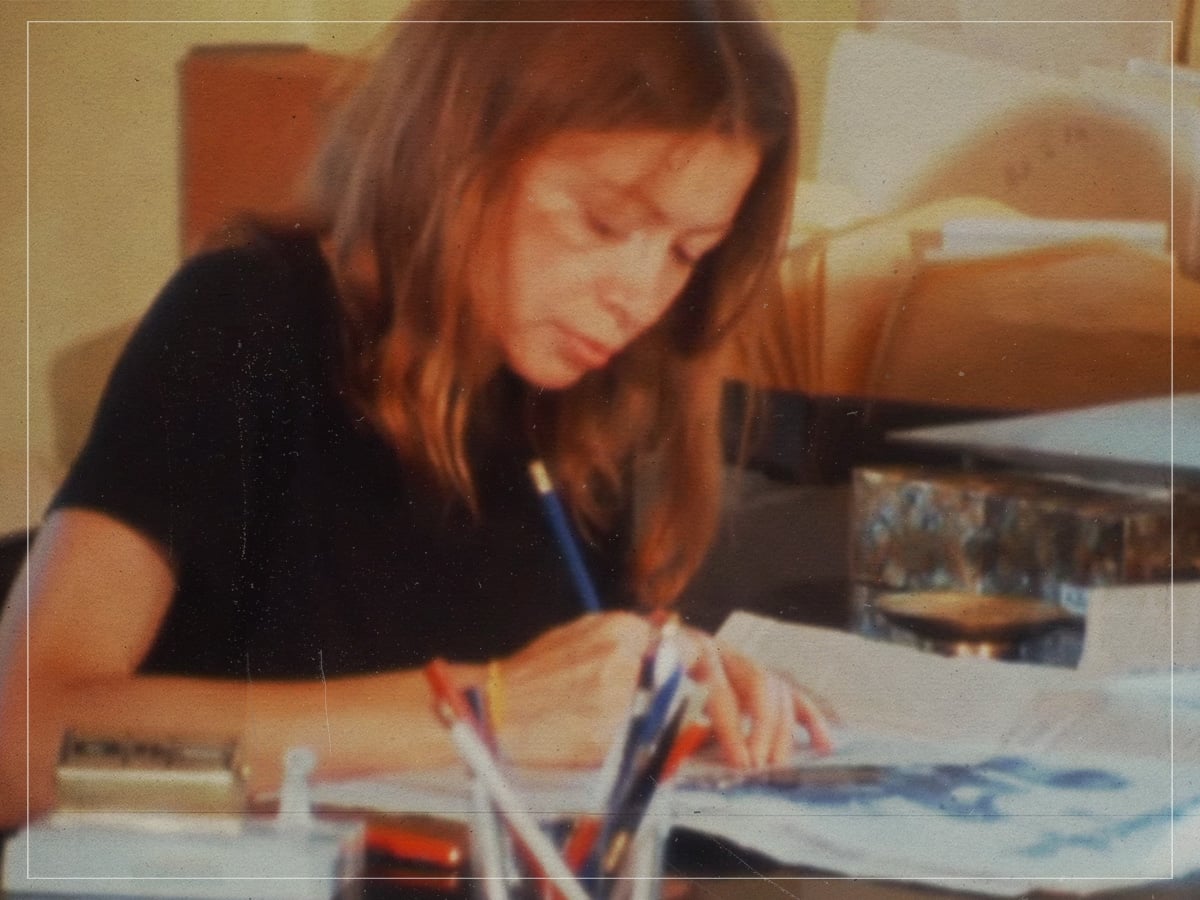 Credit: Far Out / YouTube Still
One of the many parties thrown at the Didion-Dunne household was in celebration of Tom Wolfe. As Dunne recalled to The Guardian in 2003, “It was the launch for one of his books”. Indeed, Wolfe’s nonfiction work, The Electric Kool-Aid Acid Test, was about to be published in the summer of 1968. What better place to celebrate its arrival than at the home of his fellow New Journalism pioneer in Didion, where inevitably, everyone worth knowing in Los Angeles would arrive?
The party quickly turned raucous, “a fucking zoo”, as Dunne described, by the time that Joplin arrived at around 10:30 at night. At some point, an unknown culprit presented drugs as a party favour, and word got back to Didion that they were available upstairs, where her daughter, Quintana, was asleep. As Susanna Moore, a friend of the Didion-Dunnes, recounted in her 2020 memoir, Miss Aluminum, Didion ran upstairs to find guests dispensing peyote in the hallway, right outside Quintana’s bedroom. “When she asked them to leave,” Moore wrote, “a musician who had come with Janis Joplin said, ‘You don’t know who you’re missing, babe’, and Joan, following them down the stairs to the front door, said, ‘Yes, I do’.”
“That party was… maybe the biggest party we’d ever had,” Didion recalled of the night in her documentary, Joan Didion: The Center Will Not Hold, directed by her nephew, Griffin Dunne, describing it as “the horrible thing I remember… I couldn’t believe that anybody would do that. There were a lot of drugs around town at that time, and the presence of these drugs became all that was on anybody’s mind. You wanted to get rid of them; you wanted to get them out of your house.”
Asked by Vice, upon the documentary’s release, of instances where Griffin felt the need to look at moments of his relationship with his aunt from a journalistic lens, for the sake of the film, he cited the night with Joplin. “I talked about being at the Janis party, and I talked to Joan about being there,” he explained, “I was 11 years old, and it made a huge impression on me, this party, so much so that the very first film I directed was about that party.” Indeed, Griffin would debut with his short film, 1995’s Duke of Groove, which saw him nominated for an Academy Award, following a teenage boy, played by Tobey Maguire, who is taken to a party by his mother, played by Kate Capshaw, under the guise that she does not want to go alone. The son is convinced to go on the rumour that Joplin will be stopping by after her concert.
Later, Joplin’s song ‘Half Moon’ would be chosen to soundtrack the trailer for Joan Didion: The Center Will Not Hold, a fitting parallel to the woman and night that inadvertently made Griffin a filmmaker.
The unforgettable party, as it proved to be, was one that left Didion in disbelief, shifting her frame of thought regarding musicians in the process. Already sceptical of the optimism of the 1960s that she had perceived, the decline of rock culture into an unfortunate hedonism meant that the culture that surrounded her, in Los Angeles and beyond, was beginning to take a turn for the worse.
ADD AS A PREFERRED SOURCE ON GOOGLE 