
As part of the ongoing renovations to the Space Needle in Seattle, American architecture studio Olson Kundig and engineering firm Otis Elevators have installed all-glass, double-decker elevators on the tower’s exposed core.
The elevator project is a continuation of the years-long Century Project modernisation project at the Space Needle, headed by design lead Olson Kundig. It follows the studio’s addition of a revolving glass floor in 2018.
 Olson Kundig and Otis Elevators have completed a double-decker elevator on the Space Needle
Working with Otis Elevators and spacecraft engineers Sonaca North America, Olson Kundig replaced each of the Space Needle’s three single-cab elevators with double-cab machines that were informed by original 1960s renderings.
“This is the most visceral and tactile piece of architecture that either of us will likely get to design,” said Olson Kundig principals Alan Maskin and Blair Payson.
 The design was informed by original drawings by Space Needle architect John Graham & Company
The new elevators are made up of two stacked cabs. They are each bookended with curved, golden-metal caps and are wrapped in floor-to-ceiling glass, which, according to Olson Kundig, “maintains curved, insulated, distortion-free clarity”.
The studio looked at 1960s drawings of the Space Needle by original architect John Graham & Company and found the “forgotten” detail of the double-decker elevators.
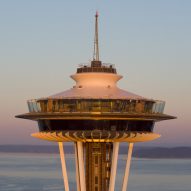
Olson Kundig completes major renovation of Seattle’s Space Needle
The design was also informed by the team’s research into elevator history, where they found the double-decker design debuted in the Eiffel Tower during the 1889 World’s Fair, which was capable of carrying 40 seated passengers at 400 feet per minute.
The Space Needle elevators are capable of carrying 46 passengers at 800 feet per minute.
 It is North America’s first all-glass double-decker elevator, according to the team
According to the Space Needle team, it is the “only tower in the world to feature double-deck, all-glass, outdoor elevators”.
The machines that power the elevators are typically used in supertall skyscrapers, as the Space Needle’s exposed core – open to elements such as high winds and rain – proposed engineering complications.
 The team will replace all three elevators on the Space Needle with the new cab design
According to Olson Kundig, the project began in earnest in 2019 when it first started collaborating with Otis Elevators, Sonaca North America, and Green Facades to develop the elevators.
The team installed one of the three new cabs late last year.
The other two are due to be opened in 2027 and 2028 on the Needle’s west-facing and south-facing sides, respectively. They will replace single, more encapsulated cabins that transported visitors up and down the tower.
Olson Kundig is known for its mechanical architecture. The studio has previously completed a moveable studio on rail tracks and a house with cantilevered walkways.
The photography is by Younes Bounhar | Doublespace Photography courtesy of Olson Kundig