
NASA’s Curiosity rover has captured its most detailed images yet of unusual spiderweb-like formations on Mars, revealing new evidence that groundwater once shaped the Red Planet’s surface.
The formations, known as boxwork, appear as vast, web-like patterns when viewed from orbit, but resolve into low ridges and hollows from the rover’s surface-level perspective.
The structures likely formed when water flowed through fractures in Martian bedrock, depositing minerals that hardened into ridges while surrounding material eroded away.
 The ‘face on Mars’ photographed by NASA’s Viking 1 Orbiter, 25 July 1976. Credit: NASA/JPL
 Spider-shaped features in the south polar region of Mars, captured by NASA’s Mars Reconnaissance Orbiter. Credit: NASA/JPL-Caltech/University of Arizona
Captured by Curiosity’s Mastcam during its ascent of Mount Sharp in Gale Crater, the new photographs provide an unprecedented look at terrain scientists have long studied from orbit.
The ridges typically stand 1–2 metres high and crisscross the landscape for miles, creating a distinctive giant spiderweb pattern.
 Spiderweb-like bodywork formations seen by NASA’s Curiosity Mars rover on 26 September 2025. Credit: NASA/JPL-Caltech/MSSS
The discovery points to the presence of liquid water on this part of the Red Planet much later than scientists previously believed.
“Seeing boxwork this far up the mountain suggests the groundwater table had to be pretty high,” says Tina Seeger, one of the mission scientists leading the investigation.
 Bumpy nodules formed by minerals that remained as groundwater dried out on Mars billions of years ago. Credit: NASA/JPL-Caltech/MSSS
“And that means the water needed for sustaining life could have lasted much longer than we thought looking from orbit.
“We can’t quite explain yet why the nodules appear where they do. Maybe the ridges were cemented by minerals first, and later episodes of groundwater left nodules around them.”
As exploration continues, researchers hope these intricate structures will provide further insights into the timing, extent and duration of water on Mars – and whether it could once have supported life.
More of Curiosity rover’s amazing Mars images
 Coral-like Martian rock as seen by Curiosity Mars rover, 24 July 2025
Credit: NASA/JPL-Caltech/MSSS
 Noctilcuent clouds on Mars captured by NASA’s Curiosity Mars rover on 17 January 2025. Credit: NASA/JPL-Caltech/MSSS/SSI
 Specks in this image were caused by charged particles from a solar storm hitting one of the navigation cameras aboard NASA’s Curiosity Mars rover. Credit: NASA/JPL-Caltech
 An image of Marker Band Valley on Mars captured by NASA’s Curiosity rover. Blue represents morning and yellow represents afternoon. Credit: NASA/JPL-Caltech
 An iridescent cloud on Mars captured just after sunset on 27 January 2023, by NASA’s Curiosity rover. Credits: NASA/JPL-Caltech/MSSS
 Strange rocks on Mars, as seen by Curiosity Rover, 15 May 2022
Credit: NASA/JPL-Caltech/MSSS
 Mars rovers regularly find meteorites on the planet’s surface. This space rock was discovered by Curiosity on 30 October 2016. It’s about the size of a golf ball. Credit: NASA/JPL-Caltech/MSSS
 A view of Mars moon Phobos (left) and Earth (right captured from the surface of Mars by NASA’s Curiosity rover. Credit: NASA/JPL-Caltech/MSSS
 Curiosity’s tracks in Gale Crater on Mars. Credit: NASA/JPL-Caltech
 A view of the Murray Buttes region of Mars, captured by the Curiosity rover. Credit: NASA/JPL-Caltech/MSSS

 An image of ‘sun rays’ or crepuscular rays on Mars, as seen by NASA’s Curiosity Mars rover on 2 February 2023. Credits: NASA/JPL-Caltech/MSSS/SSI
 A network of in a Martian rock slab known as ‘Old Soaker’ may indicate the drying-out of a mud layer over 3 billion years ago. This view comprises 3 images taken by the MAHLI camera on the arm of NASA’s Curiosity Mars rover. Credit: NASA/JPL-Caltech/MSSS
 Curiosity snaps a selfie – CURIOSITY MARS ROVER, 25 OCTOBER 2020. Credit: NASA/JPL-Caltech/MSSS
 Sulphur crystals on Mars, as seen by Curiosity Mars Rover, 18 July 2024
Credit: NASA/JPL-Caltech/MSSS
 Martian bedrock, as seen by Curiosity, 28 March 2025
Credit: NASA/JPL-Caltech
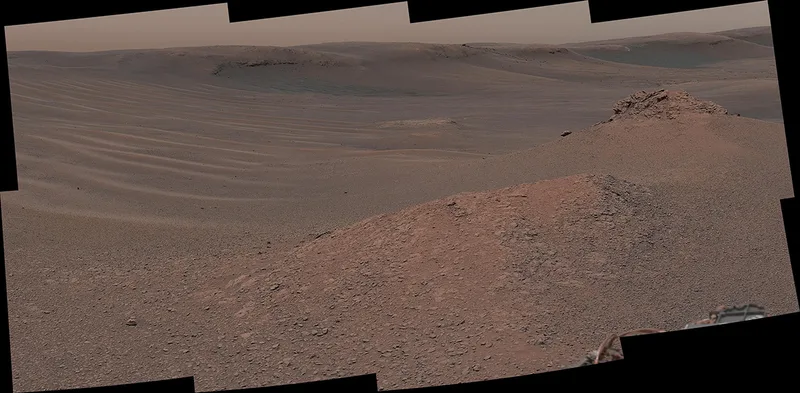 View of the region on Mount Sharp where the Mary Anning 3 sample was found. Image captured by Curiosity on 3 February 20219. NASA/JPL-Caltech/MSSS